Bendigo Cathedral’s pagan idol vanishes!

A recent article on this website reported on a scandalous ‘artwork’ being exhibited at Sacred Heart Cathedral, Bendigo. Despite the statue’s creator publicly and explicitly explaining that the inspiration for his work was witchcraft, tarot cards and occult philosophy, the Bishop responsible for the Cathedral refused to have the image removed.

Massive pushback from the laity and other clergymen in the form of letters, phone-calls, emails and petitions did not have the desired effect as Bishop Shane Mackinlay and his Diocesan bureaucrats confirmed that the idol would remain in the Cathedral for the duration of the exhibition: an entire three months.

Blatant Occultism in Bendigo Cathedral
The occult-inspired art work in Bendigo Cathedral

However, at some point during the past week, three unknown individuals decided to take matters into their own hands and quietly removed the disgusting image from Sacred Heart. A picture circulating on social media shows the spot where the idol had formerly been placed; its clay foundation, its sheer covering and the information stand remain.

The former site of the hideous idol inside the Cathedral.

The artist, Ben Wrigley, confirmed the theft on his Instagram page (while also showing his ignorance of the Commandments – the directive not to steal is Commandment number 7.)

Transcendence Wand #4 was reported to me this afternoon as having been stolen from inside the Sacred Heart Cathedral, Bendigo, today by three men.

This work depicts the transcendence of being bound by the dense material world. Of the lightness of being. The veil symbolises the gossamer thing significance of moving from the gross self to illuminated being and becoming closer to god.
One of five interconnected works representing five stations of life. L
The significance of the transgression of these three men is palpable. The eighth commandment – thou shall not steal and from a place of worship.
I look forward to having it returned.

To date, there has been no official statement from either Bishop Mackinlay or the Diocese of Sandhurst regarding the idol’s removal.

It is gratifying to know that there are still men within our ranks of the calibre of Saint Boniface who will refuse to allow holy places to be defiled by pagan images. Our prayers this week should include some for the vigilantes’ protection and well as for the conversion of Bishop Mackinlay to the Catholic faith.

Is Elon Musk a Synarchist?

There is little doubt that Elon Musk, tech-billionaire and owner of the social media platform X, is a technocrat – he has admitted as much himself. But is he a member of the occult religion of Synarchy?

If we look at the principles of Synarchy, it is obvious that many of those line up with Musk’s words and action, as well as with his lineage. If he is, indeed, a Synarchist, then this casts an even longer shadow over Trump’s re-election and what that means for the world.

Main principles and hallmarks of Synarchy (and similar Gnostic cults):

  • Belief that a small elite group should run the world: this reign should be totalitarian and authoritarian
  • Belief that this reign should be global & enforced by science and technology
  • Belief that this elite has access to secret knowledge given to them by ‘Ascended Masters’
  • Belief that the ‘Ascended Masters’ originated in Atlantis and /or are extra-terrestrial beings
  • Some acknowledge these Masters as being demons
  • Belief that occult rituals will accelerate this process & are a source of spiritual powers
  • Belief that mankind is evolving into a god-like being: this will be achieved by creating a hybrid of man and machine (trans-humanism)
  • Belief in the coming of a new ‘Christ’, who will head a world religion; this is associated with a ‘New World Order’ which is also known as the ‘Age of Aquarius’
  • Belief that the world in over-populated & that humans need to be culled & selectively bred
  • This religion is ancestral; there is a great emphasis on familial bloodlines
  • Synarchists do not have an allegiance to ‘left’ or ‘right’ side of politics: they work with whomever will advance their cause

Now let’s look at Elon Musk to see how what is known of him lines up with these principles:

RELIGION

Musk says his religion is ‘one of curiosity’, that is, fuelled by scientific enquiry. This comment shows that for him, technocracy has a spiritual quality.

While Musk claims he is ‘a big believer in the principles of Christianity’, and that he is a ‘cultural Christian‘, this does nothing to suggest that he actually embraces Christianity as a religion. Remember, there are said to be Illuminati members who respect Christianity on the basis of its contribution to Western civilisation. It is worth noting that the President of Venezuela linked Elon Musk with Fascist ‘esoteric satanic pacts.’

ATLANTIS & ALIENS

While this comment could have been tongue-in-cheek, Musk goes on to mention much more about Egyptian history and the pyramids in the thread.

DEMONS

In 2014, Musk said that with AI, man is ‘summoning the demon’: that hasn’t stopped him for leading the world in advancing AI technology. See here.

In an interesting turn of phrase, Musk biographer said he thinks that “Elon’s demons are also his inspirational angels.”

TRANSHUMANISM

One of Musk biggest projects is Neuralink: a brain implant that promises to repair the body’s functions after brain or spinal injury. Musk admits the end-goal of Neuralink is “human/AI symbiosis”, that is transhumanism. This is also the goal of Klaus Schwab’s Fourth Industrial Revolution.

Tweet on the right follows tweet on the left (Musk’s Optimus robots, dancing) – it is a reference to having sex with robots. Notice that the Twitter handle of the account Musk is interacting with is @Atlantislabs.

NEW WORLD ORDER

EUGENICS

While Musk is known for his pro-natalist stance rather than for supporting depopulation, it does appear that he is in favour of selective breeding. He is a big supporter of the immoral practice of IVF through which many of his 10+ children were conceived. This brings to mind a plan by Jeffrey Epstein to seed the world with his DNA.

ANCESTRY

Elon Musk’s grandfather was a Technocrat with an interest in a Social Credit system. His mother, Maye Musk, is often photographed making Illuminati hand-signs, and in 2022, Musk attended a Halloween event with his mother while wearing a costume decorated with a Baphomet symbol. Note also in the bottom LH corner, Maye Musk’s reference to Transhumanism.

NO POLITICAL ALLEGIANCE

Musk is now a constant off-sider to Trump, but only a year ago couldn’t stand him, and thought he was a ‘conman.’

ONE MORE THING

In 1950, author wrote a book called Project Mars, in which astronauts travel to Mars and meet its inhabitants, who are led by an entity known as ‘the Elon’.

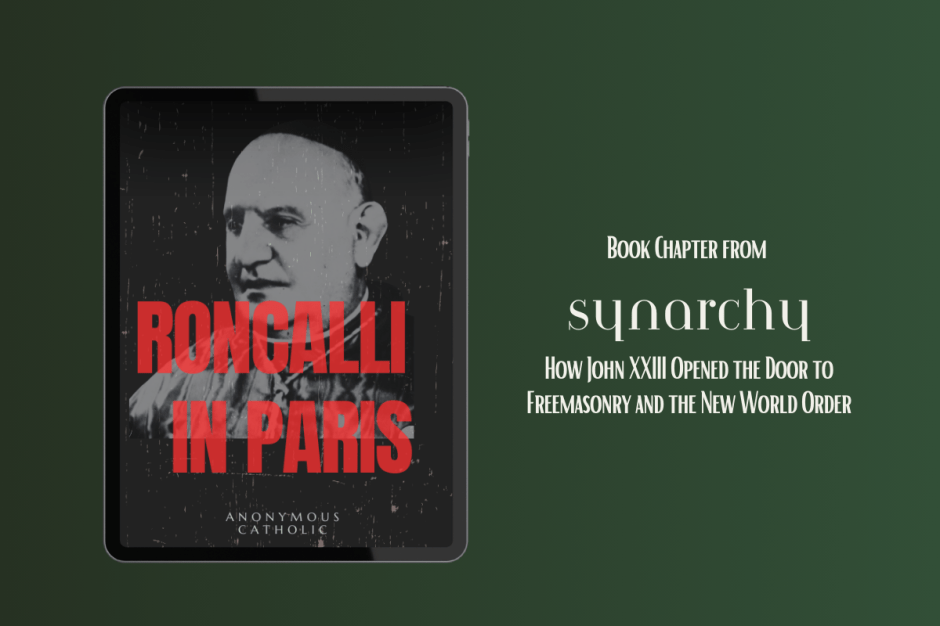
Roncalli in Paris (1945-52)

It appears that it was during his time in Paris that Angelo Roncalli was earmarked by Progressives as a future pontiff. France was always important to the Synarchists and through his diplomatic work, Roncalli was able to implant the Synarchic principles of ecumenism and globalism.

GALLICA

Roncalli’s time in Paris could be said to have consolidated his reputation with the Progressive faction. Like Montini, he was the perfect blend of Modernist ideology covered by a convincing traditionalist exterior. His pious attitude towards Our Lady and other traditional devotions meant that he was accepted fairly well by conservative Catholics, even though many of his actions appeared to them to lack consistency.These paradoxical actions were evidenced in several areas: in his attitude towards leftwing politicians and known Modernists as well as his promotion of globalism and ecumenism.

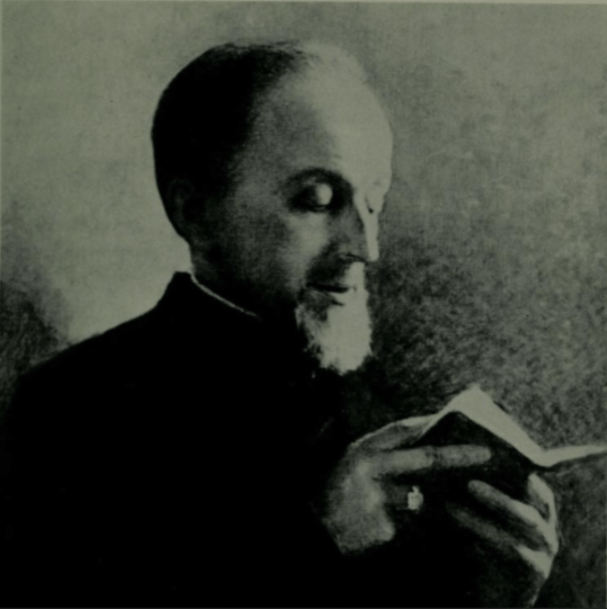
One of the first photographs of Msgr Roncalli in Paris (1945)

BACKGROUND

When Roncalli was thrust into diplomatic service in France, Europe was still in the throes of the Second World War. The Vatican had, to a certain degree, lost respect on the world stage due to its support for Fascism in Italy.

In France this attitude was magnified. When Marshall Petain moved his government to Vichy in 1940, the Holy See followed with its diplomatic corps. Petain pursued a policy of cooperation with Germany and Italy while Pope Pius XII and his French bishops encouraged Catholics to support the government during the German occupation. Thus both Petain and the Church were seen as Fascist collaborators which incensed the fiercely independent French. Their suspicion and resentment simmered during the years of occupation.

Petain had also been a friend to the Synarchists, employing many in his government. Later in 1945, when Marshall Pétain was prosecuted, he was interrogated about his knowledge of the Synarchist Pact.1

De Gaulle then came to power representing the New France, leading the Resistance with help from the Allies. Although the Resistance at that time was full of Communists and Socialists, De Gaulle was personally against Communism, but he enjoyed support Stalin’s support even while Petain was still in power. In fact, De Gaulle and Georges Bidault travelled to Moscow in December 1944 to sign an agreement with Stalin promising mutual support between France and the USSR.

In June 1944, only days after setting up the base of his provisional government at Bayeux in Normandy, De Gaulle met with Pope Pius XII, explaining his policy of zero-tolerance for collaborators. The Pope urged de Gaulle to come to an agreement with Marshall Petain but he was adamant: anyone who had supported the Vichy government was going to come within his crosshairs. This included Bishops such as the aristocratic Nuncio, Monsignor Valerio Valeri whom de Gaulle believed had abetted the Petain regime.

Msgr. Valeri, Apostolic Nuncio to France, 1936 – 1944

De Gaulle pressured Pope Pius to have Monsignor Valeri replaced, but at first, Pius stood his ground, since Valeri had done nothing to warrant such action. This situation continued until August 1944, when Paris was liberated from the Germans by the Allies with De Gaulle’s Free French Forces and Petain was suddenly grabbed from his rooms in Vichy and taken by Nazi soldiers to Germany.

The final straw for de Gaulle was learning that Valeri had been on the scene soon after Petain was taken away, and he began to put even more pressure on the Pope.2 De Gaulle then embarked on a great purge which particularly persecuted Catholics, leading to the persecution, including murders, of 100,000 people. The account from Frere Michel de la Sainte Trinite is chilling:

“The bishops, who themselves were threatened, were silent while the blood of Frenchmen and Catholics flowed profusely and the prisons filled with innocent people. There was no episcopal voice to denounce the scandalous injustices of the Christian Democrats in power, as there should have been. Rome, too, was silent.”3

Pius finally relented, appointing Roncalli to take the place of Monsignor Valeri – although Roncalli was his second choice. His first choice, Archbishop Fietta, had declined on the grounds of ill-health.4

Circumstances increased the pressure on Pius, as New Year’s Day was approaching and with it, the annual message of good will which would be given to de Gaulle by the head of the Diplomatic Corps. This was Valeri’s role and with tensions running so high, Pope Pius decided to send Roncalli to Paris to replace him, leaving many perplexed at his decision, including his sostituto Tardini.

Roncalli, on the eve of his departure to France (December 1944)

SYNARCHY

Petain’s Vichy government had expanded the influence of the Synarchists, but after his defeat their leverage was diluted to a certain extent. De Gaulle was highly suspicious of the Synarchists and once in power, launched a campaign to remove the remaining offenders from his government. Unfortunately, as we will later see, in his enthusiasm for rebuilding France, de Gaulle went on to unknowingly allow many Synarchists into positions of power.

For the Synarchists, a united Europe was the first step to a world government and they had marked France as being key to their plans. Although France retained a strong anti-clerical bent, its egalitarian spirit meant that independent leaders could spontaneously come forth from the grassroots and this continued to threaten the Synarchs’ long-term goal.

A great breakthrough for the Synarchic globalists came in 1948 with the founding of the United Nations. Roncalli loved to express his support for the globalist project during his New Year’s Day Addresses to the President. By this time, Vincent Auriol – a staunch atheist – was President, and Roncalli didn’t hold back his enthusiasm for the UN.

“During these last months Paris, the real crossroads of Europe and of the whole world, has had the honour of welcoming, with her customary exquisite hospitality, the great Assembly of the United Nations, convened to organise world peace….

Certainly it has not been possible to solve all our problems, and no one ever thought that complete success could be achieved. But the atmosphere of the debates has gradually become more serene. Several principles have been asserted, all worthy of respect because they correspond to the fundamental rights of men and citizens. One might indeed sum up the innumerable speeches made at the Assembly of the United Nations in the course of these three months in the words of St Paul’s advice: ‘Test everything; hold fast what is good’.5

In his December 1949 Address to President Auriol, Roncalli again alluded to the possibility of an earthly uptopia which revealed his own humanistic philosophy. He spoke of a return to a ‘Golden Age’ when ‘respect for man’s rights and justice for all’ are achieved, as they “alone are capable of restoring the moral order.”6

It must be noted that in Roncalli’s days, by contrast with the contemporary message from the ‘synodal’ Church, the Social Kingship of Christ was loudly proclaimed as being the exalted goal and the accepted solution to all the worlds’s ills. So while his ideas might have been commonplace for a politician of his time, they were not in keeping with the message of the Church. Roncalli stated:

Last summer, when the Council of Europe met for the first time at Strasbourg, all were moved by the noble and vigorous words of the President of the French National Assembly. He recalled the words of the northern philosopher: ‘Politics must bow to moral considerations’, and appealed most fervently to all to study the most pressing problems of international life and try to realise, as M. Herriot himself has said, ‘a good part of the highest ideal ever set before any delegation : peace on earth to men of good will’.7

Roncalli then made mention of the Holy Doors which were soon to be opened for the Holy Year, possibly making an allusion to the esoteric principle of, ‘as above, so below’, saying Through this door we go, to take the ‘road that goes up’, viam ascensionis, not to descend but to ascend. And this is what, on the spiritual plane, individuals and peoples are called to do: never to descend, always to rise.8

One of the most notable of the the French parliamentarians who furthered the goals of Synarchy during Roncalli’s tenure was Robert Schuman. Schuman is rumoured to have had associations with a Synarchist, professor of law Louis Le Fur, prior to World War II, and another associate of his, Jean Monnet, who is known as the ‘Father of Europe’, is also said to have been a Synarchist.9 Interestingly, Monnet had never approved of De Gaulle – possibly due to the latter’s independence and anti-Synarchist tendencies.

From the time he became PM, Schuman began to implement various plans that pushed Europe along the path to unity. One of these was the Council of Europe, signed in May, 1949, originally by 10 member nations, with the aim of ‘facilitating the economic and social progress” of its members.

The so-called Schumann Declaration of May, 1950, placed German and French coal and steel production under a single governing authority. Others nations later joined the alliance and this eventually led to the creation of the European Economic Community, and ultimately to the European Union. Jean Monnet worked closely with Schumann on the Declaration, keeping hidden the globalist agenda at its heart.

Schumann was favourably disposed towards Angelo Roncalli. He once said that, “He is the only person in Paris in whose company one feels the physical sensation of peace.”10 The sentiment was obviously mutual: in his Address to Auriol of December 1950, Roncalli referred to an event which “had seemed to promise better things and which had shown unmistakeable signs of the pacification and elevations of men’s minds.” According the footnotes accompanying Roncalli’s Mission to Paris, Loris Capovilla tells us this event was none other than the Schumann Declaration.11

Robert Schumann, Angelo Roncalli. 1950.12

It was during his time in Paris, that Roncalli appeared on the radar of the Office of Strategic Studies (OSS) a forerunner of the CIA.13 Files referring to Roncalli which were declassified in 1978 claim he sent information to the Vatican regarding de Gaulle’s commitment to ending the Franco regime in Spain.

While it may be hard to believe that the US government had an interest in Roncalli, one need only consider his track record in Turkey, where he made a habit of embroiling himself in high-level politics. Roncalli always had the appearance of one who was not aware of his own limitations and is also on record for passing on private comments from de Gaulle of a less political nature.

Possibly the most overt example of his support for the globalist project came in1951, when Roncalli was appointed Vatican observer to UNESCO.

Now I have noticed that among the seventy diplomatic missions, of which only thirty are Catholic, those who seem most responsive to the Apostolic Nuncio’s words, when he is inspired by this religious sense, are the Ambassadors in whose lands prevails a Buddhist, Confucian or Moslem tradition.

There are then certain elementary principles of a moral or religious character which constitute the original patrimony of all peoples, and upon which an understanding must be based, as the irreplaceable foundation of a common effort to succeed in the construction of the true social and world order of justice and peace.14

July 1951 as Vatican Observer at UNESCO

During his speech to UNESCO of July 1951, addressing the ‘elders’ of UNESCO, Roncalli spoke as a member of “the oldest and most widely extended cultural organisation in the world” referring to the “God of Knowledge” as the foundation of the Church.15

“UNESCO is a great burning furnace, the sparks from which will everywhere kindle … widespread cooperation in the interests of justice, liberty and peace for all the peoples of the earth, without distinction of race, language or religion…”16

Meanwhile, Pope Pius was playing right into the globalists; hands. He had identified the greatest threat to democracy as Communism and he became convinced that the only defence against its onslaught was a united Europe.

This was unfortunate for a number of reasons: firstly because the Synarchists also wanted a united Europe; secondly, it made him prey to many devious stratagems devised by others in the name of anti-Communism; thirdly, and most significantly, because Our Lady, through her messages at Fatima, had already provided the means of defeating Communism: the Consecration of Russia and the First Saturday devotion.

OCCULT

As with his time in Turkey, rumours abound of Roncalli’s occult involvement while he was in France. Accusations of this kind are not helped by the many occult references which peppered his speech. For example, when writing to the bishop of Bergamo following his rapid move to Paris, Roncalli said: “I seemed to be seized by surprise, like Habbakuk, and transported suddenly from Istanbul to Paris by a sort of incantation.…I was stupefied.”17

Nuncio Roncalli’s first public address to the faithful also contained an esoteric reference. During an address to the Institut Catholique at the church of St. Joseph des Carmes, he connected his last post in Turkey with his new position in France by saying:

These shining points, which stand for two worlds and two forms of civilisation, Constantinople and Paris, are spanned, as it were, by a brilliant rainbow, upon which glow the last words of the prayer of Jesus, who was about to leave his disciples and wished to comfort them: ‘That they may be one’.18

Here is may be recalled that the rainbow is a symbol beloved of occultists; it certainly has no Christian relevance in this speech. In any case, Roncalli took the opportunity to recall one of his favourite projects, ecumenism: Turkey was mainly Muslim and Orthodox with Catholics in the minority.

Roncalli’s Journal from this time reveals other comments which can be interpreted as occult references, or at least as heresy. One example of this is an entry from November of 1948, where there is a cryptic reference to what Roncalli called his ‘mystical death.’ (Journal, p. 270). Mystic death, far from being an accepted stage in a soul’s progress toward spiritual union with God, is part of the heresy of Quietism. The ‘mystic death’ was one of the 68 proposition of Quietism to have been condemned by the Church in 1687. The Spanish false mystic Michael de Molinos wrote that, “The inward way leads on to a state in which passion is extinguished, sin is no more, sense is deadened, and the soul, willing only what God wills, enjoys an imperturbable peace: this is the mystic death.”19

Reading Roncalli’s Journal, it becomes clear that he believed he experienced no passions and he wrote on many occasions of his constant state of peace. He even suggested in his Journal that he never once sinned seriously against purity in his entire life.

Then in April 1950, there is another use of the phrase, ‘Know thyself’20 which as explained previously, [in a previous chapter – Ed] was a favourite maxim of Aleister Crowley.

Roncalli’s December 1952 Address to President Auriol was his final one before leaving for Venice, and it must be said, it was rather unusual. In the Address, he told a story from The Fables of Jean Fontaine. This story contained the famous maxim, ‘all paths lead to Rome’ and to their mind, twas best that each a different path should find.’ This is rather startling from a man who six years hence would find himself in Rome as Supreme Pontiff.

This is followed by a reference to the ‘Know thyself’ mentioned previously, which Roncalli explains is “inscribed on the pediment of the temple of Delphi, which in the depth and universality of its wisdom far exceeds any merely individual application, may be widely understood and practised wherever responsibility is borne in the service of the common good, and wherever men’s minds are burdened with the most acute problem of the present hour : to save peace, to save peace at all costs.”

The fable continues:

To know himself is the first task decreed By the All-mighty for his servant man. Come, stir my rivulet — can you trace Your features? “Leave it,” the Hermit cried, “to settle down — And your image will appear again!” Thus in his wisdom spake the Anchorite; Nor was his counsel giv’n in vain.”21

Auriol responds in kind, “Discord hath ever ruled the Universe; And in this world of ours I could rehearse A thousand thralls of her uneasy sway.”22

The day after the Address in which he advised his heaers to ‘know thyself’, Roncalli wrote to Cardinal Achille Lienart of Lille. As well as sending his New Year’s greetings, Roncalli mentioned his speech of the previous day, and so had yet another opportunity to use the golden words, “Know Thyself.”

Yesterday on behalf of the Diplomatic Corps I was able to offer the same wishes to the President of the Republic. It is a difficult thing to speak in that noble and mixed assembly, but La Fontaine’s last Fable gave me the opportunity to recall the Know thyself of the old sages, which is valid for all times and all places.23

Of significance here is that Lienart was rumoured to have been a Freemason; what is certain is that he was one of the prelates accused by de Gaulle of being a collaborator.24

While the above comments may be no more than ambiguities, there are more serious accusations against Roncalli. According to Mary Martinez in her book, The Undermining of the Catholic Church, a Major René Rouchette, once a member of Presidential Garde Republicaine, told her in an interview that during the mid 1940’s, he and his confreres saw Roncalli leaving the Nunciature every Thursday evening to attend meetings at the Grand Orient of France lodge.25 Certainly, Fr. Malachi Martin had no doubt that Roncalli was a Mason; he is quoted in Eglise-Eclipsee as saying Roncalli was initiated into the Lodge by Vincent Auriol.26

Roncalli’s Freemasonic membership was even suggested by French Masons themselves when in 2019, they posted on their website congratulations to Matteo Zuppi on being elevated to the Cardinalate:

“As we renew our congratulations to the new Cardinal Presbyter of Sant’Egidio already expressed here we declare ourselves particularly pleased that the non-Freemason Matteo Zuppi, very recently named a Cardinal, wanted to significantly mention a Saint of the Church such as Pope John XXIII (our Mason Brother Angelo Roncalli in the world) to seal his new pastoral mission…”27

The Archbishop’s pro-masonic bent went well beyond having in common certain elements of their vision such as ecumenism; he also concretely advanced their sinister cause within the Church. Roncalli appointed a 33rd degree Freemason named Baron Yves Marsaudon, as head of the French branch of the Knights of Malta. This was the very order which Pius XII had suppressed and placed under investigation as he was well aware that it had become an organ of Freemasonry within the Church.28

Archbishop Roncalli’s Secretary at the Nunciature, Mons. Bruno Heim, told the Vatican’s investigator into the matter that Freemasonry was “one of the last forces of social conservation in today’s world, and, therefore, a force of religious conservation,” and that the nunciature of Paris was working in great secret to reconcile the Catholic Church with Freemasonry.”29

As Pope, Roncalli eventually suspended all investigations into the Knights of Malta (June 24, 1961) and restored free reign to the order.

Despite his tolerance for Freemasonry, Roncalli is said to have been pleased when his Parisian friend, Antonio Coën, renounced Masonry in favour of the religion of his youth …. Judaism!30 He was also besotted with the Jewish mystic, Simone Weil, whose philosophy contained Kabbalic themes. One of Roncalli’s biographers, Paul Johnson, relates that he enjoyed the sermons of Fr. Riquet.31 Yet, Pierre Virion tells us that Fr. Riquet was deliriously enamoured by the French Freemasons!32

WORKER PRIESTS

Among the prelates who had been concerned about losing their position under de Gaulle’s purge was Cardinal Suhard of Paris. He had supported Petain and thus had been flagged as a collaborator. But after speaking to Archbishop Montini, Suhard’s mind was put at rest; Montini assured him that Roncalli was a prelate in the mould of Radini-Tadeschi rather than the more conservative Ottaviani, as he had feared.

It was apparently Suhard who coined the term aggiornamento in reference to the need for the Church to update; this term was to become the leitmotif of Roncalli’s papacy. His ideas were very progressive and Rome became concerned about his support for the increasingly left-leaning Worker Priest movement.

The worker-priests were originally a response to the collapse of faith among men returning from the forced labour camps. Some of these men could not accept the liturgy as it had always been offered, having become used to Masses that, of necessity, were offered outside of the usual church setting. Some of the incarcerated priests had taken liberties with these Masses, even offering them in the vernacular. Such priests were believed by French conservatives to be Communists, and indeed, many of them were. Suhard refused to discipline them and began to oversee the Parisian worker-priest chapter after the movement was given conditional approval by Pius XII, who had designated France a ‘mission land.’

Roncalli didn’t publicly endorse Suhard’s ideas, but also did not reveal where his loyalties really lay. Montini, however, did support those ideas from his position in Rome and as Pope Paul VI went on to approve a modified form of worker-priest.33

The pontificates of both Roncalli and Montini show the influence of the ideas of Suhard. This is important because the worker-priest movement ‘Catholicised’ the anti-Catholic revolution, and Roncalli played a significant role in ensuring that the movement was allowed to flourish when it could have been nipped in the bud.

Customarily, Roncalli remained ambivalent as he did not want to become unpopular with either side. Although he valued a traditional practise of the Faith in many respects, the worker-priests exemplified Radini-Tedeschi’s dream for Catholic Action. Radini-Tedeschi had introduced the young Roncalli to the Opera Congressi, another worker movement, when the latter became his secretary in Bergamo, although Pius X later was later to suppress the Opera due to its enthusiasm for democracy and its lack of oversight. Radini-Tedeschi had also lent his support to the Sillon – another left-leaning movement which was eventually banned by Pius and in which Roncalli took some interest.34

It is also known that Roncalli had close contact with the Specialised Catholic Action movements.35 and that he met regularly with the French leaders of the JOC. Roncalli recorded in his his diary that those were ‘particularly remarkable’ meetings.36

To conclude this section, it should be noted that by his inaction regarding these left-wing groups, the Parisian Nuncio allowed Russia to spread her errors in post-war France.

PERSONALITY

A little has already been said about how Roncalli was seen by his peers in Paris: although Robert Schumann was quite taken with him, few of the Parisian elite took him seriously. After Roncalli’s death, a Parisian Jesuit wrote that the impression he gave while Nuncio was that of being “a clown.”37

His friend, the Modernist, Dom Beauduin, told the story of how he went to visit the Nuncio, who, with an enthusiastic laugh, whisked him through the door and onto a large chair. The chair, positioned on a platform, was none other than the Papal throne, the symbol of papal authority found at every nunciature. As Fr. Villa wrote, “The future pope’s use of a symbol of the papal sovereignty as a mere prop for his own jokes was sadly more than just a misguided attempt at humour; history would show it was prophetic, as he would use the papacy to promote heretics and debase the authority of his own office.”38

Similarly, the leaders of de France’s ruling party, the MRP, (Mouvement Républicain Populaire or Popular Republican Movement) had little respect for Roncalli, regarding him as untrustworthy and unscrupulous.39 Even his friends could see through his pretence: Jacques Dumaine, head of Protocol at the French Ministry of Foreign Affairs, said of Roncalli that he was “more artful than subtle.”40

To give an idea of his inflated view of himself, Roncalli was asked his opinion of the plunging necklines of society ladies present at diplomatic functions. He responded that it didn’t bother him at all, “And you don’t have to worry about the imaginations of the other diplomates present – they are too busy watching my actions to get too preoccupied with these manifestations of fashion and beauty.”41

SUPPORT FOR MODERNISTS

In his role as a diplomat, Roncalli was able to move in the elegant circles of the Parisian elite. He held fine dinner parties with a range of guests including the most radical secularists. Roncalli was preoccupied with beautifying the nunciature for his many guests at a time when poverty was rife in post-war France – although he justified the expense by claiming it was for the honour of the Pope, whose representative he truly was. A letter to Secretary of State Montini (later Pope Paul VI) provides details of the elaborate decorations Roncalli commissioned for the nunciature’s dining room. There were numerous murals, including on the ceiling, as well as expensive seventeenth century tapestries: nothing was too much for Roncalli’s salon in which the secular and religious elite of Paris were regularly entertained.42

Roncalli was also known to be friends with Eduoard Herriot, an anti Catholic socialist, who was himself a fan of both Marc Sagnier and Soviet Russia.

“Nuncio in Paris, Bishop Roncalli received at an open table Edouard Herriot and Vincent Auriol, notorious Freemasons and politicians who carried out an action persecuting the Church. In the heat of a banquet, he said to them one day: “What separates us is of little importance.”. All his happiness seemed to be that of the table where he wanted above all to please.” 43

Despite his high opinion of himself, Roncalli was out of his depth in the Parisian world of sophisticated and fashionable ideas. Even his very sympathetic biographer, Peter Hebblethwaite, wrote that Roncalli “gleaned most of his knowledge of theology from conversations” and that he could not wrap his head around the ideas of the very fashionable Teilhard de Chardin.44

By and large, Roncalli played the part of loyal representative of Pope Pius, but there are many examples which reveal his early dedication to Modernism. Such is the case of the French Ambassador, Jacques Maritain.

Roncalli met with de Gaulle in January of 1945, to discuss the latter’s choice of Maritain as French ambassador to the Holy See. The philosopher Maritain was the inventor of the liberal doctrine of ‘integral humanism’, which was to have such a devastating and lasting influence on the Church. Maritain also became very close to Cardinal Montini, more of which in another chapter, where we will explore their relationship with the Communist agitator, Saul Alinsky. Maritain’s ideas were a driving force behind the MRP, the French Christian Democratic Party which formed after France was liberated. Left-leaning, the MRP was full of Catholics in support of the Republic.

Maritain is significant because his ideas were quite heretical, although this wasn’t always acknowledged either in his lifetime or afterwards. In one paper published after his death, Maritain stated his desire that Satan would be forgiven and eventually be allowed to dwell in Limbo with the unbaptised children.45 This is hardly surprising when one learns that Maritain was led to the faith by a self-confessed ‘prophet of Lucifer’ named Leon Bloy.46 Interestingly, the language of Maritain’s philosophy was to be found in the Synarchic Pact, which referred to integral humanism as “the primacy of the spiritual in our revolutionary movement.”47

While he was stationed in Paris, Roncalli’s friend from his seminary days, Buonaiuti passed away. Roncalli had never renounced his relationship with the thrice-excommunicated Buonaiuti, and wrote at the time,

“Excommunicated in 1921, declared vitandus [shunned] in January 1926, died on April 20, 1946, Holy Saturday. Therefore he died at the age of 65: in luce et in Cruce. His admirers wrote about him that he was a profoundly and intensely religious mind, clinging to Christianity with every fiber, bound with unbreakable bonds to his beloved Catholic Church. Naturally there was no clergyman to bless his remains; no churchyard that would receive his burial.”48

Another death which took place during Roncalli’s time in Paris sheds more light on his deep-seated Modernist views. After the death of Marc Sagnier, the founder of Le Sillon, Nuncio Roncalli wrote to Sagnier’s widow. In his letter of June 1950, Roncalli described the great impression her late husband had made on him almost fifty years previously, when the latter gave a speech to Young Catholic Workers.49

Roncalli made a startling reference to the “affectionate and benevolent admonition” given by Pius X to Sagnier in 1910. Far from being an “affectionate” rebuke, Pius’ condemnation of Le Sillon was extremely firm and uncompromising, albeit made in fraternal charity. Pius made it clear in no uncertain terms that the ideology of Le Sillon was socialist, unCatholic and part of a creeping apostasy that threatened to spread throughout the world “… organized in all countries for the establishment of a universal church with neither dogmas, nor hierarchy, nor a rule for the mind, nor a bridle for the passions.”50

When the axe fell on the Modernists in the form of Pius XII’s Humanae Generis, Roncalli stayed noticeably quiet. The French liberals were hit particularly hard: Chenu, Congar, de Chardin, de Lubac and others of the nouvelle theologie school and its adjacents were censured and even lost their positions. Although he had the task of passing on the orders, Roncalli bypassed most of the controversy by taking a trip and leaving the politics to others. However the thoughts of these men recurred time and time again in Roncalli’s writings once he became Pope.

ECUMENISM

While in Turkey and Greece, Roncalli had been successful at placating non-Catholics, attempting to show that Catholicism had dropped its age-old policy of extra ecclesia nulla salus – ‘there is no salvation outside the Church’.

As time went on, Roncalli’s ecumenical bent became even more evident. In 1949, for example, he interceded with Rome for the Protestant founders of a new ecumenical community. This led to permission being granted for the celebration of their liturgies in the disused Catholic Church in the little town of Taizé.51

In paradoxical contrast, although some progressives saw it as an obstacle to ecumenism, Roncalli had no problem with Pius’ declaration of the Dogma of the Assumption in August of 1950.

LEAVING PARIS

As with most chapters of Angelo Roncalli’s life, there are several conflicting versions of the motives behind his appointment as Patriarch of Venice. The most popular version claims that in late 1952, it became obvious that Cardinal Agostini, the Patriarch of Venice, was mortally ill and Pius XII asked Roncalli to accept that post, once it became vacant. Roncalli accepted and his elevation to the rank of Cardinal was subsequently announced.

There is a different account, however, which casts Roncalli in a less favourable different light. In this version, as recounted by a sympathetic biographer, Pius XII lost patience with the overly-tolerant Nuncio who refused to voice any opposition to the worker-priests. The movement had gathered so much steam that it was espousing openly Marxist ideas, with some priests taking roles as trade union leaders.52 Seen in this light, Roncalli’s appointment to Venice was a typical Roman promoveatur ut removeatur –  “promote to remove”.

When in January, 1953, Roncalli was appointed Cardinal, his strong ties with France continued to be evident. Roncalli controversially received his red hat from the hands of the French leader, the Socialist Vincent Auriol. Although this special privilege had been granted to Catholic heads of state in France, it was pushing the boundaries to extend this honour to the atheist Auriol.

1 It was an ancient privilege of the Heads of State in Spain, Portugal and Austria to confer the biretta upon the new Cardinals. This custom had been interrupted in France in 1897 but was revived for Mgr Cerrctti (1925) and continued for Mgr Maglionc and Mgr Roncalli.53

The two were so close that Auriol visited Roncalli in Venice after he had been appointed Patriarch there. Roncalli embraced Auriol in the presence of many faithful who were “on their knees around us”, as he later wrote.54

COVER PIC: Anefo, CC0, via Wikimedia Commons

  1. https://www.newdawnmagazine.com/articles/secret-history/synarchy-the-hidden-hand-behind-the-european-union ↩︎
  2. [Shepherd, p. 200] ↩︎
  3. [Frere Michel de la Sainte Trinite. “The Whole Truth about Fatima – Vol III.” iBooks. – p 283.] ↩︎
  4. [Shepherd, p. 201] ↩︎
  5. (MTF p 90) ↩︎
  6. (MTF p 111-112) ↩︎
  7. (MTF p 112) ↩︎
  8. (MTF p 112) ↩︎
  9. https://www.newdawnmagazine.com/articles/secret-history/synarchy-the-hidden-hand-behind-the-european-union ↩︎
  10. [The Good Pope, p 83.] ↩︎
  11. [MTF p 132] ↩︎
  12. citation needed ↩︎
  13. {MTF p 144} ↩︎
  14. [The Good Pope, p 87] ↩︎
  15. [The Good Pope, p 78] ↩︎
  16. (Page 8 Mission to France) ↩︎
  17. (https://www.newadvent.org/cathen/12608c.htm) ↩︎
  18. (Journal, p 275) ↩︎
  19. (Mission To France p 168-169.) ↩︎
  20. (Mission To France P 170) ↩︎
  21. (Mission To France p 174) ↩︎
  22. [Shepherd of the Modern World p 204] ↩︎
  23. [Undermining of the Catholic Church, p 125.] ↩︎
  24. [Eglise-eclipsee p 119] ↩︎
  25. [https://www.traditioninaction.org/ProgressivistDoc/A_195_J23.html] ↩︎
  26. [Nikita Roncalli] ↩︎
  27. [Poncins p 13] ↩︎
  28. [Aime-Azam, as quoted in Shepherd, p 232.] ↩︎
  29. [Johnson, p 70] ↩︎
  30. [Virion, The Mystery of Iniquity.] ↩︎
  31. [Shepherd of the Modern World, p 215-21] ↩︎
  32. [Leaven p 103] ↩︎
  33. [Leaven in the Council p 78.] ↩︎
  34. [Leaven in the Council p 102] ↩︎
  35. [Johnson, p 70.] ↩︎
  36. Villa, “John XXIII,” p. 4. ↩︎
  37. [Shepherd p 213.] ↩︎
  38. [Paul Johnston, p 66] ↩︎
  39. [Three Popes and the Cardinal p 14] ↩︎
  40. (MTF p 115-117) ↩︎
  41. [Eglise-eclipsee p 119] ↩︎
  42. [Shepherd p 218-9.] ↩︎
  43. [Iota Unum, p 697, emphasis added.] ↩︎
  44. BROKEN CROSS ↩︎
  45. [Virion.] ↩︎
  46. [de Mattei, Roberto. “The Second Vatican Council: An Unwritten Story.”] ↩︎
  47. (MTF p 124-125) ↩︎
  48. [Pius X, Notre Charge Apostolique (Letter on the Sillon).] ↩︎
  49. [de Mattei, Roberto. “The Second Vatican Council: An Unwritten Story.” iBooks. P 98] ↩︎
  50. [Mark Fellows in Fatima in Twilight p 120] ↩︎
  51. MTF p 178 ↩︎
  52. [Aradi, p 149.] ↩︎

The Pope, the Abortionist and the Convert

Emma Bonino is an Italian, a former politician and abortionist, who is on good terms with Pope Francis and who was apparently friendly with JPII as well..

A fascinating report comes from Gloria TV (or here on his own blog, in Italian) where the author, Danilo Quinto, was once a personal friend of the notorious Ms. Emma Bonino. After experiencing a conversion, he now writes to expose the rot inside and outside the Church. God bless him.

The author is a former and repented high-placed activist of the immoral and inhuman Italian Partito Radicale which works for the de-Christianisation of Italy. On 5 November Bergoglio paid a visit to Emma Bonino, a former leader of that party. Bergoglio called Bonino a ‘great Italian’ (sic) and example of ‘liberty and resilience’ (sic).

I too frequented that terrace in Trastevere, in the centre of Rome.

Those were the years when strategies were being imagined and constructed to consolidate the results of the divorce and abortion laws, which destroyed the family institution.

A ‘demographic bomb’ was denounced, which never existed, but served to decertify an entire country and prevent, with the spread of the pill and other contraceptive systems, its growth, which is only determined by the birth of new creatures into the world.

The foundations for the campaign on euthanasia were laid, which over the years, despite the lack of a law, has become a widespread and customary practice, along with assisted suicide.

We discussed how to permanently overthrow the temporal power of the Church; the theory of the third and fourth sex, same-sex marriage, assisted fertilisation, and surrogate motherhood were being spread.

Consciences were manipulated to the acceptance and integration of people who sooner or later – after replacing us – will kill us all.

Well, on that terrace of that house that has seen literally every colour of the rainbow, the Head of the Catholic Church, the indestructible Jorge Maria Bergoglio, came up the other day.

He had a bouquet of white roses and a box of chocolates in his hand, to pay homage to the maximum exponent of that ideology – after the death of Pannella – that has contributed decisively to de-Christianising Italy and making churches useful for making large soup kitchens for the poor, for welcoming migrants or for making money by handing them over to private individuals, who manage them to make museums or other worldly stuff.

‘Example of freedom and resilience,’ Bergoglio said of Emma Bonino. He hit the nail on the head.

After all, from a man like him, who masterfully interprets the desires of this degenerate world, one could not expect the intention to convert Emma Bonino – he has declared several times that he does not want to convert anyone – but only a snapshot of reality.

Certainly, Emma Bonino is an example of ‘freedom and resilience’. Yes, from God! As is the one who uttered these words.

Both have done, and they will still do everything until their death – unless they convert, in their case publicly, given the gravity of their sins – to ensure that human beings are free from their Creator and will be resilient to His laws.

As have been those many Italian Catholics who have divorced, had abortions, used contraceptive methods, letting an ideology win that has nothing human about it.

As has been that modernist Church, a direct product of the secular work of Freemasonry and the Second Vatican Council, which has in Bergoglio its latest interpreter, after a succession of popes subsequent to Pius XII who paved the way for him and the Mafia of St. Gallen.

At the conclusion of the encyclical Etsi Multa of 21 November 1873, Pius IX uses an expression that appears twice in the Bible – Synagogue of Satan – in ch. 2 verse 9 and ch. 3 verse 9 of the Apocalypse of St John the Evangelist.

He writes: ‘It will perhaps surprise some of you, Venerable Brethren, that the war that is being waged against the Catholic Church today is expanding so much. But whoever knows the character, the aims and the purpose of the sects, whether they are called Masonic or by any other name, and compares them to the character, the manner, and the extent of this war, by which the Church is assailed on almost every side, will certainly not be able to doubt that this calamity is not to be attributed to the frauds and machinations of those sects. For from them is formed the synagogue of Satan, who orders his army against the Church of Christ, raises his banner and comes to battle’.

Prophetic words. Exemplary of the situation we live in, where men of the Church prostrate themselves to the World and the builders of Evil.

To counterbalance the attempts of those men of the Church and those builders of Evil – united by the design of the strong powers, who want to annihilate man, created in the image and likeness of God – the Church founded by Our Lord Jesus Christ, which is of divine origin, will not be brought down, despite the night of Gethsemane that it has been living through for too long, to the delight of its enemies.

As the beautiful antiphon at the introit of the Feast of Christ the King of the Apostolic Mass says:

‘The Lamb who was slain is worthy to receive power, riches, wisdom, strength, honour, glory and praise; on Him be Lordship forever’.

Here is Bonino again, dressed as a priest. This time in with US Secretary of State, John Kerry, when she was the Italian Foreign Minister in 2013.

Blackcat, CC BY-SA 3.0 https://creativecommons.org/licenses/by-sa/3.0, via Wikimedia Commons

John Paul II, Emma Bonino, Marco Pannella (Vatican City, 1986).jpg

U.S. Department of State from United States, Public domain, via Wikimedia Commons

Synarchic Morality

by Plinio Corrêa de Oliveira, written on July 1st, 1961. This article was taken from the Plinio Corrêa de Oliveira website.

“A Roman and Apostolic Catholic, the author of this text submits himself with filial devotion to the traditional teaching of Holy Church. However, if by an oversight anything is found in it at variance with that teaching, he immediately and categorically rejects it.”

 The words “Revolution” and “Counter-Revolution” are employed here in the sense given to them by Prof. Plinio Corrêa de Oliveira in his book Revolution and Counter-Revolution, the first edition of which was published in the monthly Catolicismo, Nº 100, April 1959.

With devotion to the Sacred Hearts, the Church puts in practice the contrary to materialist productivity.

A peculiar set of surreptitious morals is setting out to install itself in the entire West, constituting one of the most significant aspects of the European decadence that clashes with the morals of previous centuries. These morals center on the idea that the production of goods is the supreme value of the each man’s life and of society. Man is worth something to the degree that he in some way, by action or omission, contributes to the production and economy of material goods. If not all, at least many vices and qualities are measured by whether or not they favor production. The same can be said for nations. The production of material goods is the supreme end of man’s life and of all human society.

The penetration of these synarchic morals [Synarchicsynarchismsynarchy are used to refer to the materialist system of morality that gives value to things in so far as they produce. There is not English equivalent for the Portuguese “sinárquica”] is visible in Brazil, above all in the more industrialized centers in the guise of the industrial boom considering the most recent developments of this boom – the current industrialization is not exactly that of the time of Getulio Vargas when people only wished for millions. In the industry of today, the supreme goal, at least remotely, is to be the executive of an immense organization that prides itself in producing much for society and thus elevating the standard of living.

From the point of view of personal interest, the hard working businessman of today doesn’t know exactly why he is working. To fully gratify the largest number of people, the quality always decreases. He aims only for quantity with the minimum of quality. The formula to present and advertise products is: “They are good little trinkets.” It is the industrialization of ABC (as they call the highly industrialized satellite cities of Sao Paulo: Santo André, São Bernardo and São Caetano).

In Europe, the ABC spirit can be seen in the contrast between old monuments that show us the splendor of Europe of the past and the style of life in Europe today. The roads and squares are full of grand things from the past – castles, bridges, gates, etc. – but those who live in the middle of these splendors are each time more at the level of the “modern automobile”: they want to live a modern, tidy little life. Europeans of a certain category are still attached to the quality of products made according the good old tradition. But everything that is a new, modern product is not made of the same quality as things of the past. While what is old and at best still maintained, one way or another tends to decay. New things are produced like tin cans or worse.

This signifies a tendency to take a type of production completely different from the past as a standard. And this type of European, principally the Frenchman, is totally monopolized for social production. His spirit, mentality, way of being are all marked by the idea of economizing as much as possible. Also, productivity becomes a supreme value for him. It is the what is barely acceptable at the European level.

Man, A Mere Producer of Useful Material Goods

One could now ask why call this “moral synarchy.” In the language of the European right, synarchy is qualified as a clan of international nabobs to which they attribute the following state of spirit: They don’t want Communism, but at the same time they are full of the spirit of the Revolution. The are conservatives in the worst sense of the word since they don’t want to correct or destroy anything.  To fight Communism, they are disposed to spend any amount of money, but they are clearly opposed to any return to the past. They are indifferent to the slow evolution of society to the left so long as Communism does not arrive now.

Their action results in a slow form of Revolution in apparent conflict with the rapid form of the Revolution, that is Communism. They are a gang of criminals that in final analysis favor the Revolution considered broadly – for the Communists and even more than even the Communists – while in appearance opposing Communism. In regions where Communism produced crystallization, and only in these regions, synarchy deviates these crystallizations. At the same time they lead to socialism in the form I finished exposing: a way of life dominated by the shoddiest product acceptable and the mystique of work and of production.

This socialism can be directly that of the state as well as that of gigantic private businesses ran less by their owners than by managers who tend to ever greater proletarianization.

Thus, by these two forms of socialism – that of the state and of large businesses – that are easily distinguished in theory and that live well together in practice and of which the second prepares the way for the first, society slips toward Communism. It is a slow, light pink, unperceived, sneaky and non-violent Bolshevization.

The synarchic capitalists, to make their plans go ahead, promote and stimulate in every way this synarchic morality which is centered around the production of economic values and the consideration of man as a mere producer of material goods. But for them the economic production worthy of applause is not the production of any goods, but rather of goods useful for the material human development of man. They do not have hearty applause for an industry with a merely cultural scope.

The Characteristics of Synarchic Morality

Moral synarchy has the following characteristics:

1) It is egalitarian;

2) It depersonalizes;

3) It is materialistic;

4) It erects economic production as the criteria of morality.

Before we examine each of these characteristics, we will study how these morals spread.

From the Encyclopedists until 1939, there were unequal classes and an immense ideological fight by which the egalitarian Revolution advanced, gradually leveling these classes. People had conviction. They reasoned.  Even the adepts of wrong ideas adopted ways of seeing things that revealed an appreciation for logic, an appreciation that is inherent to the old, good traditions of Christian Civilization.  The sophistic revolution was needed to throw down the tendencies which expressed themselves and conquered territory in the realm of the ideas.

A tendential revolution – for example Romanticism, the sentimentality that preceded Romanticism and the French Revolution – was being born from the decline of logic and itself accentuated this decline. At par with reason, sentiments clearly began to appear in the fight between Revolution and Counter-Revolution. An ideological element continues to exist in the Revolution alongside a tendentious element that is each time more influential. The sophistic revolution continued to lose ground.

In our days this fact is even more accentuated coming together with the “new generation.” In reality even in preceding generations, aspects of the new generation of already came in sight. This is the sneaky way tendencies drag such things down. Without firm convictions and rather than discuss them, it was better to slowly fill the mental space of people or of the masses with new convictions.

A Surreptitious Entry Process

Without attacking the past but substituting past themes with new ones, it enters. But its process is that of the surreptitious entry. Men even continue to be friends of order, of hierarchy, etc, but these attitudes become always more platonic.

The sophistic revolution continued during the French Revolution, but it attained its height in the 19th century. In the last two decades of this century, given the climate of pacifism that was established, the sophistic revolution is diminishing. The need to discuss is substituted by a ever greater silencing tendency, and the need to attack or defend the truth with arguments disappears. The taste for discussion grows weaker as the decades pass and finally arrives at its present quasi-death like state. Terror in the face of discussion is one of the traits that characterizes Catholic circles today. They fear (and it is a fear-panic) internal and external discussion.

We have been analyzing the characteristics of the deceitful advance of the tendential synarchic revolution. It is important to describe the relations inside the mentality of the man of today between the old doctrinal deposits that still exist and the new mentality of synarchic morals we are discussing.

The values of past centuries continue to live today. They lost some of their vivacity, but it would be an exaggeration to say they died. One could then object that we are exaggerating the importance of synarchic morals. However, the affirmation I am making must be understood in light of the image I used in Revolution and Counter-Revolution of that tree (the strangler fig) that envelops the other tree and ends up devouring its substance.

The Evolution of the Human Ideal in Recent Centuries

The ideal of man in the Middle Ages was the saint. In the 18th century, it was the viveur. In the 19th century, the brilliant bourgeois. In the 20th century, the productive bourgeois.

In the 18th century, man’s ideal was no longer the saint as in the Middle Ages but rather a man whose glory consisted in making of life a fountain of pleasure for the soul and body. An elegant, refined, noble font of pleasure, at least in appearances if not in matters of morals. It is the man viveur – that is, one who loves life for the pleasure of life, aristocratic and elegant, that preceded the French Revolution.

In the 19th century, with the advent of the bourgeois, this ideal suffered a transformation. The great man of the new society came to be the brilliant bourgeois, above all the man who practiced the liberal professions or that of an artist. To be a great doctor, a great lawyer, scientist, journalist, politician, or artist was the ideal of the respectable and highly esteemed man. When a very rich person favored the arts, at least by underwriting them, he had influence in politics, and thus he could intervene in the field of ideas, in discussions, and in the intellectual life. And because of this title, he was respectable.

But the 19th century, which had so many nouveaux riches, also deeply despised the nouveaux riche. They put them in satires, songs, and made of them the image of the despised egoist. Thus, we cannot say that richness was the ideal of the 19th century.

When we pass to the beginning of the 20th century, with industrialization, the progress of natural sciences, the progress of techniques, international commerce, the accumulation of great fortunes, more and more prestige was constituted around great economic production. To make a great fortune ended up being something prestigious. It mattered little if one was uneducated, ridiculous, pretentious, or if one made his fortune in a prosaic way or even dishonestly: he was rich.

With ever lower moral and intellectual values, with cynicism and opportunism ever more accentuated because of the general decadence of morality, there was more condescendence for the parvenu, and it even arrived to the point that there was a certain consideration for him.

This admiration, which existed to some extent in Europe, was immense in the United States. The “self-made man,” the king of canned onions or chewing gum, with a patent that allows him to accumulate an unheard of fortune, were admired and venerated at the beginning of this century until approximately the Second World War.

This parvenu who is not by far the fidalgo of the past tries as much as possible to appear like the fidalgo. He will buy a title of nobility, marry into the aristocracy, and build palaces that look like wedding cakes. By a stupid luxury – champagne baths for example – he attempts to imitate the refinement of the old nobility.

The Post-War Misery Generated the Synarchic Spirit

Only latter, with the advent of post-war misery – the World War brought misery, and pari passu the horror of misery, of suffering, and of any form of suffering, these existed before, but they were accentuated – another personage rose as the social ideal. The phobia of misery brought the obsessive desire to satiate the hunger of everyone and the idea to produce as much as possible and the cheapest possible to obtain this end. The idea of individual profit was substituted by the idea of collective service. Thus appears the synarchic type that we are speaking about.

How are these things related? The tree of the 18th century, that is the admiration for the elegant, noble man was not totally destroyed by the tree of the 19th century which is admiration for the brilliant bourgeois. On the contrary, the brilliant bourgeois tried in many ways to make himself equal to the noble, imitating as much as possible the spiritual values of the noble, his culture, and his manners. And the nobility, though in a state of decadence, continued to exercise an influence throughout the 19th century that in some aspects was preponderant. Since if the nobility was not the dominant class, it served as the ideal and model of the dominant class.

But the relation of the two forces between the bourgeois and the aristocracy was such that in this coexistence the bourgeois spirit was like a tree that eats the other tree. In the bourgeois world, aristocratic values exist like an old tree with rotten wood that is being devoured and killed by the new living wood. Each day marked a decrease for the nobility and a progress for the bourgeois.

After the intellectual bourgeois came the bourgeois whose grandeur was calculated according to matter; this is what the nouveau riche is. Already, he does not imitate the spiritual values of the noble but only the material opulence of the noble. It is like another tree that eats the previous one.

After this comes finally comes the producing bourgeois who has no type of grandeur other than that productive, collective grandeur. He does not imitate the noble in any shape or form. This forms another tree that again devours the bourgeois spirit of the recently arrived millionaire.

As we have seen, the most recent dynamic force and the one that is consuming the others is the new synarchic bourgeois. Though in a state of decadence, admiration still exists for the nouveau riche. In an even greater state of decadence is appreciation for the intellectual bourgeois, the university professor, etc. In an even greater decadence is the appreciation for the noble. The appreciation for any one of the stages has not entirely died, but each tree, even before it has eaten the previous one, begins to be eaten by the one that succeeds it.

This explains how the various admirations still exist though in a state of agony. Admiration for the noble is almost annihilated while admiration for the intellectual bourgeois is slightly more alive. But the noble could say to the bourgeois: “I was what you are, you will be what I am.” The bourgeois could say the same to the nouveau riche, and he say the same to the boss of the synarchic era.

The New Ideal: The Labor Union Leader of Proletaritized Society

Synarchy did completely eliminate the previous values, but each time more their life and blood are departing. Only synarchism has true life today.  But it is already outlining the importance of the man of tomorrow that is the trade union leader of a totally proletariat society. Now we are in the era of the prestige of production.

Lets imagine an important businessman who is at the office of the Federation of Industries (Chamber of Commerce) conversing with friends before a meeting. A friend asks him: “What do your children do? Lets suppose he responded: “They don’t work because I am rich. They enjoy life.” Today, no one would dare to give this answer which would have been normal 100 years ago. He would not dare to say he has totally unproductive children. He would be a little less embarrassed to say his children were not habituated to the Brazilian ambience and that they went to live in Europe. There, we don’t know why (because he would say that he didn’t have anything to do with this) they fit in well with the aristocratic ambience, and they are very well accepted. One is engaged to the daughter of prince so-and-so, the other to duke so-and-so. He would say all this with a certain embarrassment.

Since this still manifests the acquisition of a certain value though archaic, anachronistic, and worthy of execration, he says this with less shame than if he affirmed simply that his son did not work and lived only off of interest income. But even so, he will not say this with much satisfaction. This goes so far that if he had a son who was a great university professor, he would comment on his situation differently. He would affirm that this one followed a different path, diving into research, and he lives for science. You have no idea how he works; his results are even know internationally; he received such reward, etc. This is already more beautiful compared than the noble.

Deification of Synarchic Spirit

Clearly, this businessman would like to say that his third or fourth child is a hard-working speculator who works day and night and is accumulating a very respectable personal fortune. But even this is not so beautiful since it is not so much production but obtaining profits by playing with money. In some circles, it would be better to say that the son is doing well, having started at the bottom of the ladder without any help from the father. He didn’t even want to start at his father’s business. At another firm, he progressed so fast that he was promoted and transferred afterwards to the father’s business where he is a manager. He works a lot, and perhaps he is the hardest working man at the factory. He is the first to enter and the last to leave. He doesn’t have any privileges. He is very simple and friend of all his co-workers. He even frequents the club of the workers, etc.

Since it is a little shocking to go so far along the proletariat path, the father adds that the son is now engaged to so-and-so, a parvenu. But it is the last son who made the father proud since he was the most productive. To the degree the activity of the son is close to economic production (considered the ideal) and to the degree this economic production is turned toward the collectivity and not to individual profit, the father is proud of the son.

Let’s imagine the contrary lineup. Someone asked a father how his children were, and he started proudly with this last one. When speaking of the speculator, he would speak with less enthusiasm. He would speak of the university professor with even less enthusiasm, of the aristocrat with obvious embarrassment, and of the “useless” son with endless shame.

Through these two gradations, I believe it is clear how the other values are moribund. Almost all of them can only be called values in a very relative sense because in part they cause shame. On the contrary, production is the only authentic value that causes pride and not shame.

Exemplified with Daughters

To express this in a different way, maybe more convincing, let’s imagine we are dealing with daughters instead of sons. In Brazilian society, people are not acclimated to the idea that women also should be economic producers. If a father answers that his daughter is the best because she stays at home, knits, and lives her life, the interlocutor would react with an indifferent “ah” thinking to himself that the girl is stupid and plain.

If he were to say that she spent her life entertaining herself, the interlocutor would smile, but inside he would think: she is useless. If the father said she is in Europe where she frequents high society and fits in quite well – so well that she is engaged to prince so-and-so, he would be well received since this is still beautiful for a woman. Nobility which for man is ugly since it is so distant from production, for women, who are not required to be economically productive, is still beautiful. Instead of slavering at home, at least she is doing something. If he says she married prince so-and-so whom she met while studying at the Sorbonne, this would cause admiration: besides marrying a prince, she studied literature at the Sorbonne!

But he would really be a colossus if he said this: She is at home helping her father with business and it works well; she is engaged to a boy who works for her father and who is making his career; the two live to work and like each other a lot. They would be considered a pair of enchanting little doves since this pays homage to the idol of the day, that is production.

Still, there is more tolerance for a non-producing woman, but even women are already judged according to how close they are to the ideal which is the capacity for economic production.

A Humanitarian Mystique Behind the Moral Synarchy

As always, wrong morals are based on an unilateral study of divine things. Concretely, what mystique are these morals based on? It is based on this: People suffer hunger, suffer from lack of medicine, suffer an indigent and uncomfortable life, and suffer from all limitations brought by illiteracy; they are subject to risks, to being worn out at work; they suffer from the hard contingency of having superiors and having to obey orders. There are many, many people like this – maybe the majority of humanity is in this situation. But even if they weren’t very numerous, this is entirely intolerable, and mankind absolutely must do away with this as soon as possible. This obligation is so very pressing that all must be sacrificed to it. All luxury is theft since it takes away that which is necessary for those needy people.

From this comes the uniform and omnimode tendency to lower the level of the types of production to only produce that which is essential to entirely finish with this state of misery among men.

At first sight, this mystique is humanitarian. It is based on the utopic idea that all misfortunes can be eliminated; it is based on the presupposition that the pain of physical privations is the greatest man can suffer – it is curious that this productivistic mentality ignores moral sufferings, ignores spiritual problems and sufferings, only considering material necessities; it can be qualified in the line of those scripture censures as having their stomach as their god – and they think material suffering is strictly unsupportable and revolting. We must make this stop by finishing with all luxury, pleasure, refinement, etc.

Behind the Humanitarian Mystique, Egalitarianism

Behind this humanitarian idea that is eminently laicist and completely lacking in the sense of the cross and spirituality appears another mystique: egalitarianism. It is insinuated that independent of this a man who possesses more makes the other suffer since the one without desires that which the other possesses. Perfect humanitarianism overflows into complete equality. Equality is needed so long as hunger exists; but even if all material privations ceased, inequality would be irritating; it would constitute a lack of charity. Thus, complete equality appears not as a necessity of the moment to eliminate hunger, but rather as the charming, normal order of humanity.

This position can be called Christian in the blasphemous sense in which the sons of the Revolution understand and explore Christian Democracy; that is, a sweetened, laicist Christianity that has horror of the cross, whose charity consists in hatred of all suffering and in the vision of mere material suffering. They would say that to act like I just described is very Christian, that it corresponds even to the social function of property. In first place, it eliminates misery, and secondly, it establishes equality. I believe that this radically egalitarian scheme is essential in the state of spirit that constitutes revolutionary “Christian” democracy especially in our days.

Let’s see the role of production in all of this. If everyone produces in large quantities what is indispensable, no one will suffer misery. The ideal is that everyone has only the sufficient so that no one lacks anything. Work is for this. It isn’t horrible or enjoyable; it is a duty. It is an activity that must be done. Clearly, if one diverts factories, machines and man-power to establish and maintain luxury and pleasure industries, these means will be taken from industry that produces the indispensable to sustain man. Because of this, luxury and pleasure industries must be eliminated.

On the other hand, the enjoyment of refinement and voluptuousness takes away the disposition to work. And it is a state of soul that is weak and suspect in the eyes of the modern worker-synarch. These refinements complicate life. The poet, artist, musician are seen by everyone as complicated people, almost as much as the aristocrat.  This new humanity, which does not rise to the Byzantine sphere and exclusively worries about production, is much more sympathetic. We must finish with refinement and complications so that everyone works, is simple, content with a little, so that the great economic mass functions well and contents everyone, obtaining uniform progress for all. Man must change his way of being. He cannot be stable, solemn, a thinker, but must be quick, agile, superficial, and work a lot to produce much since to think much does not fill anyone’s stomach.

Thus, we see the links between egalitarianism, the mystique of work, and the mystique of synarchic production, and we see how labourism or synarchic productivity ends up being the same thing as egalitarianism.

The Utopic Character of the Synarchic-Productivist Spirit

Clearly, this influence produces an entire social ambience that we will analyze shortly. Before proceeding, I insist on the utopia-like character of this state of spirit: “We must be optimists. Nothing will be complicated; nothing will cause trouble, everything will work out. Crying doesn’t help. The norm is “break a leg and continue smiling.’” This does not upset the relatives the man who suffered an accident, and that is good since they can go to work without worries – they do not annoy or worry the doctor. What does it help to weep if the doctor knows how much a broken leg hurts? A doctor who is not bothered is taking care of two patients; if you smile, it will help fix your leg and the other man’s too. Thus, in a certain sense social justice leads the man who breaks his leg to continue smiling. It is certain that technology will put an end to all this suffering. We have to look with optimism to the future.

If a man who is an optimist could even auto-suggest and even feel less pain; pain is a type of fantasy and lamentation from the past. The proof of this is that women give birth without pain by using hypnotism. And if science cannot eliminate the men who crash and break a leg, at least the day will arrive when the man who breaks a leg will be able to avoid feeling the pain in his leg. He will wait alongside the road with a bottle of Coke until he can be taken to the hospital. Bureaucracy, being the technique to simplify the human soul, will eliminate all real and imaginary pains. In such a way that we should be optimists, happy, and smiling.

Evidently, there is an immense lie behind all this, an immense utopia, but we must believe to avoid being antipathetic and marginalized, since only the perpetually optimistic, smiling man is nice.

This Mentality Repercuts in Medicine and in the Hospitals

These types of attitudes have an enormous repercussion in medicine. For example, relatives should not stay together with the sick man. The doctor and his technique take care of the sick man; relatives are compassion, company, mercy, and soul. Now, for this productivist world there is no soul. A man who broke his leg does not have pain in his soul. He has pain in his leg. Thus, it is useless to be close to some relative since this does not set the broken bone, and it is from the break that he is suffering. He stays alone, always smiling and giving little trouble to the nurses so they can take care of the others and so they can also live according to their schedule and under syndical vigilance because they also have the right not to suffer. You should carry yourself so that you don’t weigh on others. Isn’t it enough not to be working, thereby diminishing production by your immobility? Relatives, out! The sick one alone, without a bell by his bed, or subject to severe reprimands if he rings the bell needlessly. And he endures it smiling. This is how the productivist hospital goes ahead.

Evidently, euthanasia enters in this line: the elimination of children born with a physical defect or of old people who don’t want to live any longer, or of those who are considered not to want to live, of the incurables, etc. Also, diets to loose wait enter in this line. Never before had medicine discovered so many inconveniences in being fat. In fact, the worst thing about the fat man is that he carries with him so much protein that should belong to others. He is a type of fat shark, monopolizing it for himself on the universal level while in Malaysia there is a thin, consumptive man who would live well with that fat. The fat man is an egotist, and under this title he is seen in a bad light. Thus, medicine recommends that one be thin.

How can we describe the human type formed according to this spirit? I will describe it in man and in woman. Since all differentiations make a mess of production – because the more the standardization, the greater the production – the type of a man and of a woman should be the least different possible. But some differences remain because the weight of tradition is great.

Synarchic morality is very feminist since it wants to masculinize women. It is also somewhat “masculinist” in the sense that that it wants to feminize men to establish a medium quid. But it is above all infantilism. It wants to make of man and woman a stupid entity without soul – a big baby, a simpleton, an imbecile, a joker – with all the defects of irreflection and infantile spontaneity, almost like a mental retard.

In infancy, the sexes are less different. Leading man back to infancy, synarchy leads to the maximum of irreflection, of physical agility, entrainement for work, and the leveling of everything and everyone. In such a way the reduction of all to the physical state of adolescence and intellectual infantility is the ideal to which synarchism leads.

Synarchic Morality Exemplified in a Married Couple

Since we are analyzing man and woman, we will consider a couple with small children (this is the apex of synarchic married life, when the children are young and everything goes well). In very rich families, what characterizes this couple is that they do not join the proletariat, they do not pass to a different social class. But in their own class, they are always the most proletariat possible without falling from that class.

Lets imagine, for example, a very rich couple. They might have a large house. But in this large house, practical worries will be much greater than esthetic ones. In the past, the great preoccupation was to furnish the house beautifully, even sumptuously. Kitchen, pantry, the maid’s room, closets, etc. all well furnished. Today, no. The pride and joy of a girl is to have an ultra easy to clean kitchen organized with the practical spirit of a factory. The laundry and ironing room in the same style; stupendous rooms for the children. Storage places protected from any type of deterioration with neon lights, good ventilation, and of course easy to clean.

All this gives the greatest pride to the synarchic lady of the house who readily economizes in the living rooms to have a kitchen or children’s bathroom the best possible. At the sumptuous house, they still have a lot of money for automobiles, but they do not look for a representative car. If they have an expensive car, it would be a pretty station wagon that already can be used to transport chickens, vegetables, and children to or from the farm, the ocean, or on trips to the country, etc. The ideal is to have two or three small, easy to drive cars that the housewife and also the governess can drive. If necessary, any one of them can go to the market to buy food.

If necessary, they would have servants, but the best is to have the smallest number possible. The mania is for cleanliness. The servant can expend energy as he likes, but everything must be cleared and clean. This, one understands. What is not clean, that is dirtiness, brings with it a certain image of death, of evil. This contrasts with the spirit of utopia that dominates this mentality.

In poor and middle class houses, this spirit also exists to a certain degree. Lets imagine the house of family of the small or medium bourgeois. Everything is cleared, clean, cleanable, easily replaced, and everything is always new. Even the matron who has one or two servants cleans some things herself; the difference between the matron and the servants is not so great just as the difference between the matron, the chauffeur, and the servants is not so great. They converse and have a certain friendship. Evidently, the tendency is for the suppression of servants. It is beautiful since it leads to production.

The micro-synarchic couple in a modest house, as far as possible has a mechanized home: an excellent vacuum cleaner, an electric mixer, a blender, refrigerator, television. Air conditioning that eliminates heat is to be relished. It is funny that there is a certain modesty in feeling cold for people like this; they have a type of phobia of heat. To such a point that they go to the beach and do not say they are hot. The pretend that the heat doesn’t bother them. To feel heat is something ignominious.

In the medium level house, everything has to be cheap, but it must be joyous, dandyish, and a little ostentatious in the sense that it is durable. But nothing grave, or serious, or solemn. A portrait of the great-grandfather would by shocking in this ambience. The children also should be happy, healthy, playing with each other. The mother takes care of the children.

With these intentions, we can divide labourism into two tendencies: 1) one is Malthusian: not to many children because they might lack food; 2) the other is productivist, that is, it encourages more children: that they produce, that children are born since each child is an arm. One tendency satisfies the taste of the Protestant, and the other that of the Catholic.

Depersonalizing Character of Synarchic Morality

The pastimes of synarchic people are simple. First, they do not have vast social relations since this means prestige and prestige signifies soul. It is a spiritual value, that is, fiction, an encumbrance. The couple has their little circle of friends with whom they have fun. It is a limited circle in which the relations are very simple – no ceremony – and everything happens in the strictest intimacy. Pleasure is the television, a quick conversation that is fickle and insignificant. And all these pleasures are in a series. There is an entertainment industry that serves the whole city and all social classes.

A car for everyone since everyone has the ideal of owing a car. They have fun in waves. The style is to go to a summer resort in Guaruja, and everyone goes. No one has to think to choose his pleasure since this is completely socialized and produces in a series for everyone. And everyone has sufficient level of relaxation. To eulogize refined diversions for small groups is antipathetic.

And it is only in this socialist atmosphere that people have fun. Work dominates everything in such a way that pleasure ends up being an image of work. People no longer relax like a pasha seated on his cushions with a narghile or like an intellectual or noble in a brilliant salon, but rather by camping, surfing, climbing a mountain, doing all sorts of difficult excursions since this is the image of work. One notes that hunting is not much appreciated since humanitarianism has pity for the animals. The pleasure of sports is good because it prepares the person for work and thus leisure does not diminish his productivity.

We must admit that even work is collective. The man of exceptional intelligence should be put aside. The team routinely produces well, and produces for everyone. That is how things are good. And the universities form legions of very well informed cretins and with perfect resume for work like this. And even this of the worker university: it only gives information, not structures, general concepts. The people have piles of files, resolve concrete little cases, material life continues and all is well.

These types of people do not sympathize with the horrors of modern art. This is because the horrible is the sublime of the ugly, and it also cannot be accepted. Works of art are reduced to the crude boxes like those long, stretched out ones in Brasilia. You do not have to be an artist to make those. A team suffices that perceives functional needs that are studied and investigated by the team and resolved by the team. Clearly, with this no one is anyone, everyone is anonymous. And the only form of prayer for this type of person is liturgiscism, because people go to church and pray like they live: on a team, in common. The do not even know how to do anything else.

How far will this go? It is clear that these notes have just begun in this gloomy synarchic aurora, but they will be each time more accentuated: each time more anonymous, more egalitarian, depersonalized, a greater adoration of material values. As it becomes more accentuated, this has to arrive at Communism. Under the appearances of fighting communist morals, synarchy introduces another set of morals that is a preparation for communism.

The True Catholic Must Hate Synarchy

We will now look at the attitude of the Catholic in face of this. The true Catholic, that is not a liberal or socialist, must hate synarchy. St. Joseph and Our Lady were the opposite of producers and Our Lord too. St. Francis of Assisi and St. Claire represent the exact opposite of the businessman who adores production.

The good of temporal society is the good of the soul before that of the body. And the production of intellectual and spiritual values in light of eternal salvation is more necessary for humanity than the production of material goods. Obviously, we should tend to eliminate misfortune, but this should be done not so that no one is hungry, so that no one can have culture, or soul. This is to prepare a suffocating life for everyone, and it takes away the very reason for life away from everyone to save a few lives.

In other terms, however great one’s desire to put an end to situations where people suffer from material wants – the Catholic should desire this with all the strength of his soul – one cannot go to the point of destroying all elites, all true culture, all raffinement.

Synarchism is important in that it introduces a morality that applies only as the negation of the spirit. This morality would only be true if man were only matter. It is the logical consequence of two presuppositions: One is materialism, the negation of all Catholic doctrine; the other is the negation of the human personality, also a negation of Catholic doctrine. It is the construction of a morality – and also of a new world – founded on the liturgisist error of only collective piety when Catholic moral formation is before all else essentially personal.

To be capable of fighting this error, we have to fight the myth in us of the man who knows, who can, who does, and who has. It is already a little anachronistic, in so far as it is plutocratic, since today he is merely the manager of his goods. He is no longer an outstanding man, and he is presented as the equal of everyone; who thinks like everyone and is on the same level as the rest; who knows as much as the others; who can do as much as the other can; who has as much as the others, and does as much as the others, ashamed to be less and to be more. It is the abomination of egalitarianism.

To Be Productive in the Moral Order

When man is more, he should be happy and see in this a more faithful reflection of God and gives thanks to God. When he is or has less, he should also be happy and see in this the likeness to Our Lord’s voluntary poverty, and he also should give thanks to God. He should not continually want to be equal to everyone.

We should preserve ourselves from the synarchic morality with the same care we should preserve ourselves from all errors. From this one, with even greater care since the living error always has a greater power of seduction than the dead one. We do not run the risk so much of deforming ourselves with errors of past centuries, but we do run the risk with the errors of our century since unfortunately we are sons of our century, and we feel in us all the charge of the bad attractions of our century. With very special care, we should stomp on this synarchic idea that we should be equal to everyone, that we should not want beautiful, noble, or refined things, that we should think that the most beautiful thing for man is to be productive in the material order.

In reality, not even Catholics should think that the most beautiful thing is for man to be productive in the spiritual order, rather we should thing that the most beautiful is for him to be productive in the moral order, producing love of God. Man was made with the ultimate end not of production but to love God. And when he loves God above all things, he has the reward promised by Our Lord Jesus Christ: “Search ye first for the kingdom of heaven and all else will be added unto you.” And beyond this, we will have eternal life.

Only like this – in the complete repudiation of the synarchic spirit – will one have ordered, calm, stable, and sufficient material production without the utopia of eliminating miseries but with a true desire to reduce them to the degree possible without prejudicing the moral and intellectual necessities of a hierarchical society.

If things are not like this, charity disappears and only the cold feeling of social justice remains. Accompanied by charity, social justice is something beautiful, but separate from charity, it is a monster. It is like a human eye separated from its pair. Both were made to be together, but when they are alone on someone’s face or on the ground, one as the impression of a monstrosity.

On the other hand, we must understand that even for a poor man – who, we repeat, should be helped in every way with his material necessities – it is better to have a society full of spiritual values and to suffer some privations than to live in a society empty of spiritual values but with a full stomach. To have the soul filled is more necessary than to having a full stomach. Full of the love of God, of the light of the Holy Ghost, of the apostolic, Roman Catholic faith in which we were raised.

The task of fighting against this synarchic morality is from several aspects so serious, so arduous that it cannot be done without Divine help. This is the help we should ask for through Our Lady, Mediatrix of all graces. We should ask for these graces through the Immaculate Heart of Mary and the Sacred Heart of Jesus.

With devotion to the Sacred Hearts, the Church puts in practice the contrary to materialist productivity. There are problems of the soul, sufferings of the soul, anxieties of the soul, and the satisfaction one finds in God that the Sacred Hearts of Jesus and Mary teach us. We ask these Hearts for a meticulous and exact repudiation of all the errors of synarchism and a complete conviction and practice of the Catholic truths that are opposed to synarchic morality.
Synarchy and the Illuminati

SYNARCHY: THE RELIGION OF THE TECHNOCRATS – PART II. TO READ PART I, CLICK HERE.

There is an old saying about the devil that runs along the lines that his greatest trick was to convince people that he does not exist. The same can be said for the occult religion known as the Illuminati. This highly secretive esoteric society has been around for hundreds of years, moving in the shadows of world events, and its philosophy is closely entwined with that of Synarchy.

Background of the Illuminati

Various Illuminist (meaning ‘enlightened’) groups have appeared over the centuries, but the point of commonality is their reliance on ‘higher beings’ to reveal ‘secret knowledge’. Although occasionally true Catholic visionaries are conflated with Illuminists, in this case, the source of the occult knowledge is actually the demonic realm.

The group most closely associated with the contemporary Illuminati is the Bavarian Illuminati, founded by Adam Weishaupt in 1776. Weishaupt, a former Jesuit, was a law professor at the University of Ingolstadt in Bavaria. He infiltrated Masonic lodges with Illuminist disciples in an effort to control them, but his ultimate goal was to replace Christianity with the religion of reason.1 The precepts of the Illuminati were later repackaged for political use into the ideology of Communism, and to Illuminists financed the publication of the Communist Manifesto in 1848.

A successor of Weishaupt was Guiseppe Mazzini who founded a group in Italy called the Carbonari. A renegade Freemason, Mazzini is thought to be the author of the famous Masonic document, the Alta Vendita. This is a plot to infiltrate the Catholic Church in order to elect a Pope sympathetic to the cause of Masonry and Illuminism. This goal came very close to being realised with the near-election of Cardinal Rampolla in 1903.

Goals of the Illuminati

While it’s common to think of Illuminists as being practitioners of blood-drinking and child-sacrifice, those practices are engaged in only by the minority. Rather, the Illuminist is a high-adept satanist whose goal is to have an “intense and personal psychic relationship with Satan.”2

As a group, the goal of the Illuminati is the establishment of a global government. This is often referred to as a ‘New World Order’. As the most powerful Luciferian secret society in the world, the Illuminati are certainly in a position to make achieve their goal.

The Nature of the Illuminists and Synarchs

On the outside, many Illuminists appear to be genteel and cultured persons, which makes it difficult for people to believe they are satanists. As experts in mind-control, they can ensure that the people around them are oblivious to any red-flags provoked by their behaviour.

Since they use occult powers to become extremely wealthy and to control vast resources, Illuminists are aristocrats of both the natural world and the occult world. These members of the ‘elite’ ensure that the wealthy minority maintain an unfair economic advantage over the majority by oppressing or exploiting them.

It is here that the link between the Illuminati and Synarchy becomes most obvious: the Synarchists’ desire to form a world government using technology and the occult coincides with the Illuminati’s almost identical goal for world dominance.

High-level Illuminists may join another Order, such as the OTO (Ordo Templi Orentis) of which Cardinal Rampolla was a member. These higher levels are associated with the Palladium (or Palladin) Rite, founded by the Freemason Albert Pike. The former head of the World Bank, Alden W. Clausen, was said to have been a member of this Rite.3

The Illuminati focus on bloodlines because they believe this gives them the power to communicate telepathically with demons.4 Illuminists deliberately commune with Satan and other demons and have an obsession for them. Although extreme activities such as cannibalism/blood-drinking/sexual perversion/violence are not part of their ritual ceremonies they may be practised informally or socially. They do however surround themselves with lower-level satanists, known as ‘enforcers’ who act as bodyguards. These enforcers are usually involved in criminal activity such as human trafficking and are more likely to engage in the extreme practices mentioned above.

Eventually, Illuminists come to identify with the demons and reject their humanity entirely. At that point, the entire human race is seen as the enemy, hence the depopulation agenda which is promoted by Illuminists and shared by the Synarchists.

Part of the difficulty in identifying traits of specific secret societies lies in their interconnectedness. To become a high-adept Satanist like an Illuminist, one must first belong to another formal Luciferian group like Theosophy or Freemasonry. The ambitions satanist does not necessarily believe in the tenets of this group: he or she is merely using the group to gain standing and tried to gain a leadership position on the path to full possession.

You may have seen a photograph online of Marina Abramovic and Lord Jacob de Rothschild standing in front of this painting.

Sir Thomas Lawrence, ‘Satan Summoning His Legions’
via Wikimedia Commons.

How Illuminists have Influenced History

The Illuminati is controlled by an organisation based in Europe, known as The Committee. Although The Committee rules many Luciferian secret societies on behalf of the Illuminati, not all such groups are under its control. The Committee functions very much like a secret government because of its influence in the US, Middle East and Europe.

WARS

As powerful, wealthy individuals, Illuminati members have influenced everything from revolutions and wars to international trade agreements. They use their demonic powers to pit world leaders against each other, e.g. Rothschild family is known to have played a part in both the French Revolution and the Napoleonic Wars and used them their own financial gain.

There is actually hard proof that the Illuminati were behind the French Revolution. In 1785, an associate of Weishaupt’s named Lanz was struck by lightning. It ensued that the Bavarian police found he was carrying papers which identified his circle and this led to the uncovering of a plot to bring down the French monarchy in 1789. Unfortunately, the authorities did not believe such a conspiracy was possible and ignored the warning.5

The Illuminists’ habit of using demons to cause chaos and war stems from their desire to destroy everything good that God has made. Rather than ritually sacrificing individual children, they prefer war because it is one, long blood sacrifice.

It was also the Rothschild family who influenced the high-level Freemason, Albert Pike, to draw up his plan for the three World Wars.6 At the conclusion of each war, a new globalist entity was created to extend the power of the Illuminists and take the world closer to the New Order. After World War 1, the League of Nations was created; after World War 2, that became the United Nations. After World War 3, the New World Order itself will be established.

[NOTE: The Trilateral Commission designated 2023 as ‘Year One’ of the New World Order. My personal opinion is that in the future, Palestine’s invasion of Israel on October 7th, 2023, will be known as the beginning of the Third World War.]

Illuminati members have also played an influential role in shaping society, for example, the Rockefeller family successfully infiltrated women’s movement of 1960’s in an effort to destroy the traditional family unit (LOC 3232)

THE UNITED NATIONS

The United Nations has played a key role in bringing us closer to a New World Order. According to Kerth Barker, the UN is run by high-level Luciferians, some of whom are cannibals (don’t forget, this is quite fashionable among the so-called ‘elite’)7.

Daniel Penfield, via Wikimedia Commons (NOTE: this is the only royalty-free image of the Meditation Room I could find. This appears to be the entrance to the room.)

The UN headquarters was built on land donated by the Rockefeller family and the entire building is a Satanic Temple, complete with its bizarre ‘Meditation Room’, including a painting of a scythe which is the occult symbol for Satanic human sacrifice.

CIA MIND CONTROL

The corruption at the heart of the CIA is by now well established and a great deal of evidence exists in relation to its mind-control programmes. One of these is Operation Paperclip, under which the CIA imported Nazi war-criminals and employed them to develop mind-control programmes like MK Ultra.

Once regarded as the domain of conspiracy theorists, MK is coming to be recognised as a real CIA programme which is still in use today. MK Ultra was originally an Illuminati experiment which sought make a scientific method out of traditional Satanism. It could be correctly called the “science of Satanic Ritual Abuse”.

Mk Ultra is trauma-based mind-control in which the victim is traumatised to the point of disassociation. Victims become brainwashed into doing anything and most victims become abusers themselves. Some are recruited into secret societies, others become solo practitioners.

CIA Illuminists found that trauma-based mind control is not effective when they require a victim’s skills to be accessed. Thus it is not useful when the skills of a scientist, computer programmer or social organiser are required – although it is suitable for low-level skills like acting and entertaining. As an alternative, these diabolical handlers have turned to surgical mutilation, which leaves the victim dependant and open to suggestion but still able to function in their area of expertise.

A Cause for Hope?

These days, some Illuminati members have become disillusioned: the ‘Gentle Followers of Mary’ and the ‘Disciples of Deus’ are two such groups. The former group are heretical Christians who believe they have psychic powers, based in Hermeticism, which can be used to benefit mankind. They believe in an alternate version of history which includes the existence of aliens, and consider themselves to be ‘good’ Illuminists.

The ‘Disciples of Deus’ are Technocrats who respect Western civilisation and want to save it from the Illuminati and who also respect Christianity for its contribution to culture. This group sees the dangers of Transhumanism and has come to reject it. Again, we see here the similarity between Synarchy and Illuminism: Synarchy specifically employs Technocrats to implement its aims.

Another fairly bizarre turn of events is the Illuminati’s apparent concern about an epidemic of adrenochrome addiction. Adrenalised blood is highly addictive, and Kerth Barker explains that the Illuminati has initiated addiction recovery programmes8. This is because the high demand for fresh adrenochrome is drawing attention to the practice, especially in the realm of child trafficking.

Conclusion

So at this point, we may ask, are Illuminists identical with Synarchists? That is something I have often wondered. Members of both groups commune directly with demons and use that diabolical intelligence to steer the world toward a global government. Both use infiltration as a strategy and both will work with any political system to achieve their end.

Given the amount of overlap among the various secret societies and the convoluted pathways followed by adepts as they move through the networks of rituals and degrees, it isn’t possible to know for certain whether or not they are synonymous. Yet, their history, goals, and methods are so intertwined, that we can confidently say that to know one is to know both.


NOTE: much of the information in the article comes from the book, Cannibalism, Blood-Drinking and High-Adept Satanism by Kerth Barker. Although not for the faint-hearted, it is of great interest to those studying secret societies and their diabolical nature.

Footnotes:

  1. Brittanica website. ↩︎
  2. (LOC 1650) ↩︎
  3. Virgo Maria.org ↩︎
  4. (LOC 3432) ↩︎
  5. L’Eglise Eclipsee ↩︎
  6. (LOC 3217) ↩︎
  7. (LOC 632) and 676 ↩︎
  8. (LOC 1260) ↩︎