Synarchy: the Religion of the Technocrats

PART I

When someone uses the term, ‘Synarchy’ he or she is generally referring to one of two things. It may be that they mean the general concept of a technology-based rule by a minority, which is also synonymous with technocracy. Or they may mean something more specific: a group of high-level occultists who seek to manipulate the world using Luciferian powers, and who infiltrate governments, institutions and religious organisations in order to create their own totalitarian, globalist World Order. It is this second meaning, a specific secret society with their specific goal of world governance, to which this article refers.

Although these days, there are very few who acknowledge that the shadowy figures behind the New World Order are Synarchists, there were, in the past, a number of writer and investigators who exposed Synarchy in all its brutal reality. One of these was the Catholic author, Pierre Virion, who wrote extensively on Synarchy and the New World Order during the 1970’s.

In his book, Mysterium Iniquitas, Virion wrote that Synarchy is defined as:

a set of occult powers of all orders and of all schools united to contribute to the formation of an invisible world government. Politically, it is the desired integration of all the social and especially financial powers, forming this government in a generalized, technicalized socialist regime, extending to the world divided into geo-political zones.”

Virion continues,

Catholicism would be like all religions reputed to be equal, absorbed in a universal syncretism.

Looking at Virion’s definition, it becomes immediately obvious that the goals of Synarchy coincide precisely with the goals of Freemasonry: a universalist world religion in which the Catholic Church is no longer seen as the One, True Faith. This is the end goal of the false ecumenism which is so prevalent in the Church today, and indeed, the ecumenical movement grew out the false ideas of the Synarchists.

The religion of Synarchy itself sprang from the Lodges and, as we will eventually see, influenced the Masons to work with the Catholic Church, rather than trying to annihilate Her, as had previously been their plan.

Another early writer on Synarchy was Fr Gruber, who described it as: “a centralized world state with a centralized government planned as an anti-church.” (Athanasius and the Church of our Time p 31)

Thus, is can be seen that Synarchy is a form of Freemasonic totalitarian government, the religion of the Technocrats. Rather than being a purely spiritual movement, Synarchy seeks to employ financiers, industrialists, technocrats as well as spiritual leaders to force compliance on the populace. This is the dark and sinister end-game of globalist entities such as the World Economic Forum, the Bilderbergers, the Council on Foreign Relations and the United Nations for which the hysterical COVID ‘pandemic’ was a trial run.

[Note: In Europe, the media sometimes uses the term “synarchy” to describe any kind of conspiracy or cartel.]

The Goal of Synarchy

It is important to realise that within the dark and shadowy world of the the secret societies, there are not always bright lines delineating particular philosophies and denominations. There is a great deal of overlap, with shifting loyalties, degrees of understanding by adherents, a constant splintering and restructuring within groups with everything veiled in the utmost secrecy.

Individual initiates join the various groups for a variety of reasons – none of which may be related to world domination or even to the occult. This is particularly true of the lower levels of Freemasonry, when members may be interested purely in fostering business relationships. Even though they necessarily become involved in occult rituals, these men and women may not even realise the fact.

There are certain groups, however, whose membership is limited to those specifically pursuing esoteric knowledge. These include the Rosicrucians, the Martinists, members of the Order of the Golden Dawn and the OTO, Theosophists and so on and they are under no illusions about the true source of any power they may acquire. The Synarchists are part of this latter group, and its leaders are part of the highest level of occultists: those in direct communication with satan.

The common thread in all these brotherhoods is the source of the anti-Christic inspiration behind them. Although each adherent may perform a different series of rituals and be influenced by a completely different set of philosophies and personalities, the end goal of the demonic intelligence behind all of them is the same: the total enslavement of the human race to satan using technology and every other lever of power in society.

This is the diabolical inversion of the reign of Christ the King: the reign of satan as lord of the world. Every secret society is in some way contributing to that goal, whether or not the individuals within those groups understand it.

The History of Synarchy

Given the secretive nature of Synarchy, there will always remain some aspects and personalities that are unknown to us – especially those at the ‘top’ for whom their involvement would compromise their ability to work behind the scenes.

There are many men from the past, however, whose involvement is documented; they are the founders of Synarchy and their disciples. These include the defrocked Abbé Roca, Joseph Alexandre Saint-Yves Alveydre, and Raoul Husson. (Each of these has a separate page which can be accessed by clicking on their name.)

Joseph Alexandre Saint-Yves d’Alveydre was an occultist who was active at the turn of the 19th Century. He is credited as being the founder of Synarchy because he was the first to record its doctrines. According to Saint-Yves, the principle tenet of Synarchy was to pursue a world government with a world religion which was a mixture of the major spiritualities, including Christianity, Buddhism, Hinduism, Judaism and Islam. This world religion would be based on superstition and esotericism, rather than on any true supernatural belief.

Out of Saint-Alveydre’s teachings came the Martinist Order, founded by another occultist named Gerard Encausse, also known as Papus. One of the chief aims of this order was to form a “United States of Europe.” Saint-Yves had this idea as did his friend, Victor Hugo. Some say the Martinists also wanted to unite all occultists into a reformed Rosicrucianism, making Russia a link between East and West. Martinists initiated only master Masons into their brotherhood.

Synarchy then became linked with the rise of Fascism, especially in Italy and with the Pan-European movement.  An International Synarchist Movement was founded in 1919 to counter the rise of Communism after the Russian Revolution. There also seems to have been some influence by Synarchists on the ideology of Nazism.

The death of Encausse in 1916 led to a rupture among the Martinists due to the aversion of some to be involved in politics. The political Martinists went on to form the Martinist and Synarchic Order in 1921, headed by Victor Blanchard, who was another friend of Saint-Yves.

Blanchard was the secretary to the French government’s Council of Ministers and was also a member of the Polaire Brotherhood, a mysterious group which apparently received its orders via the Ouija Board.

Blanchard went on to form the Synarchic Central Committee in 1922, followed by the Synarchic Revolutionary Convention, in order to enlist fresh young blood from the business and bureaucratic worlds.

United Europe – the Synarchist Pact

From the 1930’s, the explicit idea of a United Europe became a theme among the Synarchists. A document known as the Synarchist Pact was written (possibly) by the occultist, Vivien Postel du Mas, in 1930 and this became a platform for the various Synarchist groups. The Pact was kept so secret that its existence remained unknown until 1941.

The Pact described the Synarchists’ plan to infiltrate governments and first take over France then form a “European Union.” Postel du Mas held soirees in his apartment where information from the “secret master” was delivered through a medium. It is said that the meetings were attended by “men of science, company directors and bankers.”

The Synarchist Empire Movement was formed in 1932 by Postel du Mas and another occultist, Jeanne Canudo. Their own secret society had the stated aim of influencing politics and the economy using spiritism. This group was responsible for much of France’s right-wing terrorism initiated by groups such as CSAR, the Secret Committee for Revolutionary Action, during the 1930’s

The movement to unite Europe continued unabated and from 1932 was spearheaded by Count Richard Coudenhove-Kalergi of Austria under the banner of the Pan-European movement. Coudenhove-Kalergi became extremely influential: Otto von Hapsburg referred to him as “guide and prophet” of a United Europe while even Winston Churchill was influenced by him and in 1953, wrote the foreword to the Count’s book.

Churchill also began to promote the idea of a united Europe. One of Coudenhove-Kalergi’s ideas, that of dividing the world into “five Imperial federations” was found in the Synarchic Pact document. 

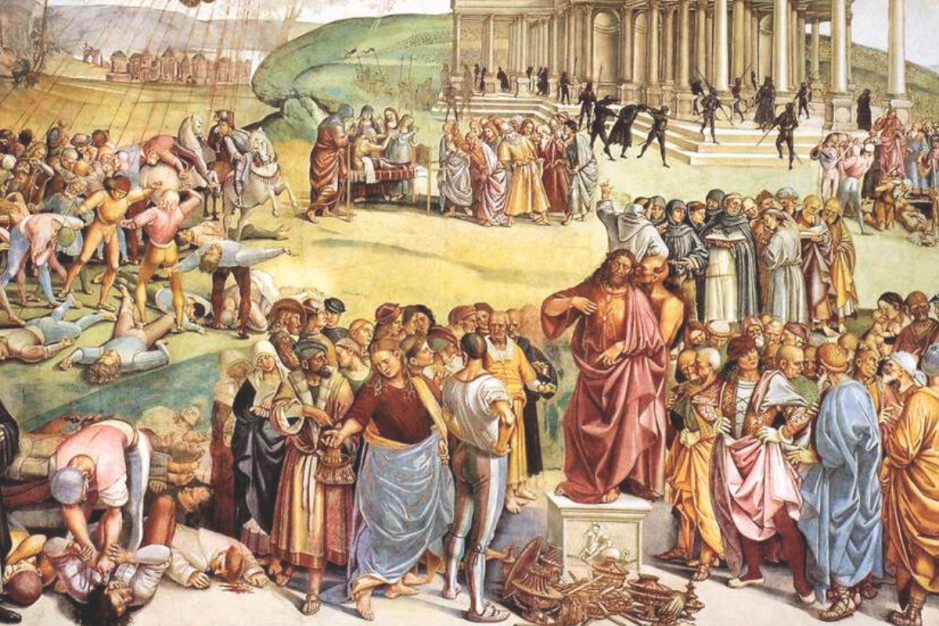
IMAGE CREDIT: Luca Signorelli: Sermon and Deeds of the Antichrist – Wikimedia

Saint-Yves Alveydre

Around the turn of the nineteenth century, there was a resurgence of interest in Rosicrucianism, Kabbalism and Spiritualism among Freemasons. You may recall that demons have revealed to exorcists that that this time period was marked by a great increase in demonic activity. Various groups, including the Kabbalist Order of the Rose-Cross, the Martinists and the Symbolists, splintered off from Masonry. These groups were particularly active in France.

One member who had connections with several of these groups was Joseph Alexandre Saint-Yves Alveydre (1842-1909). Saint-Yves was a member of the occult, moving in circles with Victor Hugo and Lord Bulwer-Lytton.

who is credited with being the founder of Synarchy because he was the first to write down its doctrines. Saint-Yves believed that he was in contact with a superior race of beings who communicated with him telepathically. He claimed that the principles of Synarchy were given to him by these beings as a way of countering the spread of anarchy which was prevalent at that time.

Whereas anarchy holds that there should be no governing authority, Synarchy imposes control over every facet of life. More specifically, Saint Yves believed that the superior beings who gave him this secret knowledge would help a ruling elite to govern society.

Saint-Yves believed that the world had once been ruled by such an elite and that their civilization was destroyed by natural disaster. His hypothesis is reflected in the legend of Atlantis and he believed that the Atlantians constructed the Sphinx.. Throughout history, the cosmic powers continued to send prophets such as Jesus, Moses, and of course, Saint-Yves, using secret societies to pass on the philosophy of synarchy. One example of this is the Knights Templar, whom he regarded as the perfect model of Synarchists because of their level of control over the three levers of power: socio-political, religious and economic.

Saint-Yves believed these three areas should be controlled by an elite who took their orders from the “wise ones”. This would be done without the general population realising that they were being governed by elite puppets. Once the elites gained control of the three levers of power, it would not matter whether a government was on the “left” or on the “right” – the outcome would be the same.

Saint-Yves also called for a united state of Europe – something that will become important later in our inquiry. Apart from his interest in geo-politics, His Synarchy adopted elements from popular occult movements of his time, melding them with his principle of taking orders directly from the “enlightened beings.”

Saint-Yves wrote many books in which he described plans for a Universal Synarchist Church, which is nothing other than Masonic syncretism. A blend of Christianity, Judaism, Hinduism, Islam, Buddhism, the church of the Synarchists would be cultural as well as spiritual.

Saint-Alveydre’s Universal Synarchic Church did not attempt to eliminate the Catholic Church, but to subsume Her into its ranks. For this two occur, Catholicism would firstly need to agree that all religions are equal and then to come to terms with Freemasonry. One can see how closely the post-Conciliar Popes have followed this programme through their promotion of ecumenism.

And while they may have officially upheld the Church’s teaching on Freemasonry, in their words and actions, they have been quite tolerant of Masonry within the hierarchy. Saint-Alveydre promoted the idea that Masonry was based in Christianity, writing that:

“If Masonry admits men without distinction of race, worship, creed, to fraternal assistance from the Prince of Wales to the pariahs of India, then it is more Christian, more Orthodox in the eyes of Jesus than you who anathematize it.” (Mission des Souverains, p 446, as quoted in Mystère d’iniquité)

Saint-Alveydre’s comment is reminiscent of Stefano Bisi, Grand Master of the Grand Orient of Italy. At a recent event to promote rapprochement between Masonry and Catholicism, he said:

“The starry sky is the same for the Buddhist, for the Catholic, for the Waldensian, for the Muslim, for all those who believe in a supreme being,” he continued, adding: “We set our brothers free to adhere to any religion and to practice. Absolute truths and walls of the mind do not belong to us, and for us they must be torn down.” 

His 1877 book, Keys to the East, introduced Synarchy to a popular audience. In1886,   Saint-Yves created the Syndicate of the Professional and Economic Press which introduced business and political leaders to synarchy. Enthusiasts included French minister François Césaire Demahy and Paul Deschanel who later became President of France.

There seems little doubt that Saint-Yves was in direct communication with demons and that the principles of Synarchy were directly inspired by hell. Certainly the consequences of a totalitarian state ruled by an unworthy elite seem consistent with their origin. Anything that lacked evidence, such as his ideas about race or the origins of the world were for Saint-Yves a product of the secret knowledge from the “wise ones.”

Raoul Husson

Roaul Husson was a Synarchist and member of a secret society for mathematicians known as the Nicolas Bourbaki group. It is possible that this group was also a member of Synarchy, as one of the founders, Henri Cartan, was the president of the European Federalist Movement (1974-1985) and promoted the idea of the United States of Europe.

In 1946,  Raoul Husson released Synarchy, Panorama of 25 years of Occult Activity under the pseudonym Geoffroy de Charnay. In the appendix to this work, he reproduced the entire “Revolutionary Synarchic Pact for the French Empire ”. In his book, he concluded that technocrats had deliberately orchestrated the collapse of France during WWII and suggested that the Synarchists were planning to repeat their performance. 

Husson spelled out the hidden plan contained within the Pact: that the unification of Europe was only the first step to a unified world.

He explained that parliamentarianism was a political enemy, and that the future citizen of Synarchy would become identified solely with his profession: he should have no part in running his country through involvement in politics.

In his book, Husson spelled out the priority for France to be infiltrated if a united Europe was to be established. It was necessary for Synarchs to be firmly positioned there because despite its anti-clerical drift, France’s egalitarian spirit meant that independent leaders could spontaneously come forth from the grassroots and threaten the Synarch’s long-term goal. He claimed this had already been achieved by 1939.

Details of the Pact include: permeable national borders, pacifism, world peace after the establishment of five political supercontinents.

“Unable to agree to dissociate ourselves from any being, we want the current world revolution to bring the peoples into an irresistible movement, beyond orthodox materialist Marxism like false capitalist liberalism, towards a high spiritual civilization marked by seal of universal humanism.”

The Church of the ‘Divine Synarchy’

This is the English translation of a section of Pierre Virion’s “Mystery of Iniquity.” Taken from the Third Edition, and released during the 1970’s, M. Virion masterfully traces the crisis in the Catholic Church back to the plans of the Synarchists.

“The development of the revolution within the Church – for it is indeed a revolution – is linked to the march of international political events. Here we are in the presence of a politico-religious complex combining in its entirety the decadence of doctrinal and institutional Catholicism with the projects of a world government which, in the end, as we have said elsewhere, would be itself, at least visibly, only a universal super-church integrating national churches. In each of these two fields, parallel processes are oriented towards the same goal, so that if one is are in a hurry to follow a political trajectory ordered to their globalism, the others, under the guise of ecumenism, but in reality with a view to a versatile and Masonic dogmatic opening, are busy perfecting this revolution. 

Progress is such that they speak openly about this world government. Le Monde of February 16, 1967, citing as an example: “the rapprochement in ecumenism of the Christian churches said something about it” in advance, like Perrette in the fable, the unhoped-for advantages: no more starving people, no more epidemics, friendly exchanges and a limitation of births. 

Georges Hourdin, in Croissance des Jeunes Nations (n° 61) quoted by the Courrier Communautaire Autaire of 15 January 1967, had a geopolitical program that was more informed about the great synarchical groups: “We must accept to group the states into large regional confederations, then into a world government. It is then necessary, and very quickly, to plan births and savings”.

The pill, which, as we can see, holds a large place in globalist diplomacy, also has the good fortune to be the link between and the ecumenism of the clerics of the new Church. But this is only a small side of the homogeneity of the system, which means that the building of the New Church, as widely open to all the faithful of multiple denominations as the world government is to all the peoples of the earth, so desired, so long awaited, whose Church of Holland is today enthusiastically presented to us like the prototype, or a politico-religious enterprise.

Holland

This will be seen by reading, in Le Figaro, the articles of Abbé Laurentin on “The Dutch Catholicism of Mutation”. For him, “Holland has been a country open to the freedoms of intelligence since the first hurricanes of the sixteenth century”. He forgets to tell his readers that this was so because Holland was then a hotbed of Rosicrucians and sects. In our day, The Masonic centres are Harlem and The Hague, where, we are told, some good Fathers are forgotten, but its activity has not been weakened. That could explain this. 

But what interests the Abbé so keenly is the sudden outburst of “Christian energies”. Let us read it, in fact (emphasis added): “The first symptoms were noticeable as early as 1950. They were linked to the economic and intellectual development that changed the condition of the Dutch Catholics. The phenomenon took on considerable proportions shortly before the opening of the Vatican Council. It catalysed research and provoked immense hope, but became a disappointment from the second session of the Council”. (Le Figaro 19/2/1967)

Doesn’t Father Laurentin know that one should never talk about ropes in the house of a hanged man? So what happened “from 1950 onwards”? We remember the ‘Schumann Bomb’ which initiated the constitution of the European Coal Community in public opinion. Thus began the reputation that the ‘Father of Europe, a title’ Robert Schumann shared with Jean Monnet, whose international synarchic power and financial relations were in direct proportion to the discretion with which it surrounded them. 

Germany

Immediately, the Études of the Jesuit Fathers, in their June issue, sounded the trumpet in favour of the ‘Christian-European epic.’ Mr Robert d’Harcourt extolled in a couplet on ‘German Realism’ the profound views and talents of Mr. Adenauer. It was reported that the Chancellor, proud of the role of the Federal Republic of Germany in this affair, affirmed that, by his decisive influence, it had accompanied Robert Schumann at the London Conference and that it thus became “a factor with which international policy must count”. This “must count” was not a figure of rhetoric. 

Let us not reproach Mr Adenauer for having wanted to create Europe and, to do so, for having used forces and the audience party, the Christian Democratic Party. But from the beginning, the company had partners who were neither on its side nor in its own designs and party whose successes he attributed in 1946 to the assistance of the financier, Pferdmenges, communicated to his European peers a a dynamism led by other powers, those of the ‘Europe of the Bankers’, less zealous than he was for the cause of the Roman Church. Pferdmenges was a pious Protestant who belonged to the Salomon Oppenheim Bank of Cologne, former president of the Chamber of Commerce and of the Bankers’ Association of this city. Having helped Mr. Adenauer to form a powerful party, he was raised by him to the rank of Grand Cross.

Bankers & Bilderbergers

Pferdmenges was chairman of the Rheinische-Westfälische Credit Bank in Cologne and vice-chairman of seven associations attached to the Dresdner Bank. His death did not put an end to other support, including that of a friend Adenauer and his financial advisor: Mr. Abs, a Catholic, it seems. With Mr. Abs, we entered a circle very similar to that of the Dresdner Bank, but more powerful than he, that of the Deutsche Bank, which owns the Rheinische-Westfälische Bank in Düsseldorf. 

With Mr. Abs, again, we had full access to the ‘World Understanding’ through the channel of the famous Bilderbergers in whose meetings he took part assiduously and recently again in Cannes with a line-up of German financiers. Mr. Abs presiding over the destinies of the Western and especially of the Rhine-Westphalia Group enjoys both the confidence of the Anglo-Saxons and holds the threads that connect powerful cosmopolitan consortiums from the Hambros Bank of London, the Lazare Bank and the International Bank of London. Luxembourg, well known to Mr. Van Zeeland, Bilderberger, too, up to the Dutch giant A. K. U. and its trusts, several of which are chaired by Mr Abs and which, as everyone knows, more or less discreetly finance the so-called right-wing parties with a tendency to Catholic or Protestant. Among the Catholic organs are Volkskrant (175,000 copies), the Tydg and its chain of four daily newspapers (114,000 copies), of which there is much talk in these times of the ‘National Council’. In these perspectives, it is conceivable, in fact, as Abbé Laurentin says, that the “economic condition” of the Dutch Catholics have changed.

Luxembourg

The Schumann-Adenauer-Monnet-Gaspéri movement was born in Luxembourg. It also settled in Strasbourg. Let’s say everything immediately: the main and always discreet craftsman was Jean Monnet. The ‘Schumann bomb’ was full of hard-hitting arguments, so powerful that in Christian Democratic circles one could perceive the repercussions as far as Strasbourg where “from 1950 various personalities either in their capacity or representing different Catholic movements belonging to eleven countries “established a Catholic Secretariat for European Problems (SCPE) previously founded in Luxembourg and which defined itself as follows:

 “A technical body made available to organisations and Catholic personalities interested in European problems. Its essential purpose is therefore to establish networks between them information and documentation. The SCPE will inform and inform interested persons of the projects which may be carried out in the Discussion in the bodies called upon to work for European unity. In addition, it will prepare the files and themes of study that will facilitate the examination of European problems involving the Christian conscience and requiring the study and presence of Catholics”. 

The presidency was devolved to the president of Italian Catholic Action, Mr. Vitorino Veronese, who in 1957 became president of UNESCO celebrated the tercentenary of Comenius, the famous Rosicrucian of the sixteenth century. The direction remained with M. Baumgartner, former finance minister with whom we remained in the orbit of the Bilderbergers. Dr. Roesen, President of the Commission to the Katolikentag was delegated by the German Catholics.

The Fingerprint of Synarchy Emerges

In 1951, the Documentation Catholique listing the various European movements presented with advantage the impetus given by the Count of Coudenhove-Kalergi and the action of M. Van Zeeland. This evocation of an authentic synarchic lineage should not make us forget that, in addition, Mr. Van Zeeland “passed through more than one place to dispose of a manoeuvring mass in impressive dollars “added to the presidency of the “Economic League for European Cooperation” of which Mr Giscard d’Estaing was vice-president. The same year, the “Comité de la rue de Penthièvre” led by Mr. Boutémy, secretary general of the French Employers’ Association. He too, it was said, had “considerable funds, not all of which were of French origin, and acted energetically in connection with the international organisation led by the former Belgian minister, Mr Van Zeeland, to promote a federal status for Europe” (J. Hammer). 

In the same year again, in the year of elections, the Communists, hardly suspected of recognizing miracles, were to observe with astonishment that, with tripartism buried, their former Christian Democrat allies had suddenly become Europeans and Globalists. It was a fine piece of work in which a technical body, as the Catholic Secretariat of Strasbourg was called, was not unknown. He had undoubtedly made available to “organisations”, “personalities”, his networks, his documentation, his files and its themes of study, but the rest? His own budget must have been very heavy and such successes are expensive. The rest could not have been neglected.

On 6 March 1953, in Strasbourg, at the Congress of the ‘Europe of the Six’, what political and financial authority other than that of M. von Brentano, Minister for West Germany, could in terms almost identical to those of the Synarchic Pact, better specify the action taken? 

“The mission received from the six Foreign Ministers and the acceptance of a task that we are now leading to its conclusion, constitute a kind of silent revolution; public opinion has taken note of this work, without, however, grasping its significance”. And the result was there, vast as the ‘Europe of the Six’, as deep as the mass of the MRP of which Robert Schumann was a member and leader of the “Movement of Christian Workers for Europe” sitting in the CFTC. 

Sub-Plot to the Vatican II Council

It is therefore understandable that in such a wide environment, in such a favourable atmosphere, in a system as well as to the immense design of politicians, in a pool of people who are as well chosen in terms of its dimensions, its resources and security, the intellectuals of the Catholic Secretariat for Europe have been able, happy as fish in water, to deepen their ‘study themes’ and push their projects. In the European and globalist perspectives, the new theology perceived, now certain of achieving this, distant to the continental measure of Christian confessions and the depths of an ecumenism defying formulations of strict Catholicity. As the occultist Abbé Mélinge predicted, liberal Protestants and broad-minded Catholics could apply “at common expense” for the construction of a new church. At common expense this was, it seems, quite the case.

But if the revolution of the politicians was silent, that of the theologians was not silent enough to be able to carry the masses along in the wake of the New World and discreet enough that one did not realise the work in which one was busy in order to to try to pass on to the future Council, supported by well-known Eminences and Excellencies, the plans prepared during the “that long maturation which has led French, German, Belgian and other theologians to prepare Vatican II from afar.” (Courier January 1967). “The phenomenon took on considerable proportions shortly before the opening of the Council” (Laurentin, Le Figaro, 19-2-1967), but The effort did not relax during the sessions. It is not to the peri-conciliar literature rising like an outbreak of revolution in the press, nor to the declamations with a great deal of costly publicity of the theologians of the future that we only think. There were also in Rome, a whole organisation which constituted an instrument of propaganda and formidable pressure, offering them round tables and crossroads, which could print on the spot and distribute to the Fathers their talks and their “themes of study.”

This French Mystic predicted the Adrenochrome trade

Blessed Marie-Julie Jahenny is well-known for her prophecies about the rise of a false Church and the Three Days’ Darkness, but a newly-released book on Marian prophecies includes rare predictions from the mystic which include references to cannibalism and the adrenochrome trade.

Adrenochrome, for those who aren’t aware, is the highly-prized nectar of the ‘elites’; a chemical harvested from the pineal gland of innocent children who have been deliberately terrified in order to increase its potency. It became mainstream after being mentioned by Johnny Depp’s character in the film, Fear and Loathing in Las Vegas. As this article mentions, though, it was referenced by Aldous Huxley, William Blake and others long before the advent of Hollywood.

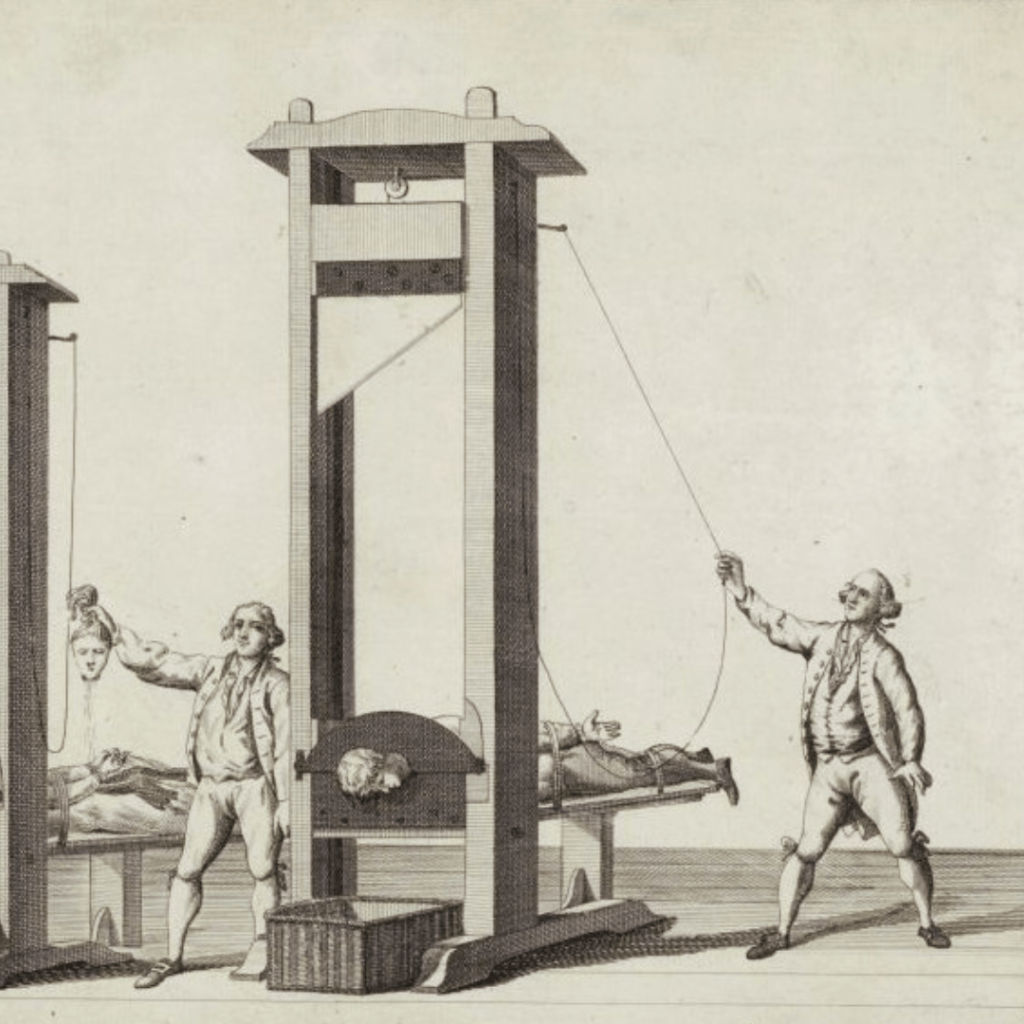
Marie-Julie also had some inspirations about other aspects of our civilisation’s decline, as if to confirm the abysmal state of this evil generation. She foresaw a totalitarian society complete with surveillance and detention, as well as a return to the use of the guillotine – that highly-favoured implement of French revolutionaries:

The strong political party will be the one of evil’s victory … the small number will fall under the thunder of these voices who call for the blood and the flesh of bodies to “stretch their instruments” as they say. The Christian judges will be replaced in every part of France. The people will have to submit to surveillers or being sent to prison and finish one’s life under cutting weapons.

(Julie-Marie Jahenny, Jan 1882)

The guillotine was developed during the French Revolution, & its results featured chillingly in the Olympics Opening Ceremony.
SOURCE Museum of the French Revolution, CC BY-SA 4.0 https://creativecommons.org/licenses/by-sa/4.0, via Wikimedia Commons

I have no idea about what “stretching their instruments” refers to, but when searching, I came across a technique used in genetic experimentation known as “stretching”. Whether or not this is related to the prophecy, there is no doubt that many of the chastisements seen by Marie-Julie Jahenny stem from the world’s obsession with Scientism and that realm’s fascination with cells stolen from aborted babies. Another quote:

…today it [the world] makes a hellish trade, the likes of which the world has never seen before … All is delivered up, everything is sold and new plots are being hatched every day. The hunger to devour human flesh, the thirst for human blood makes all their bodies seethe with unrest, and consumed with a desire to reach their goal as soon as possible.

(Julie-Marie Jahenny, Nov 1924)

So what is this “hellish trade” to which Julie-Marie was referring? Sex-trafficking? Abortion? Organ harvesting on an industrial scale such as goes on in China? She seems to be alluding to something more evil even than these.

Julie-Marie spoke of the “devouring” of human flesh and of the drinking of human blood. This is obviously cannibalism, vampirism and addiction to adrenochrome.

Nothing is more ‘hellish’ than knowing there are powerful adults who misuse innocent children for their own pleasure and profit.

These activities point to a civilisation on the brink of extinction; Hilaire Belloc, for one, believed cannibalism was the sign of a civilisation about to be annihilated. That certainly sounds like our Western culture and when the New York Times starts running articles about cannibalism, it is obvious that perversion has gone mainstream.

But we knew that, didn’t we? The Opening Ceremony of the Paris Olympics summed up the world’s obsession with perversion very succinctly. It has even been said, very insightfully, that it was the ‘Closing Ceremony of Western civilization.’

And here is something really bizarre: the article above tells of an episode of the TV drama, Lewis in which devotees of the false god, Dionysus were taking adrenochrome. Dionysus, of course, was represented by the ‘blue man’ of the Paris Olympics Opening Ceremony.

Whether you believe that adrenochrome is a real substance harvested by elites from terrified children, or whether you think it is Q-Anon bunkum, one thing is for sure: God can’t be too happy with the current state of things on earth. The transexualism, perversion, abortion, organ harvesting and violence predicted by Blessed Marie-Julie Jahenny a hundred years ago have all come to pass.

And if that isn’t worthy of divine intervention, then nothing is.

NOTE: this article was updated August 7th, 2024.

IMAGE CREDITS: Eduardo Hidalgo Downing, CC BY-SA 4.0 https://creativecommons.org/licenses/by-sa/4.0, via Wikimedia Commons; https://upload.wikimedia.org/wikipedia/commons/d/d6/Maria_Julia_Jahenny.gif

As Above, So Below

This article will look at the principle quod est superius est sicut quod inferius, et quod inferius est sicut quod est superius, meaning “that which is above is like to that which is below, and that which is below is like to that which is above”, often shortened to “as above, so below”. It will also examine a gesture used by occultists which embodies the principle.

In his work, The Mystery of Iniquity, Pierre Virion states that the “as above, so below” principle is a false analogy which is at heart anti-Christic: “Illuminism and the theogony (stories of the gods) of the sects thus lead to an inversion of the data of revelation and consequently of Catholic theology.”

Thus transformation or regeneration is evil when it relies on occult means rather than on the graces flowing from Christ’s Redemption. For the proud occultist, however, transformation and enlightenment without Jesus Christ are desired, and he believes they are achieved by the recognising and balancing of opposing forces.

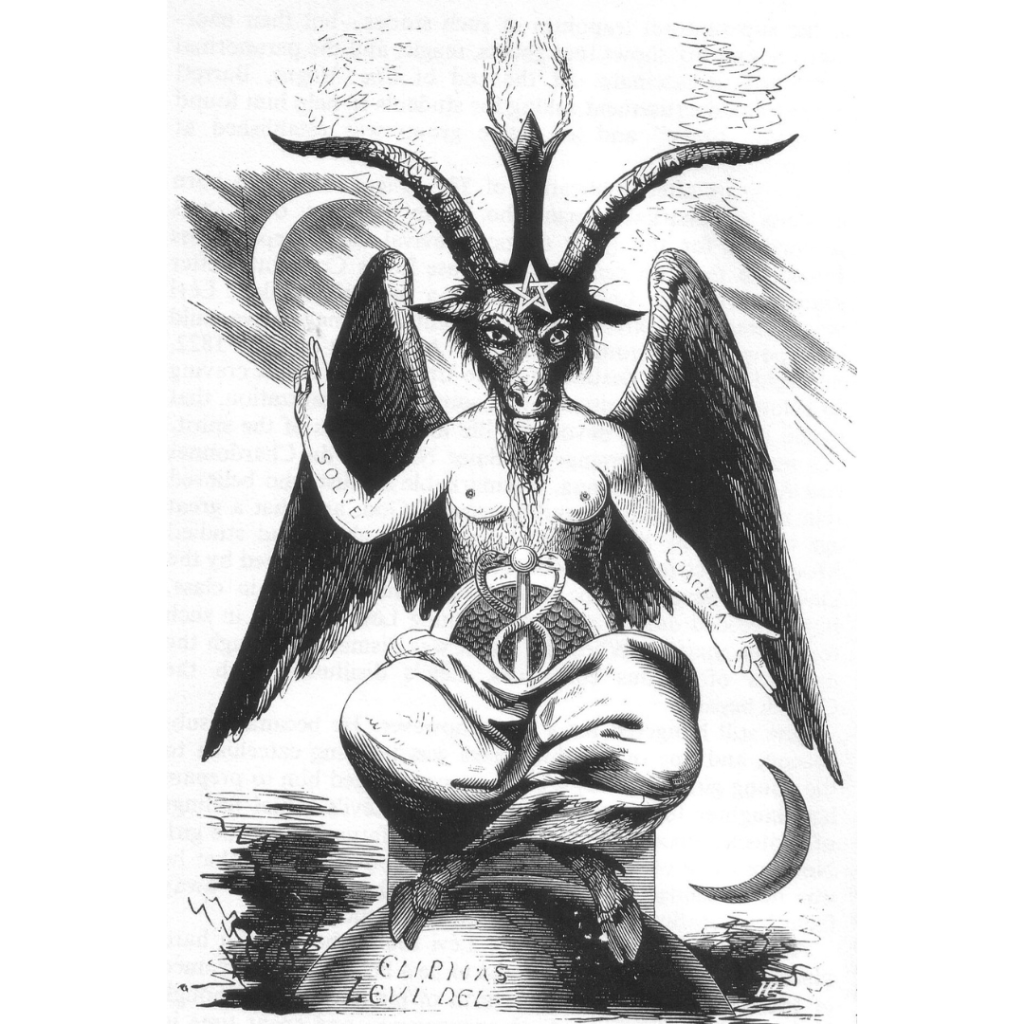
This well-known image of the demon Baphomet comes from the 1856 book, Dogme et Rituel de la Haute Magie, Volume 2 by Éliphas Levi.

Levi, a French occultist of the 19th century, greatly influenced Saint-Yves d’Alveydre, the founder of Synarchy.

Levi’s depiction embodies the principle of duality, reconciling opposites such as light and dark, male and female, spiritual and material. Baphoment, known to traditional Catholics as the demon of fornication, is androgynous and holds its hands in opposing directions in the familiar “as above, so below” formation. One explanation of the gesture is that it “signifies the flow of spiritual knowledge and the grounding of that knowledge in the material world.” The occultist believes that by using this gesture he can balance the opposing forces surrounding him.

A detail from the Redemptoris Mater chapel, created by the disgraced artist, Fr. Marco Rupnik. Christ is depicted with hands in the “as above, so below” configuration. Pope John Paul II can be seen in the background.

The principle of duality is found in a number of occult traditions such as Hermeticism and Kabbalism. In Hermeticism, the “as above, so below” represents the macrocosm (the universe) reflecting the microcosm (the individual). The Kabbalah applies a similar meaning, using the dualistic principle of the Macroprosopus and the Microprosopus (the great world and the small world). In Alchemy, this duality represents transformation, both of base metal into a precious metal and of man through spiritual enlightenment.

The characteristics of the god Baphomet with his up-down” gesture are said to be shared by the god, Baal. Baal is known as the demon responsible for promoting abortions.

This link is an interesting one given the video compilation shown in the Tweet below. In it, one finds the ultra-pro-abort Kamala Harris repeating variations of a specific phrase, accompanied by the “as above, so below” hand gesture. Harris’ gestures and repetition of the phrase, “what can be, unburdened by what has been”, are reminiscent of a witch performing an incantation.

The principle of “as above, so below” is also found in Freemasonry where it has particular significance. It refers to the presence of the Divine in both the spiritual and physical worlds and emphasises their interconnectedness. Masonry also includes the explicitly Hermetic idea that the spiritual realm is reflected in the physical realm and vice versa. Another application of the principle is found in the Masonic obligation of each human being to maintain balance and harmony, especially as expressed through Masonry’s tolerance of various creeds.

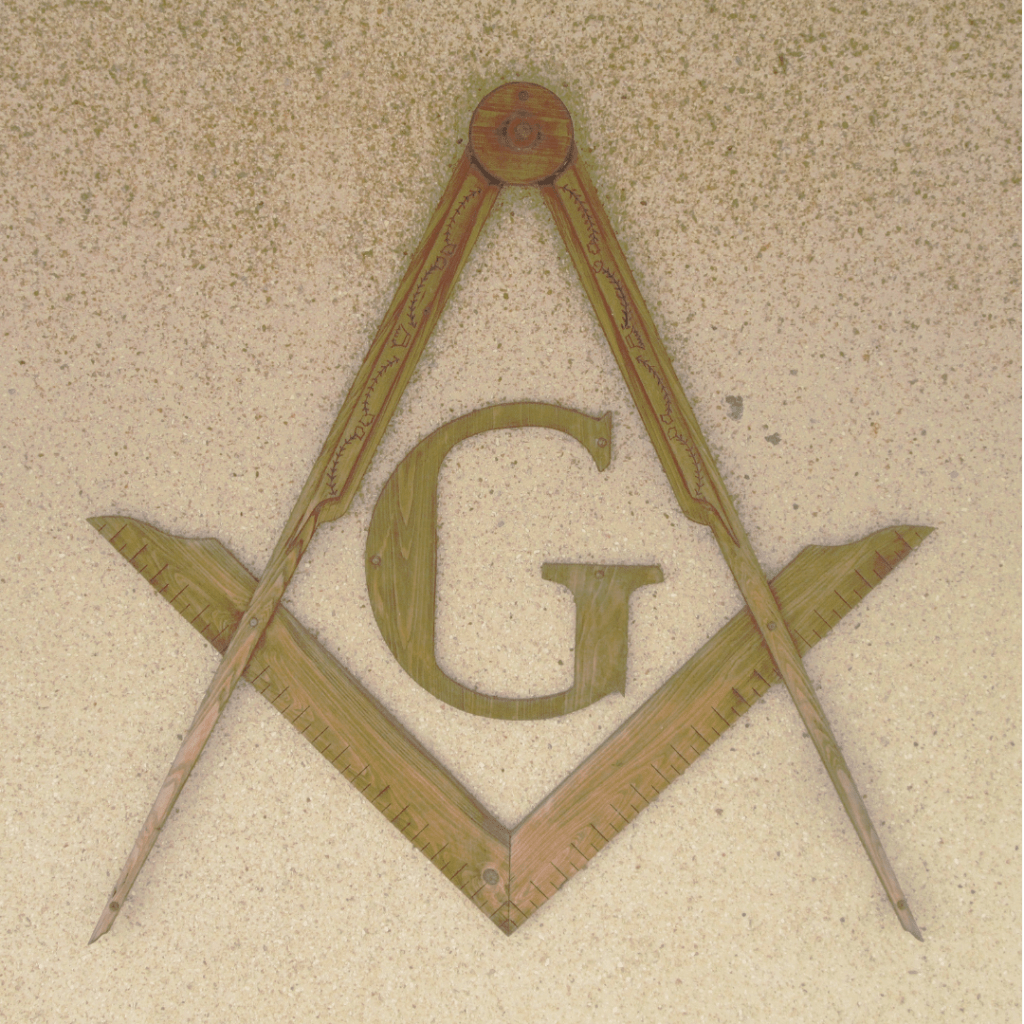
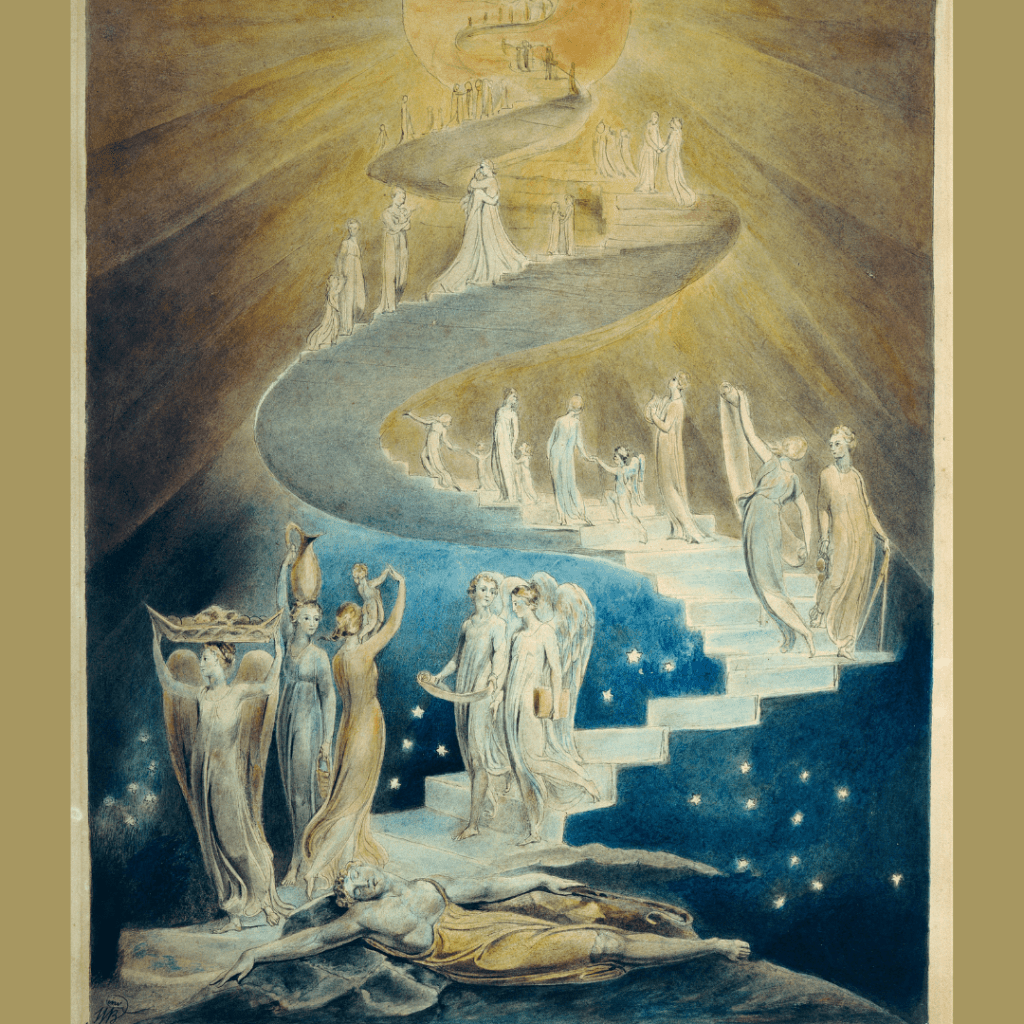
The “as above, so below” theme is found in three of Masonry’s integral symbols: the square and compass; the hexagram, also known as the Seal of Solomon; and Jacob’s Ladder.

This quote from a Freemason, explaining how Masonry’s rituals reference the “as above, so below” principle, point to a diabolical inversion of the Catholic Mass:

INFORMATION SOURCES:https://whowhatwhere.substack.com/p/hand-signals-of-baphomet-and-baal

https://en.wikipedia.org/wiki/Hermeticism

Pierre Virion, La Mystere_iniquite

Esoteric Freemasons website

On the Square website

IMAGE SOURCES: Eliphas Levi, Public domain, via Wikimedia Commons

Beyond My Ken, CC BY-SA 4.0 https://creativecommons.org/licenses/by-sa/4.0, via Wikimedia Commons

Pblpitt, CC BY-SA 4.0 https://creativecommons.org/licenses/by-sa/4.0, via Wikimedia Commons

https://www.vatican.va/content/dam/vatican/virtualtour/redemptorismater/resources/tour-en.html