Many traditionalists and conservative Catholics have been asking themselves how it could be possible that Cardinals as diverse as the arch-heretics Hollerich, the ultra-orthodox Burke and the so-called ‘centrist’ Timothy Dolan, could all come away from a decisive conclave in complete agreement over the outcome. They all seem both satisfied and confident.
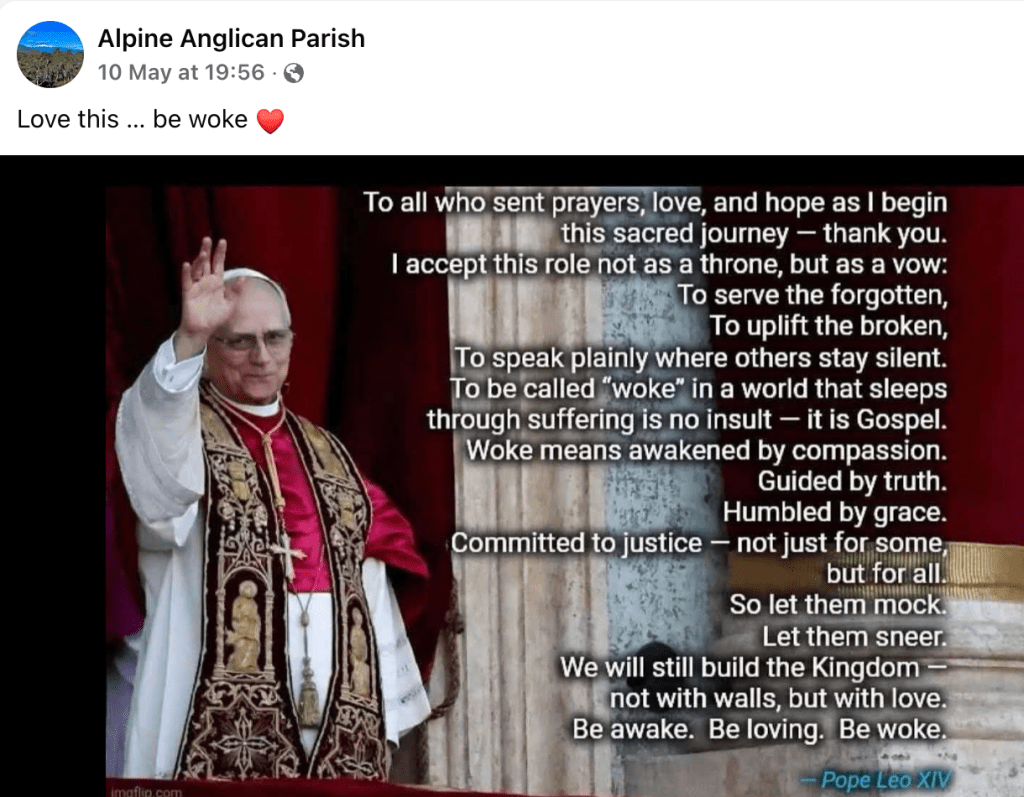
Even the unholy gay priestesses featured in another article on this site like the new guy and they picked up something about the Pope Leo which others, including me, had missed.
Indeed, an outcome which pleases the likes of Bishops Strickland and Fr. James Martin is quite remarkable. Until recent years, the possibility of such an outcome was almost non-existent – barring a mass conversion of dissidents to true Catholicism. This was due to the inherent unity of Catholic doctrine which ensures that a papal candidate who deviates from that doctrine – or upholds it – should be upsetting someone. “For there shall be from henceforth five in one house divided: three against two, and two against three (Lk 12: 52),” said Our Lord. This is division, not for its own sake but as a consequence of the inability of truth and error to coexist.
Thanks to the acceleration of revolutionary error under Pope Francis, however, the possibility of a consensus among polarised Catholic groups has presented itself and has seemingly materialised with the election of Pope Leo XIV. The mechanism for the change is one of the long-held goals of Vatican II: what is now known as ‘Synodality’.
Synodality
Prevost spoke about Synodality on a number of occasions prior to his election as Pope. For instance, in 2024 he said:
“One of the risks of that is that we miss the presence of the Holy Spirit. That breeze that may go by that says, ‘Yeah you always did it that way, and maybe for six centuries it was wonderful, but maybe it’s time to change. Maybe it’s time to look at things differently.’”
The dissident Cardinal Hollerich explained Prevost’s point of view in his interview with Avenire:
“Pope Leo spoke of a “Synodal Church ” in his first message. Having participated in the work of the Synod, we have a Pontiff who knows synodality, who understands synodality, who dares synodality. There will be no revolution that nobody wants in the Church, but instead an evolution. And that’s the best way to change.”
There we have it: an evolution and not a revolution, according to Hollerich.
He goes on to outline the Hegelian paradigm that is at play here, describing Leo XIV as a synthesis of Bergoglio and Ratzinger before him; a man who has something to offer traditionalists yet something also for radicals and revolutionaries. He adds that “Synodality is inherent in the Church”, confirming the prediction of anti-Catholic extremists prior to the election of Francis who said that “after four years of Francis, nothing will be the same.”
Cardinal Tagle repeated the same prediction about Prevost almost verbatim at a press conference after the conclave. “Now, will the programs be clones or photocopies? The programs may evolve, and they may take different expressions. But there’s no turning back from that.”
Fiducia Supplicans
Speaking specifically on the encyclical, Fiducia Supplicans, which allows blessings for same-sex couples, Hollerich opines that Leo may reinterpret it but that he won’t abolish it. Prevost’s comments from October 2024 see to confirm this.
Cultural differences may be one of the reasons why “each episcopal conference needs to have a certain authority, in terms of saying, ‘how are we going to understand this in the concrete reality in which we’re living,?’” he told a press briefing at the sidelines of the synod.
“The bishops in the episcopal conferences of Africa were basically saying, that here in Africa, our whole cultural reality is very different … it wasn’t rejecting the teaching authority of Rome, it was saying that our cultural situation is such that the application of this document is just not going to work.
“You have to remember there are still places in Africa that apply the death penalty, for example, for people who are living in a homosexual relationship … So, we’re in very different worlds.”
Prevost is not known ever to have rejected or criticised Fiducia Supplicans himself which indicates that he is personally in favour of blessings for same-sex couples. According to the principle of Sunodlaity (which, remember, is not a Catholic principle), bishops are free to apply or not apply FS as they see fit.
Under the new Pope, we should expect to see FS being implemented where a bishop is liberal and being denounced where a bishop is orthodox in the name of ‘Synodality.’
Traditional Latin Mass
Similarly, we should expect the TLM to be widely available in some diocese yet severely limited in others. It doesn’t appear that Prevost is willing to tarnish the image of his predecessor, Francis, in any way. This means that it’s unlikely that Traditiones Custodes will be rescinded – unless this was part of a deal carved out with traditional Cardinals during the conclave in exchange for votes.
Pope Leo’s first Mass was a Novus Ordo in Latin, which is perhaps a metaphor for what is to come: a dressing-up of error in the trappings of tradition. This indicates Prevost has no intention of getting to the heart of the problem, which is the Modernism that has infected the Church thanks to the Council.
An unholy Spirit
If the spirit of Synodality is alive and well in the Vatican, then so, apparently is the spirit of Francis. This may be the most unsettling thing that has come from the new Pope yet:

 Ecclesiastical Freemasonry