The Synodal Pope

Many traditionalists and conservative Catholics have been asking themselves how it could be possible that Cardinals as diverse as the arch-heretics Hollerich, the ultra-orthodox Burke and the so-called ‘centrist’ Timothy Dolan, could all come away from a decisive conclave in complete agreement over the outcome. They all seem both satisfied and confident.

Even the unholy gay priestesses featured in another article on this site like the new guy and they picked up something about the Pope Leo which others, including me, had missed.
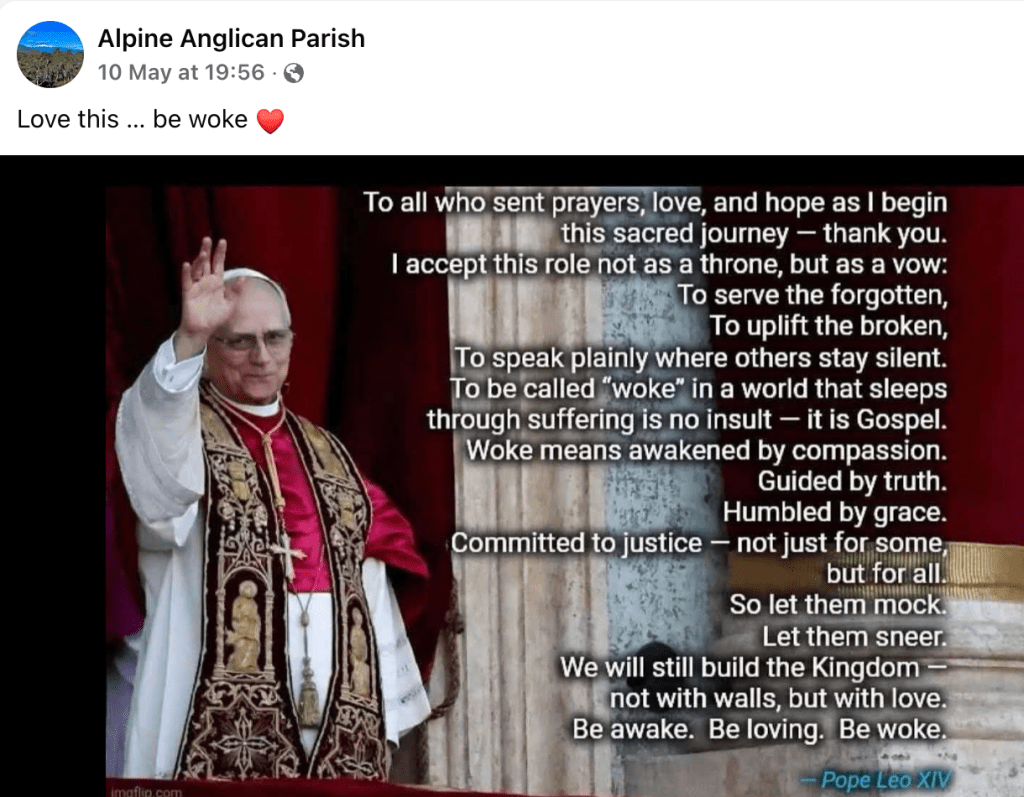
Indeed, an outcome which pleases the likes of Bishops Strickland and Fr. James Martin is quite remarkable. Until recent years, the possibility of such an outcome was almost non-existent – barring a mass conversion of dissidents to true Catholicism. This was due to the inherent unity of Catholic doctrine which ensures that a papal candidate who deviates from that doctrine – or upholds it – should be upsetting someone. “For there shall be from henceforth five in one house divided: three against two, and two against three (Lk 12: 52),” said Our Lord. This is division, not for its own sake but as a consequence of the inability of truth and error to coexist.

Thanks to the acceleration of revolutionary error under Pope Francis, however, the possibility of a consensus among polarised Catholic groups has presented itself and has seemingly materialised with the election of Pope Leo XIV. The mechanism for the change is one of the long-held goals of Vatican II: what is now known as ‘Synodality’.
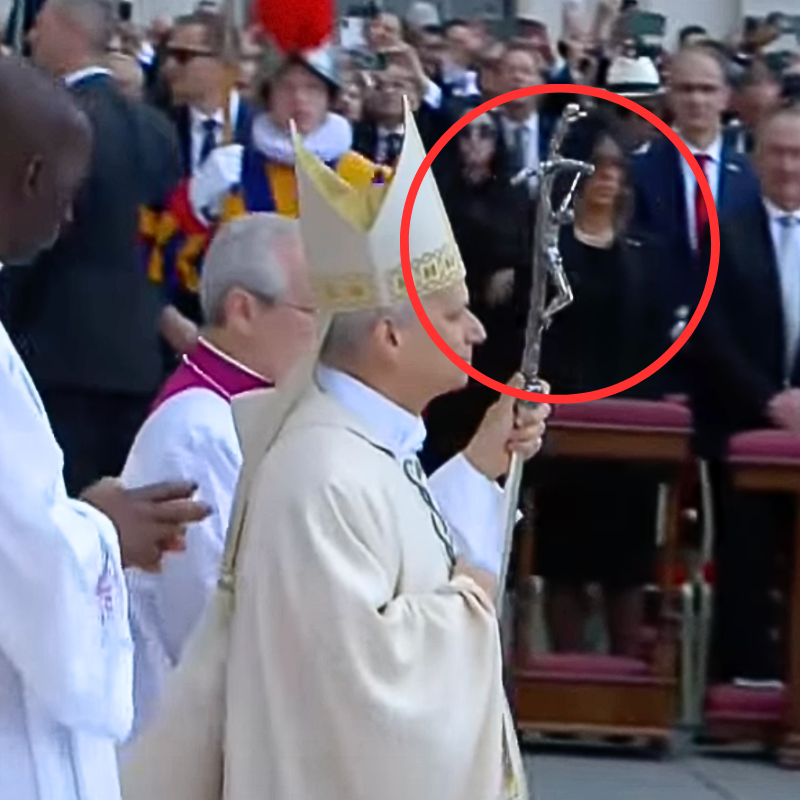
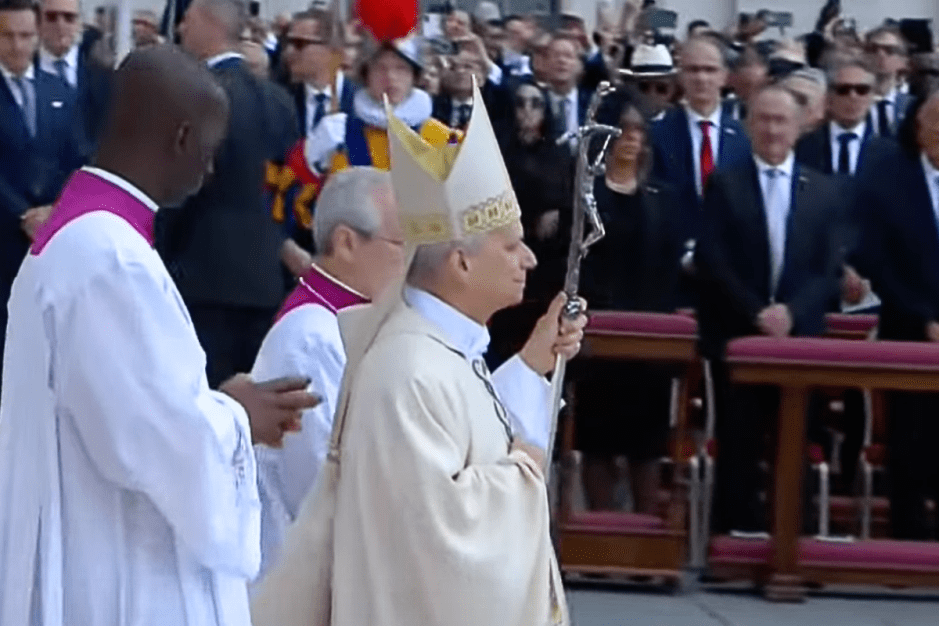
Pope Leo at his installation, carrying the hideous ferula topped by the Scorzelli cross, used by his predecessors. See more here.

Synodality

Prevost spoke about Synodality on a number of occasions prior to his election as Pope. For instance, in 2024 he said:

“One of the risks of that is that we miss the presence of the Holy Spirit. That breeze that may go by that says, ‘Yeah you always did it that way, and maybe for six centuries it was wonderful, but maybe it’s time to change. Maybe it’s time to look at things differently.’”

The dissident Cardinal Hollerich explained Prevost’s point of view in his interview with Avenire:

“Pope Leo spoke of a “Synodal Church ” in his first message. Having participated in the work of the Synod, we have a Pontiff who knows synodality, who understands synodality, who dares synodality. There will be no revolution that nobody wants in the Church, but instead an evolution. And that’s the best way to change.”

There we have it: an evolution and not a revolution, according to Hollerich.

He goes on to outline the Hegelian paradigm that is at play here, describing Leo XIV as a synthesis of Bergoglio and Ratzinger before him; a man who has something to offer traditionalists yet something also for radicals and revolutionaries. He adds that “Synodality is inherent in the Church”, confirming the prediction of anti-Catholic extremists prior to the election of Francis who said that “after four years of Francis, nothing will be the same.”

Cardinal Tagle repeated the same prediction about Prevost almost verbatim at a press conference after the conclave. “Now, will the programs be clones or photocopies? The programs may evolve, and they may take different expressions. But there’s no turning back from that.”

Fiducia Supplicans

Speaking specifically on the encyclical, Fiducia Supplicans, which allows blessings for same-sex couples, Hollerich opines that Leo may reinterpret it but that he won’t abolish it. Prevost’s comments from October 2024 see to confirm this.

Cultural differences may be one of the reasons why “each episcopal conference needs to have a certain authority, in terms of saying, ‘how are we going to understand this in the concrete reality in which we’re living,?’” he told a press briefing at the sidelines of the synod.

“The bishops in the episcopal conferences of Africa were basically saying, that here in Africa, our whole cultural reality is very different … it wasn’t rejecting the teaching authority of Rome, it was saying that our cultural situation is such that the application of this document is just not going to work.

“You have to remember there are still places in Africa that apply the death penalty, for example, for people who are living in a homosexual relationship … So, we’re in very different worlds.”

Prevost is not known ever to have rejected or criticised Fiducia Supplicans himself which indicates that he is personally in favour of blessings for same-sex couples. According to the principle of Sunodlaity (which, remember, is not a Catholic principle), bishops are free to apply or not apply FS as they see fit.

Under the new Pope, we should expect to see FS being implemented where a bishop is liberal and being denounced where a bishop is orthodox in the name of ‘Synodality.’

Traditional Latin Mass

Similarly, we should expect the TLM to be widely available in some diocese yet severely limited in others. It doesn’t appear that Prevost is willing to tarnish the image of his predecessor, Francis, in any way. This means that it’s unlikely that Traditiones Custodes will be rescinded – unless this was part of a deal carved out with traditional Cardinals during the conclave in exchange for votes.

Pope Leo’s first Mass was a Novus Ordo in Latin, which is perhaps a metaphor for what is to come: a dressing-up of error in the trappings of tradition. This indicates Prevost has no intention of getting to the heart of the problem, which is the Modernism that has infected the Church thanks to the Council.

An unholy Spirit

If the spirit of Synodality is alive and well in the Vatican, then so, apparently is the spirit of Francis. This may be the most unsettling thing that has come from the new Pope yet:

Yet Another Pope Beloved by the Masons

It is being widely reported that the Italian Grand Lodge has released a very positive farewell statement after the passing of Pope Francis, entitled, “Francis, the Pope of the Least”. (Reproduced below)

This is, of course, no great surprise considering how closely Bergoglio followed the pattern set down by the Masons in the Alta Vendita almost two hundred years ago: “…a Pope according to our needs…” During his life, Masons regularly thanked Bergoglio for his contribution to their aims. In fact, most of his programme, from Synodality to his new-fangled mortal sins, were completely in line with Masonic principles.

What is a surprise is how few realise that this appreciation is just standard fare for the Masons in regard to the conciliar popes. For example,

  • In June 1963, Mexican Freemasons glowingly farewelled Pope John XXIII 1
  • After the death of Paul VI, French and Italian Masons spoke of him favourably 2
    • “To us, it is the death of him who made the condemnation of Clement XII and of his successors fall. That is, it is the first time – in the history of modern Freemasonry – that the Head of the greatest Western religion dies not in a state of hostility with the Freemasons.”
  • During his life, John Paul II was granted an award for his dedication to promoting human fraternity by Portuguese Masons – he declined it, however.3
  • Australian Freemasons also honoured John Paul II for his leadership qualities4:
    • “John Paul II’s most outstanding leadership quality was his ability to create real presence in those who looked to him. The capacity for a leader to make those who follow them believe that the person to whom they aspire can understand, listen and comfort them in a manner that is enriching; is a quality not to be underestimated.” (Note the reference to the Real Presence – remember Masons prize mocking God above all!)
  • Sometimes the praise went in the other direction, for example when John Paul I praised a Mason, who was also known to be a satanist! (Read the article here.)

Now for the latest praise of a post-conciliar Pope by the Masons: a statement on the death of Francis from the Grand Lodge of Italy. The Mason’s mention of Bergoglio’s “path free from dogmas” is perhaps ironic given how dogmatic he was in regard to eliminating tradition.

Francis the Pope of the least

The Grand Lodge of Italy of the ALAM joins the universal condolences for the disappearance of Pope Francis, a pastor who, with his magisterium and his life, has embodied the values of brotherhood, humility and the search for planetary humanism .

The Grand Lodge of Italy of the Ancients, Free, Accepted Masons joins the universal condolences for the passing of Pope Francis, a shepherd who, with his magisterium and his life, embodied the values of brotherhood, of humility and of the search for a planetary humanism. Coming from the “end of the world”, Jorge Mario Bergoglio has been able to change the Church, reporting the revolutionary teaching of St. Francis of Assisi to the topicality of history.

In this moment of mourning, our Communion intends to pay homage to the vision of Pope Francis, whose work is characterized by a profound resonance with the principles of Freemasonry: the centrality of the person, respect for the dignity of each individual, the construction of a community of solidarity, the pursuit of the common good. His encyclical Brothers all represents a manifesto. Freedom, Equality and Brotherhood it is the triple value asset of Freemasonry. Overcome divisions, ideologies, unique thinking to recognize the richness of differences and build a humanity united in diversity, this was ardently wanted by Francis, the same design pursued by the Grand Lodge of Italy.

Pope Francis has been able to combine faith and reason, complementary dimensions of human experience, renewing the Anselmian principle of credo ut intelligam (I believe so that I may understand). A faith capable of questioning itself, of welcoming doubt and of dialoguing, which we also find in the Masonic initiatory method, founded on a path free from dogmas, substantiated by incessant search for truth.

Francis’ pontificate placed in the center the last, together with the planet care and a an ethics of development based on human dignity. This too is found in the Masonic construction of the “Inner temple”, based on tolerance, solidarity and resistance against hatred and ignorance, and finds a profound correspondence in the pastoral care of Bergoglio, which with his “sweet revolution”, showed that humility and dialogue are instruments of authentic strength. In the wake of the “Francesco Economy ” and the vision of one “common home ”, there Masonry supports the commitment to a sustainable, fair and supportive future.

In this time crossed by serious critical issues, the Grand Lodge of Italy finds itself in Pope Francis’ appeal for a “planetary consciousness”, which recognizes humanity as one community of destiny. We honor his memory by continuing to work for an ethics of the limited, for respect for the other and for the construction of a temple based on solidarity, freedom of thought and universal brotherhood.

Luciano Romoli
Grand Master of the Grand Lodge of Italy of the A.L.A.M.
Rome, April 22, 2025

  1. https://www.traditioninaction.org/ProgressivistDoc/A_145_J23-Masons.html ↩︎
  2. https://www.fisheaters.com/srpdf/xxPaul_VI.._beatified_english.pdf ↩︎
  3. https://www.traditioninaction.org/ProgressivistDoc/A_072_JPII_Masonry.htm ↩︎
  4. https://www.freemasonsvic.net.au/wp-content/uploads/2020/05/SummerJv5_FINAL.pdf ↩︎

John XXIII, ‘Pope of the Jews’

Angelo Roncalli has been accused of many things: of conversing with aliens, consorting with Freemasons, being installed by Freemasons, being a Freemason and of course, introducing Synarchy into the heart of the Church. Although those accusations rely on a degree of speculation, he exhibited enough obvious flaws (as evidenced by the disastrous Second Vatican Council) to conclude that his papacy struck a heavy blow to the Church.

Part of that blow came in the form of the ecumenical movement, which was a Modernist counterweight to the longstanding belief of extra ecclesiam nulla salus – there is no salvation outside the Catholic Church. The document, Nostra Aetate, which was a pet project of John’s, formed the basis for the reject of extra ecclesiam. Hidden within its ambiguous text was the suggestion that non-Catholics can be saved without conversion to Catholicism. The document errs mostly by omission in that it fails to advise Catholics to evangelise their non-Catholic neighbours, thus implying that there is, in fact, salvation outside of Catholicism.

One problematic section from Nostra Aetate is given below. For more samples of its errors and a commentary, please read here.)

True, authorities of the Jews and those who followed their lead pressed for the death of Christ (cf. Jn. 19:6); still, what happened in His passion cannot be blamed upon all the Jews then living, without distinction, nor upon the Jews of today. Although the Church is the new people of God, the Jews should not be presented as repudiated or cursed by God, as if such views followed from the holy Scriptures…

While it’s true that prior to being elected Pope, Angelo Roncalli assisted in the protection of thousands of Jewish people as they fled from persecution by the Nazis, he didn’t stop with merely defending their safety. As Pope, John went further and re-wrote the Church’s relationship with the Jews.

In large part, the Church’s relaxation of its policy towards the Jewish religion was the result of lobbying by a French Jewish historian named Jules Isaac.

Jules Isaac

In 1948, Isaac authored a book which, rather brashly, gave suggestions to Christians about how they should teach their children about the Jewish people. Called Jesus and Israel: A Call for Necessary Corrections on Christian Teaching on the Jews, the book included 18 points he believed should be enacted by the Catholic Church. (Read them here.)

Isaac secured a meeting with Pope John XXIII on June 13, 1960, two years prior to the Council, and recorded his thoughts immediately after they met. Isaac’s notes are treasured by Jewish historians.

For the meeting, Isaac was equipped with volumes of material which he believed was evidence that the Church’s teaching was anti-semitic and needed to be changed. Note that Isaac audaciously believed the had a right to change Catholic teaching. He wrote:

The problem of Catholic teaching which I attacked is infinitely more complex than that of the liturgy1. Seen from the special angle concerning Israel, it touches, if not the main ideas of faith and dogma, at least a thousand-year-old tradition, product of the Church fathers, from St. John Chrysostom to St. Augustine. 

Isaac’s particular concern was the so-called “teaching of contempt” of Catholic towards Judaism, which he believed to be anti-Christian and which he believed fuelled anti-Semitism. He put forward his arguments and suggested that the Pope create a sub-committee to study his concerns. The Pope agreed to seek advice on the matter and they parted cordially.

Judaic Influence

A few months later, a group of American Jewish men from a society known as B’nai B’rith met with the Pope. B’nai B’rith (see more here) has close ties to Freeemasonry, and founded the Anti Defamation League.

At that meeting, John told them that: “You are of the Old Testament and I of the New Testament, but I hope and pray that we will come closer to the brotherhood of humanity… It gives me great pain and sorrow to see these recent events (a rash of swastika graffiti) which not only violate a natural right of human beings but destroy the understanding between brothers under God…”

That same year, he also met with a group called United Jewish Appeal, when he said: “We are all sons of the same Heavenly Father. Among us there must ever be the brightness of love and its practice. I am Joseph, your brother.”

Later in 1960, John called for those clerics preparing for the Council to add a declaration on the attitude of the Church towards the Jews. He approved the first draft, entitled Decretum de Judaeis (“Declaration on the Jews”) in November 1961, but didn’t live to see the document in its final form. That was left to Paul VI, who promulgated it as Nostrae Aetate in 1965.

Perfidious Pontiff

Yet, the Jewish question had been in John’s mind before these meetings, as back in March of 1959, during the Good Friday Liturgy, John demanded that the word, ‘perfidious’ should not be read during the prayer for the Jews.

As even such Modernists as Cardinal Bea and Henri de Lubac point out, the adjective ‘perfidious’ was included in Medieval times when its meaning was less offensive than it is today. ‘Perfidious’ originally meant ‘unbelieving’ or ‘unfaithful’ and was thus perfectly appropriate for describing the Jewish people.

[It is worth noting that when Benedict XVI allowed for wider use of the traditional Latin Mass, he only authorised the use of the 1962 Missal from which the word “perfidious” had been removed. Fr. Mawdsley has a lot more to say on this.]

Next, John attacked the Rite of Baptism, removing the necessity to “Abhor Jewish unbelief (in Jesus Christ) and reject the Hebrew error (which is that the Messiah has not yet come).”

John also ‘cancelled’ Pius XI’s prayer from 1925, the Act of Consecration of the Human Race to the Sacred Heart of Jesus. The words, ‘Look with Thine eyes of mercy upon the children of that stock, so long Thy Chosen People; May the blood called upon them of old, now descend on them as the waters of redemption and life,’ were now deemed to be politically incorrect. 

Making Catholics Pay

John went even firther in his efforts to appease the Jews. With the assistance of the heterodox Cardinal Frings, John required that a prayer be said by German Catholics on the Feast of the Sacred Heart. It went:

“Lord, God of our Fathers! God of Abraham, Isaac and Jacob! God of merry and God of solace! We confess before you: Countless men were murdered in our midst, because they belonged to the people from whom the Messiah rose up in the flesh. We pray Thee: Lead all among us who became guilty through deed, omission, or silence, that we may see the wrong and turn from it. In the spirit of heartfelt atonement, we beg for forgiveness for the sins which were committed by our fellow citizens. We beseech that the spirit of peace and reconciliation return to all homes and we pray for the peace of Israel among the nations; on the borders of its state and in our midst…”

While there was most likely a need for some German Catholics to repent of their collaboration with the Nazis, the hypocrisy of John demand is obvious. The Jews detested being held to account as a group for the crime of their forebears – putting Christ to death – yet John expected German Catholics to be held responsible, as a group, for the crime of the Nazis.

And where was the acknowledgement of the non-Jews who were persecuted under Hitler? Including thousands of priests, nuns and lay Catholics? The prayer does not mention those poor people.

Don’t Convert!

John’s commitment to non-evangelisation was well known. Secretary to John XXIII, Loris Capovilla told this story to Time Magazine:

“A young Jewish lad made the acquaintance of Giuseppe Roncalli when he was the Cardinal-Archbishop of Venice. The young man wanted to become a Catholic, but Roncalli kept putting him off. ‘Look,” he said, ‘you’re a Jew. Be a good Jew. Becoming a Catholic will kill your parents.’ The young man persisted and Roncalli finally said he could be baptized — in secret.

“Several years later (in 1961) after his parents had died, he presented himself at the Vatican to see his old mentor, now the Pope. He wanted the Pope to give him the Sacrament of Confirmation. ‘All right, all right,’ said Pope John XXIII, ‘but you have got to continue to be a good Jew, in your own community, go to the synagogue, support the Jewish schul, because, by being a Catholic, you do not become any less a Jew.”

Pope of the Jews

In 2014, Rabbi Dalin, a former professor of Ave Maria University, reminisced about John’s contribution to Catholic-Jewish relations and it was from this man that we learn John was known as the “Pope of the Jews.”

Dalin tells the story of Pope John driving through the streets of Rome on a Saturday, when he suddenly ordered his car to stop in front of Rome’s great synagogue. He got out of the car so he could bless the Jews of Rome as they were leaving: an important symbolic act that earned their gratitude.

“In doing this,” Rabbi Dalin observes, “he began to transform the history of Catholic-Jewish relations in our time, with initiatives inspired by his work on behalf of Jews during the holocaust….

… “Twentieth and 21st-century Jews will forever be indebted to Pope John XIII for his historic role in bringing about Nostra Aetate. It changed forever the relationship between Catholics and Jews.”

It is worth noting that John XXII was canonised (along with another ecumaniac, John Paul II) on the eve of Yom Hashoah, the international day of Holocaust remembrance observed in Israel and by Jews around the world.


  1. see John XXIII’s changes to the liturgy in a later section ↩︎

Problems with ‘Nostra Aetate’

Some of the problematic sections from Nostra Aetate are given below. For a fuller explanation of how this and other Vatican II documents deviate from traditional Catholic teaching, please read here.)

Tolerance for Eastern Religions


The Catholic Church rejects nothing that is true and holy (vera et sancta)in these religions. She looks with sincere respect upon those ways of conduct and of life, those rules and teachings which, though differing in many particulars from what she holds and sets forth, nevertheless often reflect a ray of that Truth which enlightens all men….

… Thus in Hinduism, men contemplate the divine mystery and express it through an unspent fruitfulness of myths and through searching philosophical inquiry. They seek release from the anguish of our human condition through ascetical practices or deep meditation or a loving, trusting flight toward God….

…Buddhism in its multiple forms acknowledges the radical insufficiency of this shifting world. It teaches a path by which men, in a devout and confident spirit, can either reach a state of absolute freedom or attain supreme enlightenment by their own efforts or by higher assistance….

Nostra Aetate §2

Tolerance for Islam

Upon the Moslems, too, the Church looks with esteem. They adore one God, living and enduring, merciful and all-powerful, Maker of heaven and earth and Speaker to men (qui unicum Deum adorant etc…., homines allocutum). They strive to submit wholeheartedly even to His inscrutable decrees (cuius occultis etiam decretis toto animo se submittere student), just as did Abraham, with whom the Islamic faith is pleased to associate itself….

…”Though they do not acknowledge Jesus as God, they revere Him as a prophet. They also honor Mary, His virgin Mother1 ; at times they call on her, too, with devotion.”

… Although in the course of the centuries many quarrels and hostilities have arisen between Christians and Moslems, this most sacred Synod urges all to forget the past and to strive sincerely for mutual understanding. On behalf of all mankind, let them make common cause of safeguarding and fostering social justice, moral values, peace, and freedom.

Nostra Aetate §3

JOHN PAUL II AT ASSISI IN 1986 – A LOGICAL CONSEQUENCE OF NOSTRA AETATE

Misrepresentation of the Jewish Religion

True, authorities of the Jews and those who followed their lead pressed for the death of Christ (cf. Jn. 19:6); still, what happened in His passion cannot be blamed upon all the Jews then living, without distinction, nor upon the Jews of today. Although the Church is the new people of God, the Jews should not be presented as repudiated or cursed by God, as if such views followed from the holy Scriptures.

Nostra Aetate §4

Refuting Nostra Aetate’s Claims about Judaism

“Necessary to note here is the attempt to limit the responsibility for Deicide to a small group of quasi private individuals, whereas the Sanhedrin, the supreme religious authority, represented all of Judaism. Therefore, in the rejection of the Messiah and Son of God, it had collective responsibility for the Jewish religion and the Jewish people, and this irrefutably is stated in Holy Scripture: “And from then on, Pilate was looking for a way to release him. But the Jews cried out, saying, ‘If thou release this man, thou are no friend of Caesar; for everyone who makes himself king sets himself against Caesar'” (Jn. 19:12); and “And all of the people answered and said, ‘His blood be on us and our children'” (Mt. 27:25).

“Also striking is the statement that “the Jews should not be presented as repudiated or cursed by God, as if such views followed from the holy Scriptures.” This lacks the necessary distinction between individuals and the Jewish religion. If the subject is individual Jews, the statement is true, and is exemplified by the great number of converts from Judaism in all eras. But if the subject is Judaism as a religion, the assertion is both erroneous and illogical: erroneous, because it contradicts the evangelical texts and the Church’s constant faith from her origins. (Cf. Mt. 21:43: “Therefore I say to you, that the Kingdom of God will be taken away from you and will be given to a people yielding its fruits.”) And it is illogical, because if God did not reject the Jewish religion or the Jewish people in the religious sense (which in Jesus’ time was one and the same thing), then the Old Testament has to be viewed as being still valid, and contiguous and concurrent with the New Testament. This, then, would sanction the unjustified awaiting of the Messiah, a hope still entertained by today’s Jews! All of this is a totally lying representation of Judaism and its relationship to Christianity.”2

  1. She is honoured by Moslems as mother of a prophet, not mother of the Son of God ↩︎
  2. All taken from the SSPX Asia website ↩︎

 Jules Isaac – Jesus and Israel

Extract from Jesus and Israel: A Call for Necessary Corrections on Christian Teaching on the Jews, published in 1948 (Impact-Site-Verification: 8dad7fd3-e727-499b-bef3-6d8d25dba811)

For purposes of greater clarity, may I be allowed to submit for the examination of Christians of good will—who are agreed in principle on the need for rectification—the following Eighteen Points, meant to serve at least as a basis for discussion.

Christian teaching worthy of the name should

  1. give all Christians at least an elementary knowledge of the Old Testament; stress the fact that the Old Testament, essentially Semitic—in form and substance—was the Holy Scripture of Jews before becoming the Holy Scripture of Christians;
  2. recall that a large part of Christian liturgy is borrowed from it, and that the Old Testament, the work of Jewish genius (enlightened by God), has been to our own day a perennial source of inspiration to Christian thought, literature, and art;
  3. take care not to pass over the singularly important fact that it was to the Jewish people, chosen by Him, that God first revealed Himself in His omnipotence; that is was the Jewish people who safeguarded the fundamental belief in God, then transmitted it to the Christian world;
  4. acknowledge and state openly, taking inspiration from the most reliable historical research, that Christianity was born of a living, not a degenerate Judaism, as is proved by the richness of Jewish literature, Judaism’s indomitable resistance to paganism, the spiritualization of worship in the synagogues, the spread of proselytism, the multiplicity of religious sects and trends, the broadening of beliefs; take care not to draw a simple caricautre of historic Phariseeism;
  5. take into account the fact that history flatly contradicts the theological myth of the Dispersion as providential punishment for the Crucifixion, since the Dispersion of the Jewish people was an accomplished fact in Jesus’ time and since in that era, according to all the evidence, the majority of the Jewish people were no longer living in Palestine; even after the two great Judean wars (first and second centuries), there was no dispersion of the Jews of Palestine;
  6. warn the faithful against certain stylistic tendencies in the Gospels, notably the frequent use in the Fourth Gospel of the collective term “the Jews” in a restricted and pejorative sense—to mean Jesus’ enemies: chief priests, scribes, and Pharisees—a procedure that results not only in distorting historic perspectives but in inspiring horror and contempt of the Jewish people as a whole, whereas in reality this people is in no way involved;
  7. state very explicitly, so that no Christian is ignorant of it, that Jesus was Jewish, of an old Jewish family, that he was circumcised (accordsing to Jewish Law) eight days after his birth; that the name Jesus is a Jewish name, Yeshua, Hellenized, and Christ the Greek equivalent of the Jewish term Messiah; that Jesus spoke a Semitic language, Aramaic, like all the Jews of Palestine; and that unless one reads the Gospels in their earliest text, which is in the Greek language, one knows the Word only through a translation of a translation;
  8. acknowledge—with Scripture—that Jesus, “born under the [Jewish] law” (Gal. 4:4), lived “under the Law”; that he did not stop practicing Judaism’s basic rites to the last day; that he did not stop preaching his Gospel in the synagogues and the Temple to the last day;
  9. not fail to observe that during his human life, Jesus was uniquely “a servant to the circumcised” (Rom. 15:8); it was in Israel alone that he recruited his disclples; all the Apostles were Jews like their master;
  10. show clearly from the Gospel texts that to the last day, except on rare occasions, Jesus did not stop obtaining the enthusiastic sympathies of the Jewish masses, in Jerusalem as well as in Galilee;
  11. take care not to assert that Jesus was personally rejected by the Jewish people, that they refused to recognize him as Messiah and God, for the two reasons that the majority of the Jewish people did not even know him and that Jesus never presented himself as such explicitly and publicly to the segment of the people who did know him; acknowledge that in all likelihood the messianic character of the entry into Jerusalem on the eve of the Passion could have been perceived only by a small number;
  12. take care not to assert that Jesus was at the very least rejected by the qualified leaders and representatives of the Jewish people; those who had him arrested and sentenced, the chief priests, were representatives of a narrow oligarchic caste, subjugated to Rome and detested by the people; as for the doctors and Pharisees, it emerges from the evangelical [Gospel] texts themselves that they were not unanimously against Jesus; nothing proves that the spiritual elite of Judaism was involved in the plot;
  13. take care not to strain the texts to find in them a universal reprobation of Israel or a curse which is nowhere explicitly expressed in the Gospels; take into account the fact that Jesus always showed feelings of compassion and love for the masses;
  14. take care above all not to make the current and traditional assertion that the Jewish people committed the inexpiable crime of deicide; and that they took total responsibility on themselves as a whole; take care to avoid such an assertion not only because it is poisonous, generating hatred and crime, but also because it is radically false;
  15. highlight the fact, emphasized in the four Gospels, that the chief priests and their accomplices acted against Jesus unbeknownst to the people and even in fear of the people;
  16. concerning the Jewish trial of Jesus, acknowledge that the Jewish people were in no way involved in it, played no role in it, probably knew nothing about it; that the insults and brutalities attributed to them were the acts of the police or of some members of the oligarchy; that there is no mention of a Jewish trial, of a meeting of the Sanhedrin in the fourth Gospel;
  17. concerning the Roman trial, acknowledge that the procurator Pontius Pilate had entire command over Jesus’ life and death; that Jesus was condemned for messianic pretensions, which was a crime in the eyes of the Romans, not the Jews; that hanging on the cross was a specifically Roman punishment; take care not to impute to the Jewish people the crowning with thorns, which in the Gospel accoounts was a cruel jest of the Roman soldiery; take care not to identify the mob whipped up by the chief priests with the whole of the Jewish people of Palestine, whose anti-Roman sentiments are beyond doubt; note that the fourth Gospel implicates exclusively the chief priests and their men;
  18. last, not forget that the monstrous cry, “His blood be on us and on our children!” (Mt. 27:25), could not prevail over the Word, “Father, forgive them; for they know not what they do” (Lk. 23:34).

Pope Francis’ Simple Guide to Diagnosing Mental Illness

 A time is coming when men will go mad, and when they see someone who is not mad, they will attack him saying, ‘You are mad, you are not like us.’ – St. Anthony the Hermit.

Thank God the mentally ill finally have a place to call their own. For decades, mentally ill Catholics struggled to find their place within the Church after the Second Vatican Council swept away all that was comforting and familiar to them, replacing it with a newness that many found disorienting.

Now that Pope Francis, the Papa of Psychology, has renewed his pronouncement that those attached to the traditional liturgy suffer from a kind of mental impairment, the news is sure to be met with gratitude by the thousands of traditional Catholics worldwide who operate under the delusion that the Novus Ordo Missae isn’t able to provide the nourishment their minds and souls require.

Pope Francis might lack the qualifications the secular world finds necessary to diagnose mental competence, but that hasn’t stopped him from going to the peripheries of Catholicism to dig out anyone displaying symptoms of Tradition.

A mentally-ill priest faces the wrong direction
Completely normal priest

His simple method of evaluating the precise mental illness based on just three criteria means a diagnosis comes quickly and easily, because fortunately, every single traditional Catholic suffers from exactly the same condition!

The Pope outlined his ground-breaking method in his recently-released third papal auto-biography, which like the others, he didn’t actually write. Here it is in simplified form so that anyone can use the Pope’s method on their family and friends.

Just answer ‘yes’ or ‘no’ to the three questions below to find out if you are one of those ‘special’ Catholics who suffer from a mental illness.

NB: it should be noted that encouraging/discouraging others from taking part in these activities leads to the same score.

Pope Francis’ Simple Guide to Diagnosing Mental Illness 1

  1. Do you wear lace vestments? Y/N
  2. Do you attend the Traditional Latin Mass? Y/N
  3. Do you breed like a rabbit? Y/N

With the Pope’s new method, the days of careful, time-consuming analysis are over: gone are the days of making tedious physical checkups and taking expensive lab tests to check for chemical imbalances.

This innovative method, from the same ideology that brought you ecumenism and synodality, is sure to revolutionise the mental health industry as well as clear out the detritus from the pews. It’s faster than a RAT-test and far more fun. If you make a mistake, just find a sympathetic confessor and you’re good to go again. It’s that easy.

The best news is that if you want to be cured of your mental illness, there are many great programmes being offered by the Synodal Church to help you get back into the Post-Conciliar groove!

Recovering Traditional Catholics in behavioural therapy

  1. 3 x Y = MENTALLY ILL
    3 x N = COMPOS MENTIS
    Mixed result = ATTEND MORE PRIDE MASSES ↩︎