Jesuit Freemasons during JPII’s pontificate

taken from “the jesuits” by malachi martin. something to remember: this is written from Fr Martin’s perspective, as he saw it in 1988. judging from his later books, it appears that he had a less-than-rosy appraisal of JPII’s effectiveness in geopolitical strategy.

” …. there were continual streams of complaints arriving at the papal office, all detailing the unorthodox opinions being taught by Jesuits in Europe and the United States. There were, in addition, revelations that certain circles of the international section of the Masonic Lodge in Europe and Latin America were actively organising opposition to the Pontiff in Poland, that Vatican prelates – some twenty in all – were formal members of the Italian lodge; and that once again Arrupe’s [Superior General of the Jesuits] Jesuits seemed involved with Lodge circles opposed to the Pontiff.

“Paul VI had already in 1965 warned Arrupe and the Delegates to the 31st Jesuit General Congregation of the dangers in belonging to the Compact; it began to appear to John Paul that the warning had not been too wide of the mark.” p 76

“And then, too, there was the strange case of Jesuit Father Caprile, who wrote in the official Jesuit magazine, Civilta Cattolica, published in Rome. At issue for Caprile was the Roman Catholic prohibition, under pain of excommunication, against Catholic membership in the lodge. Excommunication was a dead letter, Caprile wrote in his article, and lodge membership was open to any Catholic. That was a blatant undermining of the Pope’s own decisions about morality….The alliance between the Cardinal Secretary [Cardinal Agostino Casaroli] and Civilta Cattolica was a matter of record….”

A fascinating article about Freemasons & Catholics from Pillar Catholic

when catholics could be masons by nico fassino at pillar catholic

For hundreds of years, the Catholic Church has prohibited its members from joining Masonic lodges.

Freemasonry has been denounced by numerous popes, beginning with Pope Clement XII in 1738, on the grounds that it promotes religious indifferentism.

But after the Second Vatican Council, many Catholics around the world suddenly became confused about whether it was permissible for Catholics to become Masons. 

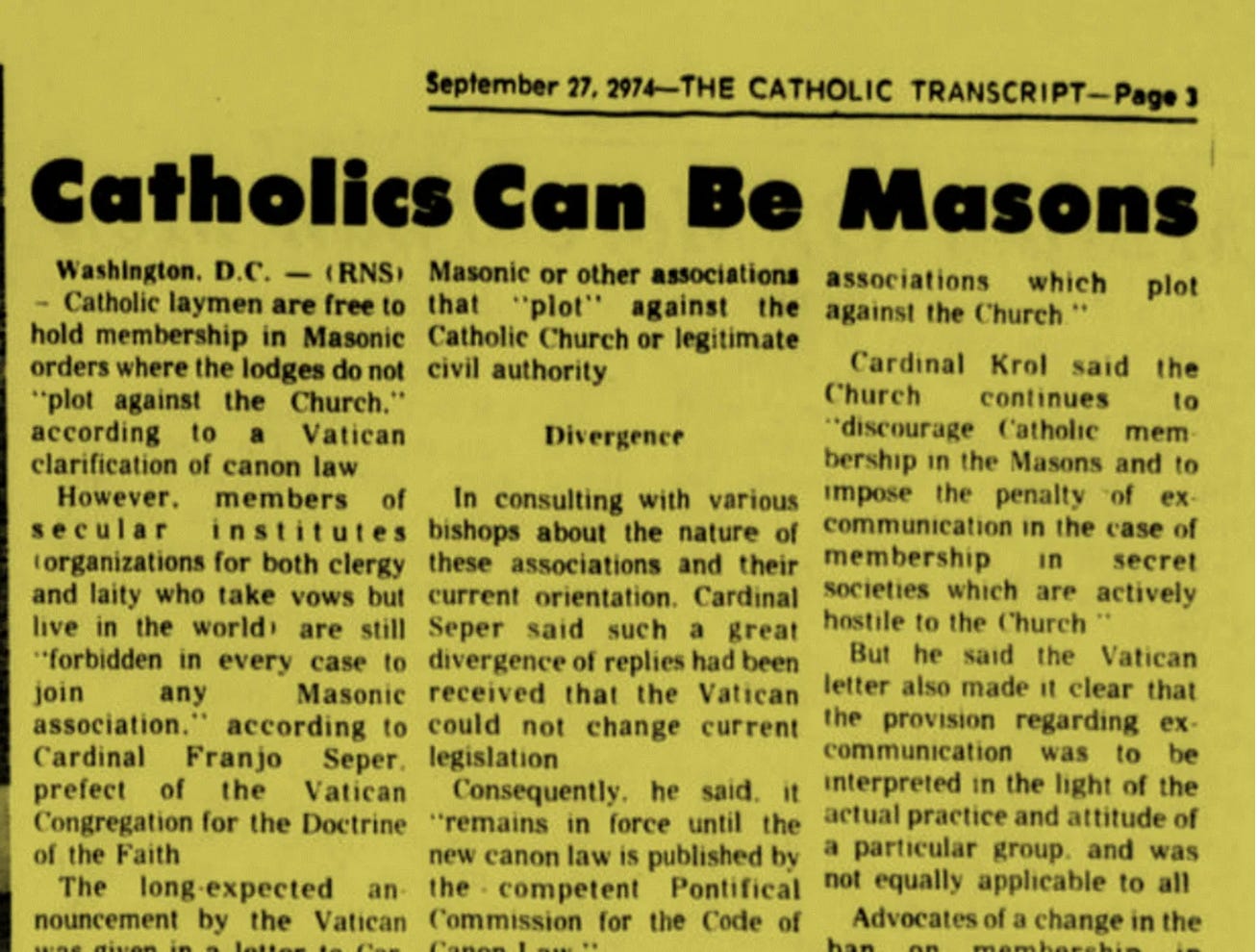
From the Catholic Transcript (newspaper of the Archdiocese of Hartford), September 27, 1974, page 3. Scan via Catholic News Archive, public domain.

In fact, there was a seven-year stretch in the 1970s when the English-speaking Catholic world was taught by its bishops that, although it was not encouraged, it was in fact permitted to become a Mason, as long as certain conditions were met. 

Then, at the end of those seven years, these Catholics were suddenly informed that joining the Masons was actually still forbidden under pain of excommunication – and always had been.

That period in history is all but forgotten today. But a survey of Catholic newspapers from the time period offers a glimpse into the confusion that surrounded the subject of Masonry in the American Catholic world 50 years ago.

Changes anticipated: 1971-1974

While work was underway on the revised Code of Canon Law in Rome in the early 1970s, it became clear that there was widespread anticipation that the Church would soon change her teaching on Catholic participation in Freemasonry. 

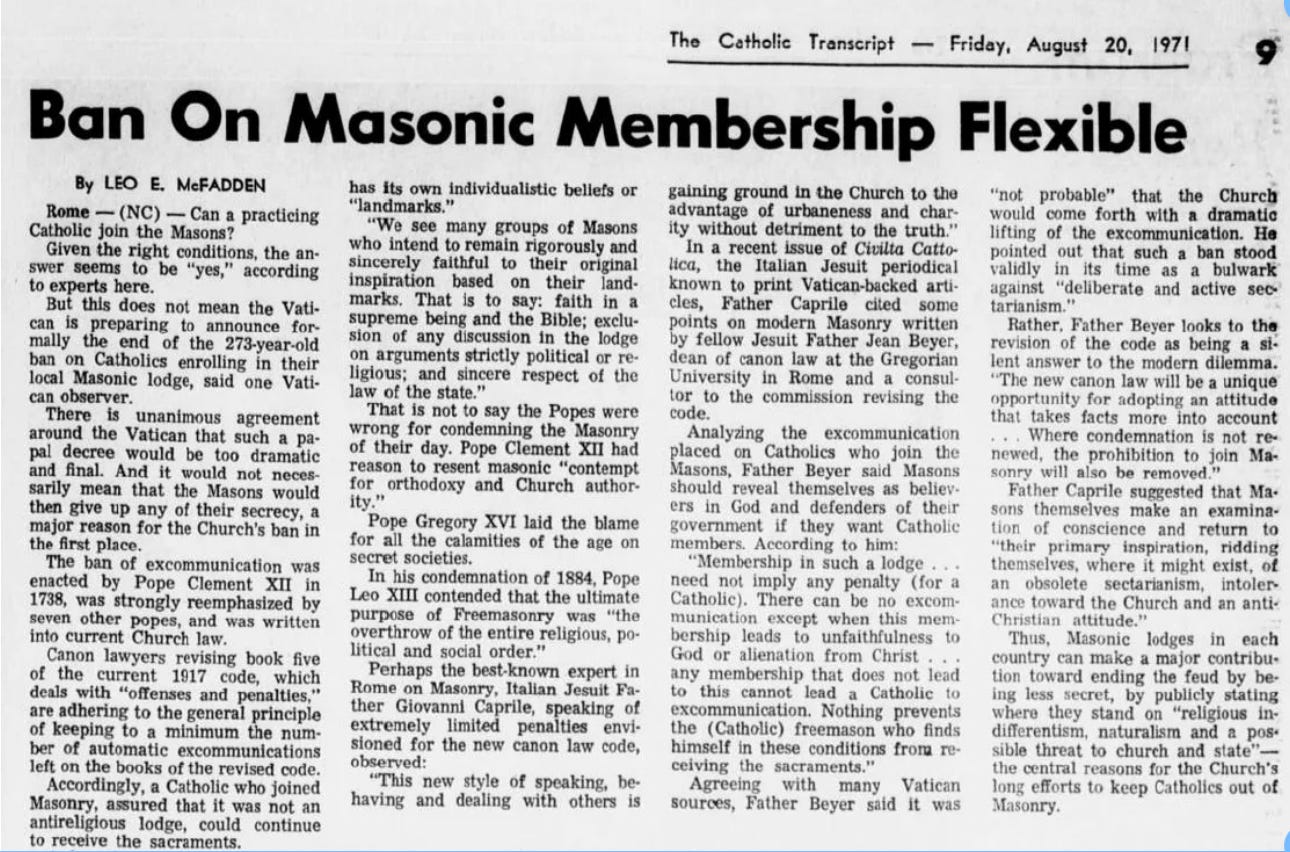
In August 1971, National Catholic News Service – the news service of the U.S. bishops – issued a lengthy report which predicted that the Church would soon modify her teaching on the matter. 

Headlined, “Catholic-Masonic Relations Enter Friendly New Era,” the report included commentary from leading experts in Rome, including Fr. Jean Beyer, SJ – Dean of Faculty of Canon Law at the Gregorian University in Rome and a consultor to the Vatican Commission for the Revision of the Code of Canon Law. The syndicated story ran in official diocesan newspapers throughout the nation. 

The Catholic Transcript (newspaper of the Archdiocese of Hartford), August 20, 1971, page 9. Scan via Catholic News Archive, public domain.

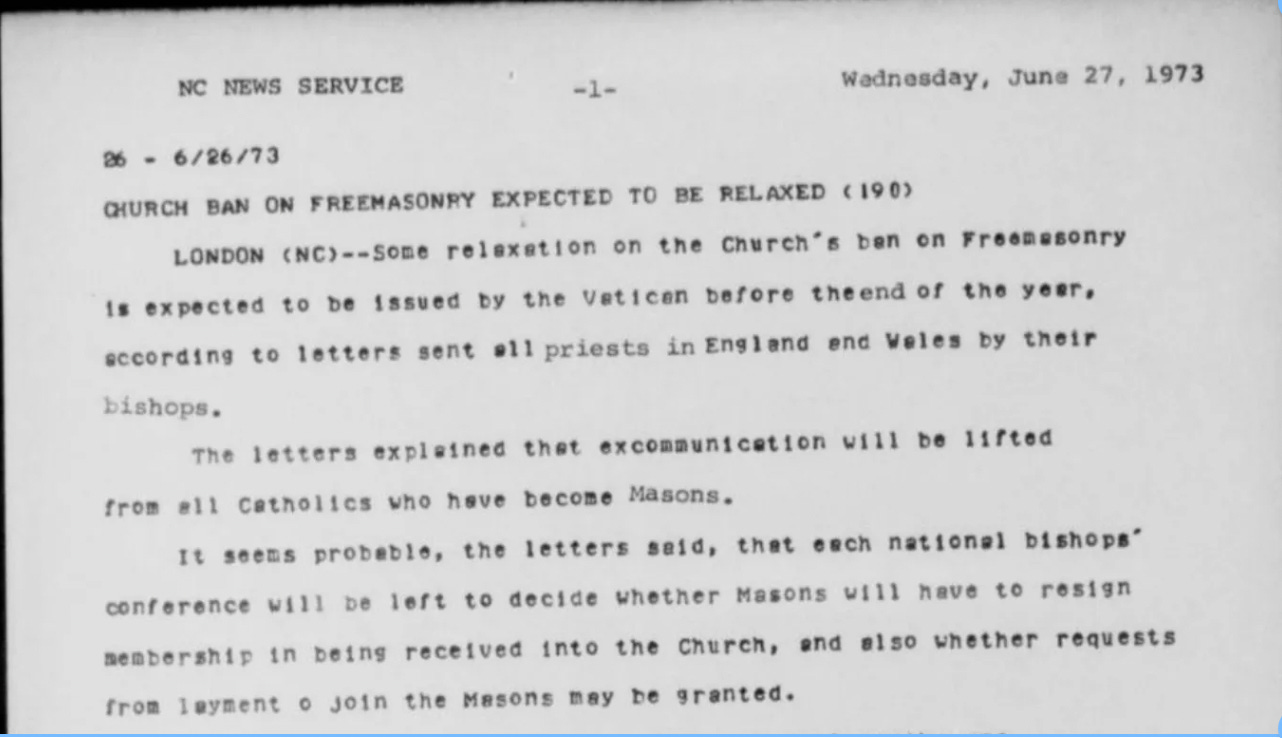
Two years later, in June 1973, National Catholic News Service again reported that Church officials were expecting and planning for a change in Church teaching. 

The article, headlined “Church ban on Freemasonry expected to be relaxed,” revealed that the Catholic Bishops of England and Wales had sent letters to all priests in their country, informing them that some “relaxation” in the ban on Freemasonry was expected soon. 

According to the letter from the English hierarchy, “it seems probable that each national bishops’ conference will be left to decide whether Masons will have to resign membership in being received into the Church, and also whether requests from laymen [to] join the Masons may be granted.”

The National Catholic News Service (by the US Bishops Conference), June 27, 1973, wire copy page 1. Scan via Catholic News Archive, public domain.

This news was widely printed in official diocesan newspapers throughout the country and continued to be discussed in newspapers and clerical journals between the summer of 1973 and spring 1974.

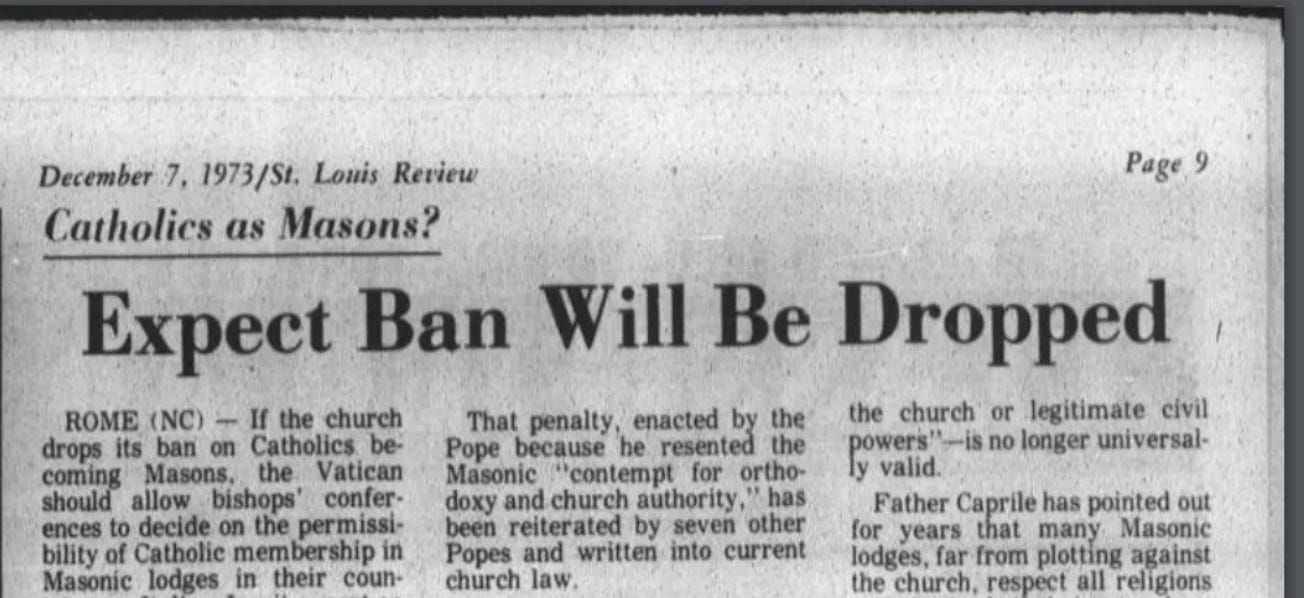
The growing consensus — as promoted by the U.S. bishops’ news service — was that the old prohibition would soon be changed.

The St. Louis Review (newspaper of the Archdiocese of St. Louis), December 7, 1973, page 9. Scan via Catholic News Archive, public domain.

Continue reading this article at Pillar Catholic:

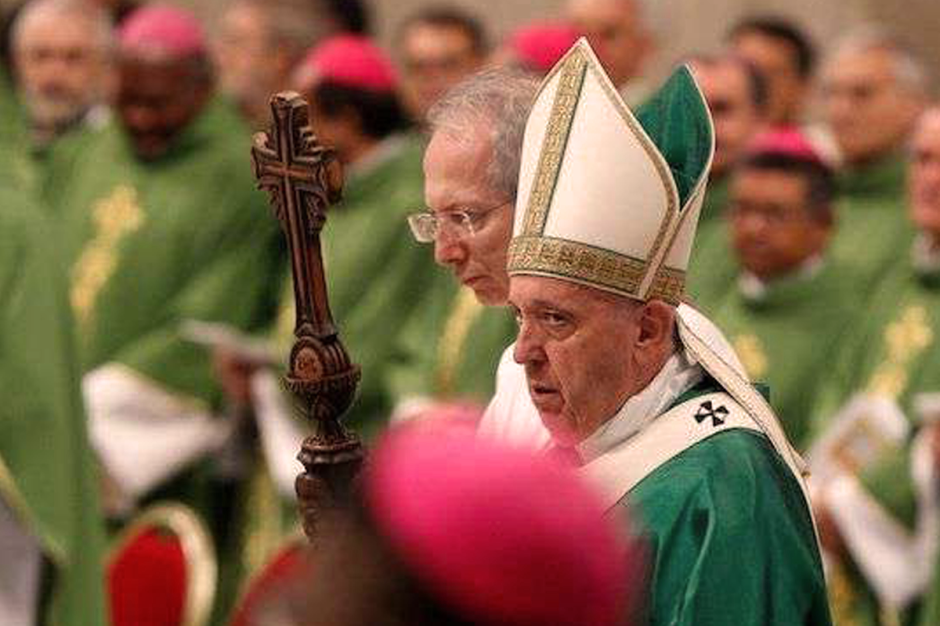
Note regarding the main image: it was found at this site and is obviously taken more recently than the 1970″s!!

Setting the Scene for Masonic Infiltration

this article, by david l gray, is republished from one peter 5. While i don’t agree with the author’s conclusion (as reflected in my title), it does contain some relevant information for followers of ecclesiastical freemasonry.

There was such a dramatic change in the social and theological dispositions towards Freemasonry amongst many European, Argentinian, and North American Catholics immediately following the conclusion of the Second Vatican Council in 1965, that, at minimum, should have provoked a reasonable and rational concern amongst the faithful.

Some have argued that this divergence from the traditional teaching about Freemasonry was just the fruit of an infiltration of Freemasons that began with the Carbonari’s 1859 Alta Vendita plot. However, this analysis is too simplistic.

The Carbonari was an Italian political sect, whose membership was not exclusively composed of Freemasons. It was not a Masonic sect (i.e., beholden as an affiliate or appendant to the Grand Lodge). The fact the Catholic Church has never treated the Carbonari as a Masonic sect, but as a distinct secret society that plots against the Church, is affirmed by Pope Pius VII in his 1821 Ecclesiam a Jesu, and by Pope Leo XIII in his 1826 Quo Gaviora.

This is not the say that there have not been initiated Freemasons throughout the clergy, for that has certainly been true in the past and in the present. Rather, it is to say we can do better in analyzing and verifying those movements inside the Catholic Church which made it more friendly with Freemasons and more sympathetic toward some sects of Freemasonry. This first article will discuss some of the Masonic influences before Vatican II, stretching back some three hundred years. In the next article we will treat more specifically the claim of some to place the blame of infiltration solely on the plot of the Alta Vendita.

Vatican II Red Flags

Truly, smoke signals should have gone up in 1967 when the Scandinavian Bishop’s Conference (consisting of the countries of Sweden, Norway, Finland, Denmark, and Iceland), following a four-year study into Freemasonry in their dioceses, decided to permit Catholics in their dioceses to retain their Masonic membership, “but only with the specific permission of that person’s bishop.”[1] This deference to the local ordinary on a matter, heretofore, considered to be immutable, was the Scandinavian’s Bishops interpretation of Paul VI’s Apostolic Letter Moto Proprio, De Episcoporum Muneribus, which, itself is an interpretative reading of para. 27 of Lumen Gentium, gave bishops more authority to be the final arbiters of Canon Law.

Truly, alarm bells should have gone off on March 16, 1968, The Tablet (a progressive Catholic international weekly review published in London) reported in their ‘The Church in the World’ news and noted section:

Go-ahead for Catholic Masons: Vatican sources have recently been quoted as saying that Catholics are now free to join the Masons in the United States, Britain and most other countries of the world. However, the European Grand Orient Lodge of Masons, established primarily in Italy and France, is still considered anti-Catholic or, at least, atheistic.

Later that year, The Tablet would also take an Editorial stance in opposition to Pope Paul VI’s encyclical Humanae vitae.

Truly, visible panic should have ensued on July 19, 1974, when Cardinal Franjo Seper, Prefect of the Sacred Congregation for the Doctrine of the Faith, wrote a letter, which was supposedly intended to be private correspondence, to Cardinal John Krol, the Archbishop of Philadelphia at the time, supporting the Scandinavian interpretation of De Episcoporum Muneribus concerning Canon Law No. 2335 (prohibiting membership into societies that plot against the Catholic Church), stating,

Many Bishops have asked this Sacred Congregation about the extent and interpretation of Canon 2335 of the Code of Canon Law which prohibits Catholics, under pain of excommunication, to join masonic associations, or similar associations… Taking particular cases into consideration, it is essential to remember that the penal law has to be interpreted in a restrictive sense. For this reason, one can certainly point out, and follow, the opinion of those writers who maintain that Canon 2335 affects only those Catholics who are members of associations which indeed conspire against the Church.

It was almost hilarious that men who were plotting against the Catholic Church themselves were then putting themselves in a position to tell us which sects of Freemasons were not plotting against the Catholic Church. But this was something that went back centuries.

Pre-Vatican II Efforts to Normalize Freemasonry

This scheme to differentiate the Anglo-sects of Freemasonry (those whose charters and warrants originate from the Mother Grand Lodges of England, Ireland, and Scotland) from the Continental-sects of Freemasonry (those whose constitutions and rites are based upon the Grand Orient Lodges of France and Italy) began in 1738, when on the eve of Pope Clement XII issuance of his Apostolic Constitution In Eminenti apostolatus specula (The High Watch) on April 28, 1738. This Pontiff in fact had to endure the efforts of his nephew, Neri Maria Cardinal Corsini, who attempted to prevail upon him that Freemasonry in England was merely an “innocent mirth.”[2]

Indeed, perhaps Cardinal Neri revealed himself as a Freemason with his choice of those descriptive words, which is, curiously, are the exact instruction given to Freemasons in Article VI of the 1723 Constitution of the Grand Lodge of England (so-called Anderson’s Constitution) concerning how Freemasons ought to behave amongst each other after the official meeting of the lodge has concluded and the brethren are not, yet, gone; “You may enjoy yourself with innocent Mirth . . .”

Pius IX clearly taught in this 1873 Etsi Multa that Church teaching does not distinguish between sects of Freemasonry; “Teach them that these decrees refer not only to Masonic groups in Europe, but also those in America and in other regions of the world.” Nevertheless, Father John E. Burke of the Catholic Board of Negro Mission, reported to the United States Bishops the fact that one of the barriers in place that was preventing more Black Americans from becoming Catholic was that too many of them belonged to forbidden secret societies like the Freemasons. Therefore, he argued, permission should be obtained from the Holy See to allow prospective Black American converts to retain their membership in such societies for the sake of the financial benefits. Burke’s errant finding was that Black secret societies did not present the same threat to Catholics that the White societies did.[3]

The idea of their being a socially acceptable and theologically compatible version of Freemasonry is a myth. All sects of Freemasonry have always been prohibited because they all hold fast to the dogma of indifferentism and the belief that Freemasonry is man’s highest good (see my prior analysis here and here). Yet, to this day, this insane myth, first uttered by Cardinal Neri to Pope Clement XII, continues to be spread throughout the Catholic Church and made amazing strides in the neo-heterodox-praxis of the Catholic faith thanks to the liberal interpretation of para. 27 of Lumen Gentium that birthed De Episcoporum Muneribus in the wake of Vatican II.

Continue reading at One Peter 5
Did God will a diversity of ministries?

The 72nd National Liturgical Week is currently underway in Italy with the theme “Ministries at the Service of a Synodal Church.”

As you can see, the switch from the “Catholic Church” to the “Synodal Church” is almost complete now, with “synodality” being tossed freely about at every Catholic committee meeting, conference and talkfest.

“Synodality” and its converse – the death of Tradition – is almost a fait accompli. Of course, being of Divine origin, Tradition can never really die, but it certainly can languish in a dungeon while the ape of the Church ploughs on with its programme.

Cardinal Parolin is there at the conference, drawing attention to the great transformation currently underway. He reminds us that these nouveau ministries hold “particular significance for the Church in the present historical moment.” Well, of course they do. These Synodal Ministries will ensure the extermination of the Latin Mass by making the new generation of lukewarm Catholics complicit in the destruction.

Speaking on behalf of the Pope, Cardinal Parolin quoted the pontiff and his desire that the legion of Made-Up Ministers become “experts in the art of encounter,” something with disconcerting undertones in these days of gay-cruising priests, semi-naked liturgical dancers, and episcopal beach houses.

But he probably just means that the Apostles of the Church of Nice will be trained (at the pew-sitter’s expense) to speak nicely about nice topics, referencing the nicest parts of Scripture and generally promulgating the virtue of niceness.

Except when dealing with Trads. Because they don’t count.

Thankfully, the Pope can rest his novel schemes on the solid basis of a predecessor. Who says Francis only relies on his own ideas? What balderdash.

Francis has reached back through the mists of time to draw on the perennial wisdom of the magisterium as it has existed for ……. the last fifty years …… to remind us of the reforms of Paul VI and to dreamily cast his vision for “the renewal of the Church in an increasingly “communal” and less clerical direction.”

What a relief for those billions of victims of heterodox teaching clericalism. After all, clericalism really is the main problem facing the Church today.

Parolin, ever the dutiful son of the Church, reminds the more skeptical among us that the universal priesthood must not be confused with the ministerial priesthood.

Whew. Thanks for that, Your Excellency. I’m sure placing those two terms in the same sentence and in the context of expansion of ministries for the laity definitely won’t produce confusion.

We are all priests now.

Francis serves up another heresy sandwich with Desiderio Desideravi.

The documents of Vatican II are often likened to a cake to which a teaspoon of poison has been added, rendering the whole thing unfit to eat. Our present Pope has taken that to a new level with his regular offerings of heresy sandwich: two wholesome slices of brown bread (sound doctrine) with a thick layer of heresy sandwiched between them.

His Apostolic letter, Desiderio Desideravi, is a prime example of this. With its calls for more reverent celebration of the Mass, and for congregants to be better educated about the nature of the Mass, most of its content is as solid as the homemade loaves baked by grandma on her woodstove.

Then we hear from Giovanni Zaccaria, professor at the Pontifical University of Santa Croce who really knows how to draw attention to that soul-snatching poison found lurking in the sandwich. (“Wait!” I hear you say. “The Pope didn’t say this.” To which my response is: this is how he operates; this is “his style”, as he is so fond of saying. Bergoglio’s “style” is to get a mouthpiece to explain what is really going on in his mind.) Back to Zaccaria:

“The first need is to understand the priestly dimension of the baptized. That all the baptized are priests, they participate in the priesthood, through the common priesthood of the faithful, they participate in the priesthood of Christ. Therefore, in that celebration, they are also protagonists”.

Well, not really.

In the Mass, there is ONE priest, a ordained man who gave up the promise of comfort and family life for the sake of Jesus Christ. But even HE is not the “protagonist” of the Mass: the protagonist in the Mass is Jesus Christ, the Second Person of the Trinity, offering His Sacrifice of Himself to the First Person of the Trinity, God the Father, through the action of the Third Person, the Holy Ghost. A priest simply acts in persona Christi.

There is no human protagonist in the Mass.

Of course, the Modernists always make a fuss of this ‘Royal Priesthood” thing, and of course, they have Scripture to back them. up. 1 Peter 2:9 is a favourite reference; a look at the second part of that verse gives a clue as to why this verse is so beloved of the modern Church: “But you are a chosen generation, a kingly priesthood, a holy nation, a purchased people: that you may declare his virtues, who hath called you out of darkness into his marvellous light.

It’s a handy little verse that can easily be co-opted by lodge-attending Modernists. They just LOVE Masonic-sounding Bible references.

Now, some might think that Fr Zaccaria is applying St Peter’s exhortation to the faithful in order to make them more appreciative of their baptismal graces and ultimately more attentive at Mass. However, reading more of his comments makes it quite clear, that this man’s intention – if not that of the original document – is to encourage the “clericalisation of the laity and the laicisation of clerics.”

The laity don’t kneel in Mass because they are a lesser form of priest, the laity (and priest) kneel as a sign of humility before the awe-inspiring sacrifice of Jesus Christ, before the grandeur of the Trinity, before the miracle of Transubstantiation.

We kneel because we deserve hell but also have a chance of avoiding it.

We kneel out of love and reverence – not because we want to be – or are, in some mysterious way – priests.

By the way, this final phrase could be taken to suggest that traditionalists, who are known for doing a lot of kneeling during a Latin Mass, simply do so because that it their personal preference – their “party.”

“When you kneel it is also a sign of the priestly dimension of everything you are doing. The gestures already exist, but they need to be understood, explained better, because if not, they become our party and the Mass is not our party”.

So what at first seems like grandma’s good and wholesome bread may in fact leave the recipient with a rather nasty taste in his mouth – if not a case of indigestion.

If only the reality was as insignificant as the analogy, since a heresy sandwich is something that harms not the body, but the soul.