I didn’t watch the interview – why would any faithful Catholic want to put themself through that? Reading the summary article was bad enough.
For those who aren’t aware, sodomite priest James Martin interviewed sodomite Democrat politician, Pete Buttigieg, for a new podcast series at the sodomite outlet, America Magazine. If the premise itself wasn’t bad enough, Martin took the opportunity to blaspheme in previously unheard of ways.
Well, occultists and sodomites blaspheme like this all the time. The difference is that pious ears normally aren’t aware of it.
According to the interview, Buttigieg is the son of an ex-Jesuit priest, so he didn’t receive the greatest start in life. Buttigieg, the former Secretary of Transportation, likes to think of himself as a “committed Christian”, and Martin does nothing to convince him otherwise. Rather, Martin confirms Buttigieg in his gravely sinful lifestyle: an active sodomite who lives with his gay “husband”. The men have adopted two little boys, deliberately depriving them of their mothers – those irreplaceable women who are most essential for the well-being of any child.
For Buttigieg, being a sodomite Christian is not incidental; it is his very identity. He says, “For There are two things I’m really sure about. One is that God loves me. And another is that I’m gay…. “
Then comes the blasphemy – and this really is a new low for Martin. He writes that when Buttigieg saw his little son hurt himself, he was struck by the love of God the Father for His Son. Buttigieg said:
“It just took over my entire psyche…. The central story of the New Testament involves the grisly execution of the son of God.… It just makes it so much more searing and visceral now that I’ve got kids.”
Well, for one thing, those aren’t your kids, but whatever, Buttigieg. According to Martin, this realisation “invited him to meditate more deeply on something Trinitarian: the Father’s love for the Son.”
Not only is he unable to count (only two Persons were mentioned, and not the three that constitute the Blessed Trinity) but the perverted mind of James Martin. SJ correlates the mystery of the Holy Trinity with the one sin that not even demons dare to witness! This is obscene blasphemy, friends.
Here is what Our Lord told St. Catherine of Siena about the sin of sodomy:
It is not only that this sin stinks before Me, Who am the Supreme and Eternal Truth, it does indeed displease Me so much and I hold it in such abomination that for it alone I buried five cities by a Divine judgment, My Divine justice being no longer able to endure it.
This sin not only displeases Me as I have said, but also the devils whom these wretches have made their masters. Not that the evil displeases them because they like anything good, but because their nature was originally angelic, and their angelic nature causes them to loathe the sight of the actual commission of this enormous sin.
They truly enough hurl the arrow poisoned with the venom of concupiscence, but when their victim proceeds to the actual commission of the sin, they depart for the reason and in the manner that I have said.
Our Lord was particularly upset by priests who engaged in this grave perversion:
But they act in a contrary way, for they come full of impurity to this mystery, and not only of that impurity to which, through the fragility of your weak nature, you are all naturally inclined (although reason when free-will permits, can quiet the rebellion of nature), but these wretches not only do not bridle this fragility, but do worse, committing that accursed sin against nature, and as blind and fools with the light of their intellect darkened, they do not know the stench and misery in which they are.
So according to Our Lord, pro-gay priests like James Martin are “full of impurity”, “wretches” and “stench and misery.” Notoriously, Martin was appointed to the Vatican’s Dicastery for Communication in 2017 by Papa Bergoglio and at the time of writing, (June 27, 2025) his name still appears on the Dicastery’s official webpage as a Consulter.
Will Pope Leo XIV remove this dreadful man from his official position? Will Martin be chastised for his blasphemies? This seems very unlikely as Leo and James Martin appear to be on the same page. Recall that Martin was absolutely jubilant at the election of Leo XIV and that this was the first red flag indicating that Prevost would continue Bergoglio’s agenda.
Please make reparations for these blasphemies; the Golden Arrow prayer is ideal for this purpose:
May the most holy, most sacred, most adorable, most incomprehensible and unutterable Name of God be always praised, blessed, loved, adored, and glorified in heaven, on earth, and in the hells, by all the creatures of God and by the Sacred Heart of our Lord Jesus Christ in the Most Holy Sacrament of the Altar. Amen.
Beware of false prophets, who come to you in the clothing of sheep, but inwardly they are ravening wolves – Matthew 7:15.
Some may think that the election of yet another unworthy Cardinal to the Papacy causes perverse delight for writers who routinely expose wrongdoing in the Church. Nothing could be further from the truth! It is actually a source of pain to be counted among the minority who disregards popular opinion in order to defend the rights of God.
It was Christ Himself who warned us to be on the watch for dangerous men who like to appear as one thing, while having intentions that are altogether different. Our Lord even specifically warned that such men will dress the part in order to lead His unsuspecting sheep astray.
This profile of a ravenous wolf perfectly fits the latest Pontiff, Leo XIV, who has chosen to adopt the outward persona of a traditionalist, all the way from his heavily embroidered pallium down to his relic-embedded pectoral cross.
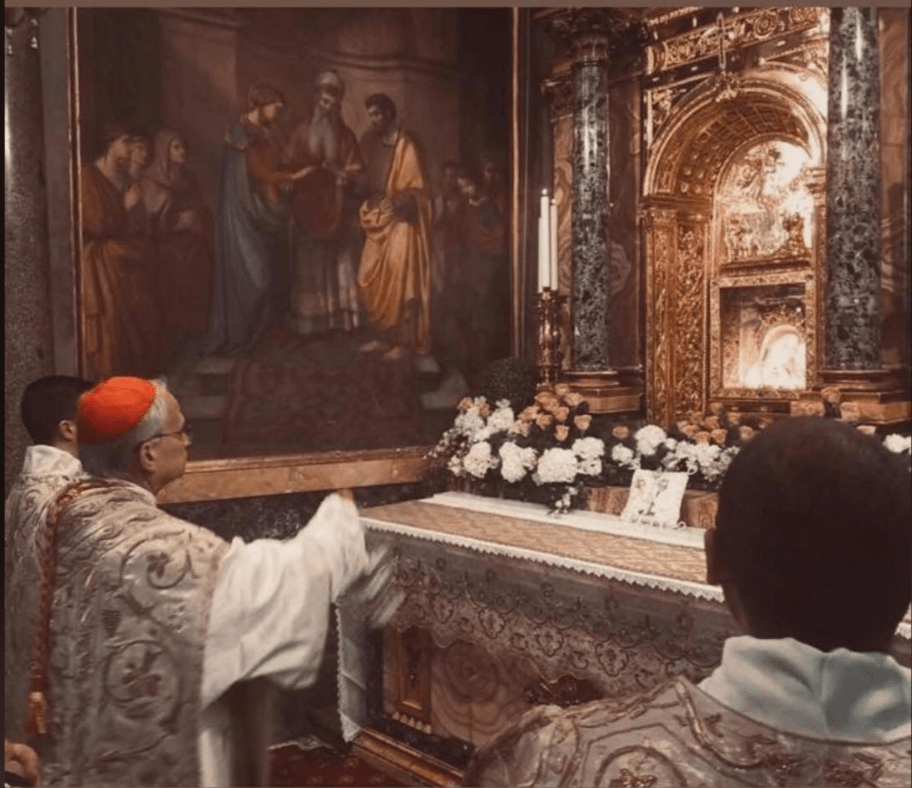
He is gaining favour with Trads, as stories of him offering private Latin Masses are doing the rounds of social media. Those posts are often accompanied by a photograph, shown below, of then-Cardinal Prevost wearing traditional vestments. However, the liturgical event was not a traditional Mass; rather Prevost was simply incensing an image of Our Lady, possibly the miraculous icon at Gennazzo. [We know it wasn’t a Mass because the altar is covered, and there are no altar cards, vessels or missal.]
Prevost NOT offering a TLM.
So what is underneath the lovely vestments and fluent Latin that should have us so concerned? It is that Prevost is a Modernist, through and through, and that he a stated goal of picking up where Francis left off, steering the Barque of Peter firmly along a course of Synodality.
The Catholic Esquire has done a great job of explaining succinctly the programme of this papacy and how it is in perfect continuity with that of Francis – and of the entire Revolution. [His short (17min) video can be found here.]
In short, Synodality is the name of the game: decentralising the Church in an attempt to obliterate the foundation of Her unchanging doctrinal authority. Now, obviously, this plan can never ultimately succeed, as Christ is that foundation, but the Synodalists have and will continue to inflict great damage on the Church in their attempt.
We should expect to see national bishops’ conferences implementing their own local brand of Catholicism whilst tolerating all manner of error. We can also expect some tinkering with the Novus Ordo liturgy, as Synodalists move along in their efforts to further delegitimise, and one day completely invalidate that form.
The persecution of Traditional Catholics could perhaps appear to soften, but in no way should a return to the widespread traditional practice of the Faith be expected. Should Traditiones Custodes be revoked, then Traditional Catholics must not let down their guard. If a convincing wolf is in charge, then we must not stand near him saying “what big teeth you have!”
As explained in my last article, we also should not expect to see a cleansing of sodomites from the ranks of the hierarchy under this pontificate. The moral chaos and errors are very likely to increase, rather than diminish. And that means an increase of moral chaos in the wider society as well.
What about Ecclesiastical Freemasonry? Will Pope Leo denounce Masonry in the strongest terms, like his namesake, Leo XIII? That is most unlikely. The best that can be hoped for is the reiteration – on paper, at least – of the Church’s longstanding condemnation as was produced by Tucho Fernandez under Bergoglio in November 2023. That ostensible condemnation was more likely aimed at disempowering the Masonic Old Guard in the Curia, led by then-papabile Cardinal Parolin, than at actually dissuading Catholics from becoming Masons. Francis’ Masonic credentials certainly suggest that this was the case.
Speaking of Masons, an intriguing image was posted on a Masonic Instagram account a few days after the death of Bergoglio. There’s no way of knowing what it meant, but the timing was most interesting. It was accompanied by a snippet of Masonic poetry, without any additional commentary. Note the red cuff on the figure of the Pope, as well as the (Rosicrucian-inspired?) equilateral crosses on his vestments.
From a Masonic Instagram account, posted April 26th, 2025. Pope Francis died April 21st and Leo XIV was elected on May 8th.
As with the election of other Popes since the Council, Freemasons have expressed their congratulations to the newest Pontiff. This was the only example that was easily found, but it is early days yet.
Pope Leo XIV welcomed by the Freemasons of Tanzania
The surest confirmation of Pope Leo’s agenda will be his selection of a new Curia, which won’t happen until after his official installation on May 18th. Some more Masonic well-wishing around that time is to also be expected.
So is there reason for us to be disoriented? Or disillusioned …. depressed? Well, no. All of this has to play out before the time of Our Lady’s Triumph.
Since the majority of Catholics, including a series of Popes, has refused to honour the requests of Our Lady at Fatima and elsewhere, another destructive papacy is simply part of the package.
However, we are not powerless in the face of adversity. In fact, there is much we can do to mitigate the effects of another ‘worm-ridden’ papacy. The following Rules of Engagement with the revolutionary forces – both natural and supernatural – may be of assistance:
A renewed commitment to daily prayer, especially the Holy Rosary
A commitment to a small form of daily penance for Pope Leo XIV, that God will work much good through his pontificate (and even a conversion can’t be ruled out)
A commitment to limiting online criticism to the actions of the new pope, while being careful not to demean his office
Similarly, great care should be taken always to distinguish between the human element of the Church and Her Divine origin. {For example, as clearly stated by Pope Gregory XVI in Mirari Vos: “To use the words of the fathers of Trent, it is certain that the Church “was instructed by Jesus Christ and His Apostles and that all truth was daily taught it by the inspiration of the Holy Spirit.” Therefore, it is obviously absurd and injurious to propose a certain “restoration and regeneration” for her as though necessary for her safety and growth, as if she could be considered subject to defect or obscuration or other misfortune.“]
Asking heaven for the grace to remain on the Ark; to stay within His Church, no matter how bad things get.
PS. It is well-known that Hollywood and the celeb-world are in cahoots with the revolution everywhere – including within the Church.
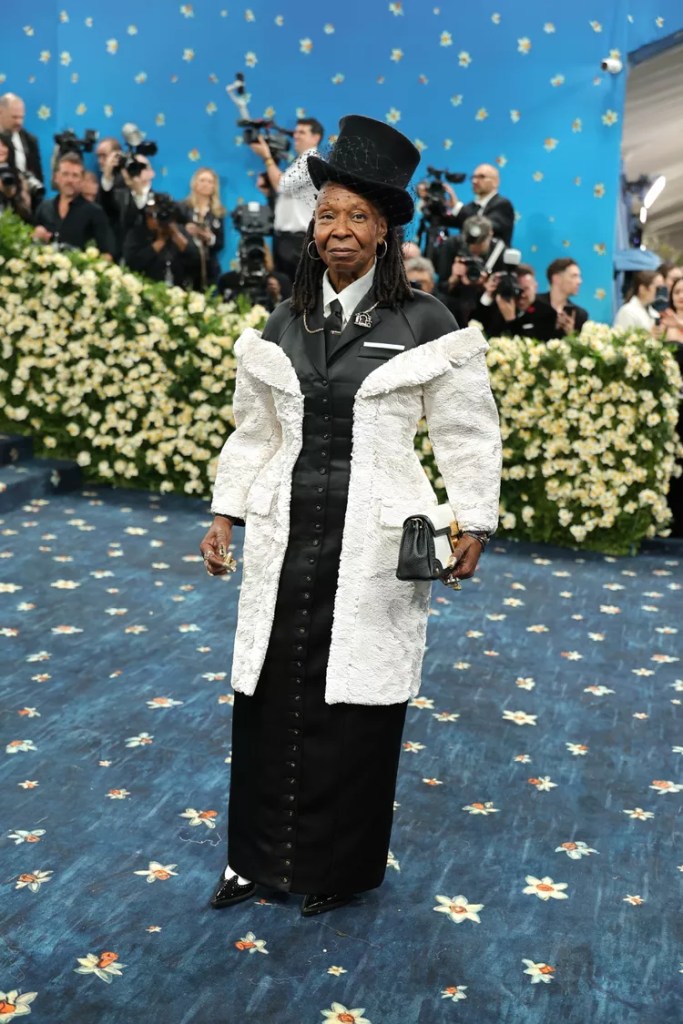
Does anyone else think this costume worn by Whoopi Goldberg at the recent Met Gala refers to an ecclesiastical wolf in sheep”s clothing? The furry-looking overcoat seems to peel away, revealing a sombre, even militaristic suit beneath. The bottom of the suit is even more surprising, as it is buttoned all the way down, just like a cassock.
To top it off, the brooch on her lapel is in the shape of a key-hole. Food for thought….
The following is taken from silere non possum. It has been translated into english using an online tool & edited slightly for clarity.
The Fraternity of Communion and Liberation for years, he has been experiencing a true and silent abuse by the Dicastery for the Laity, the Family and Life.
These are those offices of the Roman Curia which are led by Kevin Joseph Farrell, who lived in the same house as the abuser, Theodore Edgar McCarrick. Over the years, while McCarrick has been accused of performing the worst actions in his home, Farrel has been elevated to cardinal dignity and has been entrusted with crucial roles of the Roman Curia.
At the moment he is the cardinal who plays all the roles where the most reliable people are placed: Prefect of the Dicastery for the Laity, Family and Life, Camerlengo of the Holy Roman Church, President of the Commission of Confidential Matters, President of the Investment Committee and President of the Court of Cassation (Supreme Court) of the Vatican City State. It is good to remember that Kevin Joseph Farrell has never obtained any title in canon law or in economics.
Together with Farrell, as regards the Fraternity of Communion and Liberation, the ambitious Linda Ghisoni was in the front row, known in the sacred rooms for her desire for power.
Cardinal Kevin Farrell
To friends, todo, todo, todo
According to the motto of a great mentor of Francis, “Al amigo, todo; the Dicasteries of the Roman Curia and also the dioceses in the world govern the enemigo, for whom there is ni justicia ”.
As has been pointed out several times, law is being trampled on in the Church today and this is a serious problem. According to what is happening, it is now necessary to start questioning the States that recognize the judgments of the courts of the Holy See, of the diocesan courts and also of the Vatican City State. In fact, if a norm states something, the Pope always acts ‘notwithstanding’ that same text.
When the Apostolic Constitution Praedicate Evangelium was issued, everyone wondered how some rules would apply. Article 17, for example, provides: “§ 4. As a rule, after five years, clerical officers and members of Institutes of Consecrated Life and Societies of Apostolic Life who have served in curial institutions and offices return to pastoral care in their Diocese / Eparchy, or in Institutes or Societies of belonging. If the Superiors of the Roman Curia deem it appropriate, the service can be extended for another period of five years “.
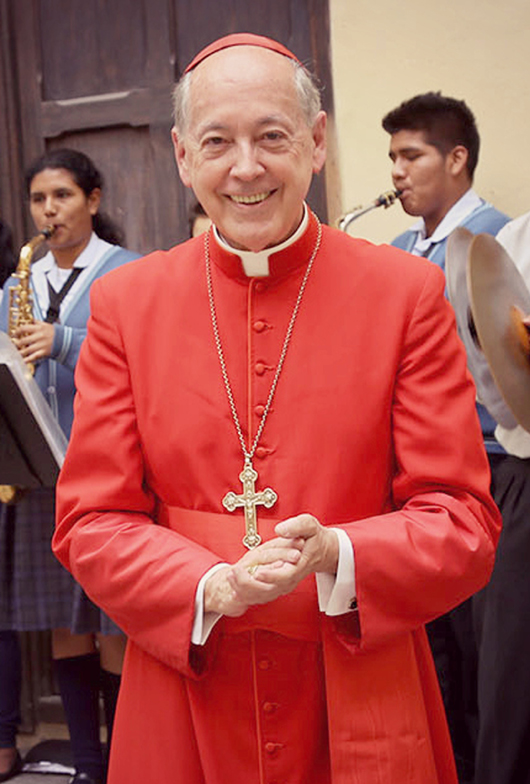
Cardinal Juan Luis Cipriani Thorne
In Santa Marta someone mumbled: “The extensions will be different and will always concern the most faithful”. It is the practice of this pontificate. Cardinal Cypriani is accused? He is guilty beyond reasonable doubt. The process? Never celebrated. The evidence? Never presented. The penalty? Already applied. (Cipriani admits he is under restrictions for abuse: see here.)
Oscar Zanchetta have you been sentenced with evidence and public trial?
“Yes, but he is the victim of a conspiracy,” the Pope said to his faithful collaborators. This is today’s modus operandi; the Argentine dictators to whom Francesco is inspired were fresh air in comparison.
Communion and Liberation
This system is also being repeated with regard to movements and associations, religious orders, societies of apostolic life, etc …These are real abuses of power by the ecclesiastical authority against the various realities. The fact that this happens in a historical moment such as the present one in which there are real attempts to eradicate the numerous abuses of conscience that are perpetrated against the weakest in the various communities around the world, is something very serious.
In the Church what happened in Caltanissetta is happening with the story, well known in Italy, which involved the judge Silvana Saguto. There, a system called “Mafia of Antimafia” was discovered, that is, the mafia was fought with an equally mafioso system. Another mafia, in essence. The same happens in the Church. Abuse is committed in the name of the fight against abuse. By abusing consciences and their power, it is claimed abuse of power is eliminated.
On June 3, 2021 the Dicastery signed a very important decree that it tries, not always successfully, to eliminate the ‘eternal mandates’ of the superiors of these ecclesial realities. In Article 1 it is written: “The mandates in the central government body at an international level can have a maximum duration of five years each “. Just as we will legislate about a year later on the Roman Curia.
In recent years, unfortunately, serious abuses of power have been committed in Communion and Liberation which have led most of the members of the Fraternity to close in a silence typical of those realities where abuse of conscience is committed. In his book “Crushing the Soul,” Father Dysmas De Lassus explains these dynamics perfectly. What has been repeated several times to Memores Domini, as regards their reality, and to the members of the Fraternity of Communion and Liberation, as regards their reality, was precisely to keep silent in obedience to the Pope.
Obedience to the Pope has become, since 2013, the balance on which to measure everything and everyone. Those who are victims of this system, however, unfortunately do not have the tools to understand that these are abuses of power, because those who act according to transparency and justice do not need to impose any silence because, even if information comes out, this should not worry them.
The Minister General of the Carthusian Order writes:
To this question is added another: what is the extension of the secret? If it extends to every person who comes from outside – family, friends, confessor etc. -, are you not setting up an isolation practice that has nothing to do with preserving inner life?If the discipline of secrecy is part of a pyramidal structure and a unique thought, a good part of the elements of a sectarian drift are put in place.
In fact, in a framework of this kind, members of the community who may have doubts no longer have the opportunity to compare them with someone else, neither inside, due to the pyramidal structure, nor outside, because of the secret.
Perhaps we are not trying to ward off any risk of dissent, what makes every totalitarian power?In practice, this type of drift translates into the interdiction to have external exchanges with people, in particular with the family or confessors, on everything related to community life and the personal life of the religious.
In the impossibility of explaining the real reasons for this prohibition, other more acceptable reasons are presented: the need to wash dirty clothes in the family or to keep family secrets, because “they would not understand us” or, also, the somewhat enigmatic word of Jesus: “Do not give holy things to dogs and do not throw your pearls in front of the pigs.” (Mt 7,6).
These precautions may have some good motivation, which makes it more difficult to discern the threshold beyond which a common sense recommendation becomes a gag. A little bit of discretion on the small defects of the brothers or sisters and on the small gossip of the community doesn’t hurt. But when it comes to a profound unease experienced by the religious or religious, preventing him from talking to external people means forcing him to close himself in his malaise and refuse him any chance of finding the light.
Prosperi reconfirmed
In spite of the decree mentioned above, Pope Francis on 1st February 2025 signed a letter prepared by Linda Ghisoni and Kevin Farrell. Although Article 3 provided that “All members pleno iure have an active, direct or indirect voice in the establishment of the bodies that elect the central government body at an international level”, the Pope is not interested in what he approved in 2021.
In the letter he writes: “I arrange that you, Professor Prosperi, remain at the helm of the Fraternity as President for a further five-year term, starting from the natural expiry of the mandate currently underway ».
But how, the mandates were not five years old? «This is, therefore, a very delicate and, of course, of great ferment in CL’s life for the achievement of that renewed and fundamental ecclesial maturity so much desired, which entails the full and faithful enhancement of his charism, remaining firmly anchored in the Church universal of Our Lord Jesus Christ » continues Francesco.
For years, therefore, the narration is the same: «CL members are idiots, they cannot elect and decide who should be at their helm, so we do it ».
This speech is the same that is re-proposed regarding those nations that elect candidates from the political party opposite to those related to the press and therefore the narrative is: “Brogli (electoral fraud) in the elections”. Francis acts in all respects in this way, according to those canons and practices which are typical of a certain political orientation.
In reality, this way of acting – however paternalistic and abusing – hides the flaws of a Dicastery that for years has tried in every way to manipulate the consciences of those belonging to this reality. Joseph Kevin Farrel and Linda Ghisoni have multiple times – we have audio recordings -slandered and defamed Fr Julián Carrón attributing to him actions or intentions that in reality have never even gone through his head. With this excuse, just as happened with Cardinal Cipriani and many others, the Spanish priest was ousted and sent out of government. Restrictions were even imposed on him for which Carrón himself went several times to the Pope to ask for explanations.
Recently Cardinal Fernandez reported that work is being done on legislating spiritual and conscientious abuse. Welcome but if the application of these rules is despotic and based on personal sentiment or political interests, perhaps it is not appropriate to add elements to those – very numerous – already present.
From vice to president
In 2021 Davide Prosperi had already been identified by the Dicastery as the right person to succeed Fr Julián Carrón. We must also reflect on these movements and ask ourselves what is happening.
The Holy Pontiff said: “You have to be at the top to be able to see and judge”. Far from feeling “top”, however, we try to climb the high summit in order to have an “overall vision” of what happens in the Catholic Church. It is emblematic that many of those realities that undergo, in fact, a commission, see the “vice” go to the helm of the community.
It happened in Community of Bose, which we talked about for a long time and highlighted the serious abuses committed by Pietro Parolin, Amedeo Cencini, Pietro Parolari and Anna Deodato,and it has happened in many other realities.
Also in Communion and Liberation. Prosperi, who had been appointed by Carrón as his deputy in 2011, was brought to the pedestal. In 2021 he wrote: “I have accepted the assignment that I hold as an act of obedience to the Holy Father and I wish to carry it out as a service to the life of our company and of each of you. As far as possible, I would like to listen to everyone and give space to the initiative of anyone who wants to collaborate. The witness task that God entrusts to us is great and, as Fr Julián reminded us in his last letter, at this particular moment everyone is called to take responsibility for the charism. I ask each of you to help me bring mine with an advance of trust and esteem ».
An internal source reported to Silere Non Possum:
They don’t actually listen to anyone. In the meetings it is often reiterated how one must “obey”, “answer the requests of the Holy See”.
Prosperi usually says: “The Pope wants”, “The Pope asked me”. This happens every time we also find ourselves in meetings with the leaders of the Dicastery. Everyone puts their ambitions in the Pope’s mouth and sells them as “the Pope’s will”. Francesco, however, is aware of it?
Do you know CL? Are you aware of what has been happening here for years? We are completely divided. They have created division and are aware that a reality like ours is difficult to “manipulate” because we almost all have a certain degree of education, important positions and we are also engaged in different areas of institutions. At the same time though, they manage to manipulate consciences with a few simple words “obedience to the Pope”.
We are all aware that in reality the Pope does not know much and the purpose of the Dicastery is to control a reality that has always been viewed with distrust. Prosperi is the right person to do it because, in the name of a candy that is currently the one of power, he is willing to sell the people who are part of it and also the movement, the charisma, the fraternity.
I was present on several occasions when the Gius [Don Luigi Giussani ed.] met Pope John Paul II. This was not what both wanted. We recently published a podcast in which it is possible to listen to Fr Giussani’s living voice speak of Jesus. Listen to him and you will understand why we followed him. We followed him because he spoke to us of Jesus in that way and made us fall in love with him.
During most of the twentieth century, the prohibition on Catholics being Freemasons was well known, as it was explicitly mentioned in the the 1917 Code of Canon Law. Canon 2335 conferred the penalty of excommunication on any Catholic who was the member of a sect which conspired against the Church or the State, including Freemasonry.
However, as time progressed, various clerics began to engage in an appeasement approach which caused confusion among the faithful – and indeed, among the clergy themselves. This came to a head in the 1970’s when Cardinal John Krol of Philadelphia requested clarification on the matter from the Congregation for the Doctrine of the Faith. The Prefect of the CDF at that time was Cardinal Franjo Seper, who wrote to Cardinal Krol assuring him that the penalty of automatic excommunication only applied to members of those organisations which actively plotted against the Church.
Coming as it did, with the apparent authority of the CDF, this statement was seen by many as a blanket lifting of the penalty for Masonic membership.
The Revised Code of Canon Law
Pope John Paul II established the Plenary Congregation of the Pontifical Commission for the Revision of the Code of Canon Law in 1981 to make the changes which were eventually promulgated two years later. The majority of the members of the Plenary Congregation were not in favour of renewing canon 2335, the Canon referring to Freemasonry, and so it was dropped from the 1983 Code.
Instead, a new canon was created, canon 1374, which omits any explicit mention of Freemasonry. Canon 1374 reads: “One who joins an association which plots against the Church is to be punished with a just penalty; one who promotes or moderates such an association, however, is to be punished with an interdict 1.”
Those in favour of the Change
The arguments in favour of not renewing the Code included the belief that in most countries, Freemasonry no longer posed a threat to the Church; that if a threat did in fact exist, many Masons were unaware of a anti-Catholic agenda within their sect; and that Communism posed more of a threat than Freemasonry. There was also a desire to conform to guidelines set down by Paul VI which sought to reduce the number of latae sententiae penalties in the Code.
Included among those who held this position were Esteban Gomez, OP, an instructor at the Angelicum in Rome; Cardinal Rosalio José Castillo Lara, SDB, Secretary of the Pontifical Commission for the Revision of the Code of Canon Law; Bishop José Vicente Andueza Henriquez of Venezuela; Bishop Roman Arrieta Villalobos, President of the Bishops’ Conference of Costa Rica; and Cardinal Franz König, Archbishop of Vienna.
The inclusion of Cardinal König’s name is somewhat unsurprising as he was well-known to the Italian Freemasons who even claimed to have given him money on several occasions:
First, he started a confidential dialogue with the most important Masons. Once it was accepted, he waited for the right moment to propose a different image of Masonry to Catholics. His influence in the Code was decisive. Koenig is well aware of what the Institution is. He has a good understanding of Masonic “solidarity,” because every time he asked help from us, he received it, without having to explain the purpose for that money.
Italian Grand Master Armando Corona, from a 1990 interview
Those Against the Change
Those who were in favour of retaining Canon 2335 included the German Bishops’ Conference, who had been engaged in extensive dialogue with Freemasons, yet concluded that in its essence, Freemasonry remained hostile to the Church. Cardinal Siri was also against any change, saying that nothing in Freemasonry had changed. Cardinal Ratzinger, then Prefect of the CDF, declared that Freemasonry posed an ‘extraordinary danger’ and that if it was thought in some countries to have changed, then that only indicated that its danger was not understood by the bishops there.
Further, Cardinal Pietro Palazzini, Prefect of the Congregation for the Causes of the Saints, stated that retaining the penalty of excommunication for Freemasons did not violate Paul VI’s guidelines. He said that:
….. their “creed” is “apostasy, at least implicitly”; that is, it eliminates truth and revealed religion while welcoming Catholics as “useful idiots”. In pastoral practice there is a need to avoid equivocating and to clearly show the sure way to salvation. Freemasonry is more dangerous than Communism, because while Communism is the explicit enemy of the Church, Freemasonry is more subtle.
Fr. Paolo M. Siano, referring to Cardinal Palazzini’s statement.
Ratzinger Fights Back
Cardinal Ratzinger, obviously unhappy with the outcome, released his “Declaration on Catholic Membership in Masonic Associations” in 1983. Ratzinger explains that the omission of specific mention of Freemasonry in the 1983 Code was due to “editorial criteria” and goes on to reiterate the Church’s long-held view:
Therefore the Church’s negative judgment in regard to Masonic association remains unchanged since their principles have always been considered irreconcilable with the doctrine of the Church and therefore membership in them remains forbidden. The faithful who enrol in Masonic associations are in a state of grave sin and may not receive Holy Communion.
The Subsequent “Commentary”
A Commentary on the Code of Canon Law was released in 1985 then republished in 2001. Both editions were edited by Monsignor Pio Vito Pinto, whose name curiously appeared on the famous Pecorilli’s List of Ecclesiastical Freemasons. Msgr Pinto went on to become Dean of the Roman Rota and is known to have expressed great outrage at the Dubia of the Four Cardinals against the heretical actions of Pope Francis.
Notably absent from the Commentary is any mention of the long-standing prohibition on Catholics being members of Freemasonry. Rather the Commentary mentions only Canon 1374, the Canon requiring a “just punishment” for members of any association which conspires against the Church. According to the Commentary, “it is not easy to apply canon 1374 unless the competent universal and local ecclesiastical authority clearly indicate which organizations fall under the authority of that canon…”
One can only wonder at the blindness of those clerics who failed to see that Freemasonry never lost its anti-Catholic agenda.
A prohibition which excludes the faithful from certain activities such as participating in the Mass and Sacraments or from having a Christian burial. ↩︎
This article comes from Stilum Curiae and was written by Professor Bernardino Montejano of Buenos Aires. It has been translated using an online translation tool.
CHURCH IN EXIT OR IN LIQUIDATION?
Pope Francis speaks with joy of the outgoing Church “; For me, in European countries such as Germany, Belgium, Luxembourg, we are faced with a Church ” in liquidation “. And for all the naive and the gullible there are some figures, because if mathematics has a virtue, it is precision.
Today, in the land of Luther, the great heretic, honored today in the Vatican, 27% of Germans trust the Protestant Church, while only ’ 11% trust the Catholic Church, but it is worth noting that in 2017 the percentage of those who trusted the former was 48%, that is, in a few years the drop is 21%. As for Catholics, the percentage of those who trusted was 29% in 2017, in other words, the decrease is 18% in difficult auctions for those who lose more.
It should be added that the Catholic Church has 900 thousand employees and that in recent years it has changed its working standards to accommodate LGBT employees, that is, homosexuals and lesbians. transsexuals and other herbs of the same suit
At the same time, in 2016, 60% of Germans trusted and believed in Pope Francis; Today, after eight years of government, the percentage is 16%.
A catastrophic decline in the path of synodality, along which many travel together, perhaps without realizing that it leads them to the abyss.
But the Church is universal and resists self-demolition, invaded as Paul VI expressed by the smoke of Satan and resists and not only in Africa and Asia, but in Europe, America, Oceania.
It resists vigorously in countries that have suffered under Soviet communism, in Poland, Ukraine, Hungary, Slovakia, for example.
He resists in Holland with the great figure of Cardinal Eijk, in France where abbeys, monasteries and traditional convents and massive pilgrimages multiply, he resists less in Italy and Spain, but shows that the Vatican’s efforts to end the extraordinary rite of the Roman liturgy, they are useless and counterproductive, because they increase their diffusion.
It resists in the United States, because the Vatican’s efforts to break the unity of its excellent episcopate, with scandalous appointments such as that of the archbishop of Chicago, Cardinal Cupich, his prayers at the democratic conference and his ridiculous requests to his parishioners to refrain from communion kneeling so as not to prevent the fluidity of the transit of those who communicate, he recently forced us to remind him of the importance of worship, as an external act of religion, the first of the moral virtues and the teaching of St. Thomas Aquinas on kneeling, because the good disposition of the body helps the elevation of the soul.
He resists in Oceania, Australia, through the living example of Cardinal Pell and his virile and heroic behavior during his captivity, which recalls the great Vietnamese Francisco Javier Nguyen van Thuan.
It resists in Africa, where entire episcopates have repudiated the blessing of homosexual couples and where priestly and religious ordinations multiply and seminaries overflow with postulants.
It resists in Asia, despite the notorious handover of the Church to China by the Vatican to the Communist Party.
In this regard, we are reading a very interesting book by Fr. Enrique Rau, “Racism and National Socialist Christianity ” (Gladium, Buenos Aires, 1939), who received the Nihil osbtat by father Julio Meinvielle. Soon we will analyze it with a methodology that will convince any honest Catholic: where Hitler appears, we will put the name of the tyrant of China and where racism appears we will put sinicization.
But there is a big difference between Pius XII and sometimes even the deputies of the Chinese Communist Party.
But despite the betrayal of Cardinal Parolin endorsed by Francis, the clandestine Church resists and its members face persecution, prison and imprisonment in re-educational fields, but refuse to replace the images of Christ and the Virgin Mary, with the portraits of the tyrant Xi- Jimping –
The Church of Hong Kong resists, led by its great ninety-year-old cardinal Zen, who had to endure the mistreatment of Francis, who made him wait three years to receive him. How many comrades will he have received at that time of the Base Unit installed in the Vatican? Countless. Their low political gossip interests him and he likes them.
On the other hand, the noble figure of the resistant cardinal annoys him.
The Church of Vietnam resists in Asia, supported by the blood of its martyrs and by the exemplary figures of Cardinal van Thuan and his uncle, the martyred President Diem, with his crowded seminaries and numerous priestly ordinations, tolerated by the communist regime.
I can’t talk about the Church of Brazil because I lack the data. But little resistance is noted in Argentina, with a servile and populous episcopate, politicized and led by rough prelates in Buenos Aires and La Plata, lovers of poverty and annexations. A Church in liquidation, with almost empty seminaries, which rent rooms to maintain themselves and few ordinations.
According to AICA, there were seven diaconal ordinations this year, 3 in Buenos Aires, 2 in Santiago Rosario and 2 in Mendoza, where the new president of the episcopate “Palomo ” Colombo recommended to “love all without exclusions ”, except the priest Christian von Wernich, sentenced to perpetual imprisonment, his bishop
At least I can attest to the priestly ordination because I attended the first mass of Santiago Ibarra on December 12 in the packed chapel of the Don Jaime school in Bella Vista.
The new priest was ordained on December 7 in San Rafael, Mendoza, by the diocesan bishop, Carlos María Domínguez and belongs to the Institute of the Incarnate Word. Curious case of this Institute, born in Argentina and here in its country of origin, it is present only in San Rafael, Major Seminary, Minor Seminary, Novitiate and in the parish of San Massimiliano Kolbe, in La Plata, parish of Santa Rosa de Lima , in the Mercedes. Monastery of Nuestra Señora de Luján and Añatuya, Santiago del Estero, parishes of Suncho Corral and Los Juríes.
The IVE, mistreated by the pontifical commissioners Santos and Abril, may be in Gaza, Ukraine, Syria, but cannot settle elsewhere in Argentina, perhaps for the fear of its bishops that it may breathe new life into a Church. in liquidation.
Until the mentality of the group of bureaucrats and burini who today manage our church in liquidation changes, there is no future for this.
But God can do the impossible. We ask him in these Christmas times for mercy for our Argentine Church.
It appears that it was during his time in Paris that Angelo Roncalli was earmarked by Progressives as a future pontiff. France was always important to the Synarchists and through his diplomatic work, Roncalli was able to implant the Synarchic principles of ecumenism and globalism.
GALLICA
Roncalli’s time in Paris could be said to have consolidated his reputation with the Progressive faction. Like Montini, he was the perfect blend of Modernist ideology covered by a convincing traditionalist exterior. His pious attitude towards Our Lady and other traditional devotions meant that he was accepted fairly well by conservative Catholics, even though many of his actions appeared to them to lack consistency.These paradoxical actions were evidenced in several areas: in his attitude towards leftwing politicians and known Modernists as well as his promotion of globalism and ecumenism.
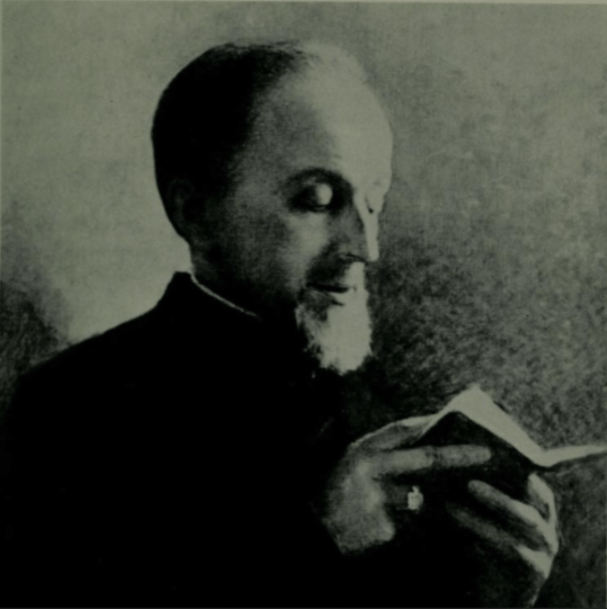
One of the first photographs of Msgr Roncalli in Paris (1945)
BACKGROUND
When Roncalli was thrust into diplomatic service in France, Europe was still in the throes of the Second World War. The Vatican had, to a certain degree, lost respect on the world stage due to its support for Fascism in Italy.
In France this attitude was magnified. When Marshall Petain moved his government to Vichy in 1940, the Holy See followed with its diplomatic corps. Petain pursued a policy of cooperation with Germany and Italy while Pope Pius XII and his French bishops encouraged Catholics to support the government during the German occupation. Thus both Petain and the Church were seen as Fascist collaborators which incensed the fiercely independent French. Their suspicion and resentment simmered during the years of occupation.
Petain had also been a friend to the Synarchists, employing many in his government. Later in 1945, when Marshall Pétain was prosecuted, he was interrogated about his knowledge of the Synarchist Pact.1
De Gaulle then came to power representing the New France, leading the Resistance with help from the Allies. Although the Resistance at that time was full of Communists and Socialists, De Gaulle was personally against Communism, but he enjoyed support Stalin’s support even while Petain was still in power. In fact, De Gaulle and Georges Bidault travelled to Moscow in December 1944 to sign an agreement with Stalin promising mutual support between France and the USSR.
In June 1944, only days after setting up the base of his provisional government at Bayeux in Normandy, De Gaulle met with Pope Pius XII, explaining his policy of zero-tolerance for collaborators. The Pope urged de Gaulle to come to an agreement with Marshall Petain but he was adamant: anyone who had supported the Vichy government was going to come within his crosshairs. This included Bishops such as the aristocratic Nuncio, Monsignor Valerio Valeri whom de Gaulle believed had abetted the Petain regime.
Msgr. Valeri, Apostolic Nuncio to France, 1936 – 1944
De Gaulle pressured Pope Pius to have Monsignor Valeri replaced, but at first, Pius stood his ground, since Valeri had done nothing to warrant such action. This situation continued until August 1944, when Paris was liberated from the Germans by the Allies with De Gaulle’s Free French Forces and Petain was suddenly grabbed from his rooms in Vichy and taken by Nazi soldiers to Germany.
The final straw for de Gaulle was learning that Valeri had been on the scene soon after Petain was taken away, and he began to put even more pressure on the Pope.2 De Gaulle then embarked on a great purge which particularly persecuted Catholics, leading to the persecution, including murders, of 100,000 people. The account from Frere Michel de la Sainte Trinite is chilling:
“The bishops, who themselves were threatened, were silent while the blood of Frenchmen and Catholics flowed profusely and the prisons filled with innocent people. There was no episcopal voice to denounce the scandalous injustices of the Christian Democrats in power, as there should have been. Rome, too, was silent.”3
Pius finally relented, appointing Roncalli to take the place of Monsignor Valeri – although Roncalli was his second choice. His first choice, Archbishop Fietta, had declined on the grounds of ill-health.4
Circumstances increased the pressure on Pius, as New Year’s Day was approaching and with it, the annual message of good will which would be given to de Gaulle by the head of the Diplomatic Corps. This was Valeri’s role and with tensions running so high, Pope Pius decided to send Roncalli to Paris to replace him, leaving many perplexed at his decision, including his sostituto Tardini.
Roncalli, on the eve of his departure to France (December 1944)
SYNARCHY
Petain’s Vichy government had expanded the influence of the Synarchists, but after his defeat their leverage was diluted to a certain extent. De Gaulle was highly suspicious of the Synarchists and once in power, launched a campaign to remove the remaining offenders from his government. Unfortunately, as we will later see, in his enthusiasm for rebuilding France, de Gaulle went on to unknowingly allow many Synarchists into positions of power.
For the Synarchists, a united Europe was the first step to a world government and they had marked France as being key to their plans. Although France retained a strong anti-clerical bent, its egalitarian spirit meant that independent leaders could spontaneously come forth from the grassroots and this continued to threaten the Synarchs’ long-term goal.
A great breakthrough for the Synarchic globalists came in 1948 with the founding of the United Nations. Roncalli loved to express his support for the globalist project during his New Year’s Day Addresses to the President. By this time, Vincent Auriol – a staunch atheist – was President, and Roncalli didn’t hold back his enthusiasm for the UN.
“During these last months Paris, the real crossroads of Europe and of the whole world, has had the honour of welcoming, with her customary exquisite hospitality, the great Assembly of the United Nations, convened to organise world peace….
Certainly it has not been possible to solve all our problems, and no one ever thought that complete success could be achieved. But the atmosphere of the debates has gradually become more serene. Several principles have been asserted, all worthy of respect because they correspond to the fundamental rights of men and citizens. One might indeed sum up the innumerable speeches made at the Assembly of the United Nations in the course of these three months in the words of St Paul’s advice: ‘Test everything; hold fast what is good’.5
In his December 1949 Address to President Auriol, Roncalli again alluded to the possibility of an earthly uptopia which revealed his own humanistic philosophy. He spoke of a return to a ‘Golden Age’ when ‘respect for man’s rights and justice for all’ are achieved, as they “alone are capable of restoring the moral order.”6
It must be noted that in Roncalli’s days, by contrast with the contemporary message from the ‘synodal’ Church, the Social Kingship of Christ was loudly proclaimed as being the exalted goal and the accepted solution to all the worlds’s ills. So while his ideas might have been commonplace for a politician of his time, they were not in keeping with the message of the Church. Roncalli stated:
Last summer, when the Council of Europe met for the first time at Strasbourg, all were moved by the noble and vigorous words of the President of the French National Assembly. He recalled the words of the northern philosopher: ‘Politics must bow to moral considerations’, and appealed most fervently to all to study the most pressing problems of international life and try to realise, as M. Herriot himself has said, ‘a good part of the highest ideal ever set before any delegation : peace on earth to men of good will’.7
Roncalli then made mention of the Holy Doors which were soon to be opened for the Holy Year, possibly making an allusion to the esoteric principle of, ‘as above, so below’, saying Through this door we go, to take the ‘road that goes up’, viam ascensionis, not to descend but to ascend. And this is what, on the spiritual plane, individuals and peoples are called to do: never to descend, always to rise.8
One of the most notable of the the French parliamentarians who furthered the goals of Synarchy during Roncalli’s tenure was Robert Schuman. Schuman is rumoured to have had associations with a Synarchist, professor of law Louis Le Fur, prior to World War II, and another associate of his, Jean Monnet, who is known as the ‘Father of Europe’, is also said to have been a Synarchist.9 Interestingly, Monnet had never approved of De Gaulle – possibly due to the latter’s independence and anti-Synarchist tendencies.
From the time he became PM, Schuman began to implement various plans that pushed Europe along the path to unity. One of these was the Council of Europe, signed in May, 1949, originally by 10 member nations, with the aim of ‘facilitating the economic and social progress” of its members.
The so-called Schumann Declaration of May, 1950, placed German and French coal and steel production under a single governing authority. Others nations later joined the alliance and this eventually led to the creation of the European Economic Community, and ultimately to the European Union. Jean Monnet worked closely with Schumann on the Declaration, keeping hidden the globalist agenda at its heart.
Schumann was favourably disposed towards Angelo Roncalli. He once said that, “He is the only person in Paris in whose company one feels the physical sensation of peace.”10 The sentiment was obviously mutual: in his Address to Auriol of December 1950, Roncalli referred to an event which “had seemed to promise better things and which had shown unmistakeable signs of the pacification and elevations of men’s minds.” According the footnotes accompanying Roncalli’s Mission to Paris, Loris Capovilla tells us this event was none other than the Schumann Declaration.11
It was during his time in Paris, that Roncalli appeared on the radar of the Office of Strategic Studies (OSS) a forerunner of the CIA.13 Files referring to Roncalli which were declassified in 1978 claim he sent information to the Vatican regarding de Gaulle’s commitment to ending the Franco regime in Spain.
While it may be hard to believe that the US government had an interest in Roncalli, one need only consider his track record in Turkey, where he made a habit of embroiling himself in high-level politics. Roncalli always had the appearance of one who was not aware of his own limitations and is also on record for passing on private comments from de Gaulle of a less political nature.
Possibly the most overt example of his support for the globalist project came in1951, when Roncalli was appointed Vatican observer to UNESCO.
Now I have noticed that among the seventy diplomatic missions, of which only thirty are Catholic, those who seem most responsive to the Apostolic Nuncio’s words, when he is inspired by this religious sense, are the Ambassadors in whose lands prevails a Buddhist, Confucian or Moslem tradition.
There are then certain elementary principles of a moral or religious character which constitute the original patrimony of all peoples, and upon which an understanding must be based, as the irreplaceable foundation of a common effort to succeed in the construction of the true social and world order of justice and peace.14
July 1951 as Vatican Observer at UNESCO
During his speech to UNESCO of July 1951, addressing the ‘elders’ of UNESCO, Roncalli spoke as a member of “the oldest and most widely extended cultural organisation in the world” referring to the “God of Knowledge” as the foundation of the Church.15
“UNESCO is a great burning furnace, the sparks from which will everywhere kindle … widespread cooperation in the interests of justice, liberty and peace for all the peoples of the earth, without distinction of race, language or religion…”16
Meanwhile, Pope Pius was playing right into the globalists; hands. He had identified the greatest threat to democracy as Communism and he became convinced that the only defence against its onslaught was a united Europe.
This was unfortunate for a number of reasons: firstly because the Synarchists also wanted a united Europe; secondly, it made him prey to many devious stratagems devised by others in the name of anti-Communism; thirdly, and most significantly, because Our Lady, through her messages at Fatima, had already provided the means of defeating Communism: the Consecration of Russia and the First Saturday devotion.
OCCULT
As with his time in Turkey, rumours abound of Roncalli’s occult involvement while he was in France. Accusations of this kind are not helped by the many occult references which peppered his speech. For example, when writing to the bishop of Bergamo following his rapid move to Paris, Roncalli said: “I seemed to be seized by surprise, like Habbakuk, and transported suddenly from Istanbul to Paris by a sort of incantation.…I was stupefied.”17
Nuncio Roncalli’s first public address to the faithful also contained an esoteric reference. During an address to the Institut Catholique at the church of St. Joseph des Carmes, he connected his last post in Turkey with his new position in France by saying:
These shining points, which stand for two worlds and two forms of civilisation, Constantinople and Paris, are spanned, as it were, by a brilliant rainbow, upon which glow the last words of the prayer of Jesus, who was about to leave his disciples and wished to comfort them: ‘That they may be one’.18
Here is may be recalled that the rainbow is a symbol beloved of occultists; it certainly has no Christian relevance in this speech. In any case, Roncalli took the opportunity to recall one of his favourite projects, ecumenism: Turkey was mainly Muslim and Orthodox with Catholics in the minority.
Roncalli’s Journal from this time reveals other comments which can be interpreted as occult references, or at least as heresy. One example of this is an entry from November of 1948, where there is a cryptic reference to what Roncalli called his ‘mystical death.’ (Journal, p. 270). Mystic death, far from being an accepted stage in a soul’s progress toward spiritual union with God, is part of the heresy of Quietism. The ‘mystic death’ was one of the 68 proposition of Quietism to have been condemned by the Church in 1687. The Spanish false mystic Michael de Molinos wrote that, “The inward way leads on to a state in which passion is extinguished, sin is no more, sense is deadened, and the soul, willing only what God wills, enjoys an imperturbable peace: this is the mystic death.”19
Reading Roncalli’s Journal, it becomes clear that he believed he experienced no passions and he wrote on many occasions of his constant state of peace. He even suggested in his Journal that he never once sinned seriously against purity in his entire life.
Then in April 1950, there is another use of the phrase, ‘Know thyself’20 which as explained previously, [in a previous chapter – Ed] was a favourite maxim of Aleister Crowley.
Roncalli’s December 1952 Address to President Auriol was his final one before leaving for Venice, and it must be said, it was rather unusual. In the Address, he told a story from The Fables of Jean Fontaine. This story contained the famous maxim, ‘all paths lead to Rome’ and to their mind, twas best that each a different path should find.’ This is rather startling from a man who six years hence would find himself in Rome as Supreme Pontiff.
This is followed by a reference to the ‘Know thyself’ mentioned previously, which Roncalli explains is “inscribed on the pediment of the temple of Delphi, which in the depth and universality of its wisdom far exceeds any merely individual application, may be widely understood and practised wherever responsibility is borne in the service of the common good, and wherever men’s minds are burdened with the most acute problem of the present hour : to save peace, to save peace at all costs.”
The fable continues:
To know himself is the first task decreed By the All-mighty for his servant man. Come, stir my rivulet — can you trace Your features? “Leave it,” the Hermit cried, “to settle down — And your image will appear again!” Thus in his wisdom spake the Anchorite; Nor was his counsel giv’n in vain.”21
Auriol responds in kind, “Discord hath ever ruled the Universe; And in this world of ours I could rehearse A thousand thralls of her uneasy sway.”22
The day after the Address in which he advised his heaers to ‘know thyself’, Roncalli wrote to Cardinal Achille Lienart of Lille. As well as sending his New Year’s greetings, Roncalli mentioned his speech of the previous day, and so had yet another opportunity to use the golden words, “Know Thyself.”
Yesterday on behalf of the Diplomatic Corps I was able to offer the same wishes to the President of the Republic. It is a difficult thing to speak in that noble and mixed assembly, but La Fontaine’s last Fable gave me the opportunity to recall the Know thyself of the old sages, which is valid for all times and all places.23
Of significance here is that Lienart was rumoured to have been a Freemason; what is certain is that he was one of the prelates accused by de Gaulle of being a collaborator.24
While the above comments may be no more than ambiguities, there are more serious accusations against Roncalli. According to Mary Martinez in her book, The Undermining of the Catholic Church, a Major René Rouchette, once a member of Presidential Garde Republicaine, told her in an interview that during the mid 1940’s, he and his confreres saw Roncalli leaving the Nunciature every Thursday evening to attend meetings at the Grand Orient of France lodge.25 Certainly, Fr. Malachi Martin had no doubt that Roncalli was a Mason; he is quoted in Eglise-Eclipsee as saying Roncalli was initiated into the Lodge by Vincent Auriol.26
Roncalli’s Freemasonic membership was even suggested by French Masons themselves when in 2019, they posted on their website congratulations to Matteo Zuppi on being elevated to the Cardinalate:
“As we renew our congratulations to the new Cardinal Presbyter of Sant’Egidio already expressedherewe declare ourselves particularly pleased that the non-Freemason Matteo Zuppi, very recently named a Cardinal, wanted to significantly mention a Saint of the Church such as Pope John XXIII (our Mason Brother Angelo Roncalli in the world) to seal his new pastoral mission…”27
The Archbishop’s pro-masonic bent went well beyond having in common certain elements of their vision such as ecumenism; he also concretely advanced their sinister cause within the Church. Roncalli appointed a 33rd degree Freemason named Baron Yves Marsaudon, as head of the French branch of the Knights of Malta. This was the very order which Pius XII had suppressed and placed under investigation as he was well aware that it had become an organ of Freemasonry within the Church.28
Archbishop Roncalli’s Secretary at the Nunciature, Mons. Bruno Heim, told the Vatican’s investigator into the matter that Freemasonry was “one of the last forces of social conservation in today’s world, and, therefore, a force of religious conservation,” and that “the nunciature of Paris was working in great secret to reconcile the Catholic Church with Freemasonry.”29
As Pope, Roncalli eventually suspended all investigations into the Knights of Malta (June 24, 1961) and restored free reign to the order.
Despite his tolerance for Freemasonry, Roncalli is said to have been pleased when his Parisian friend, Antonio Coën, renounced Masonry in favour of the religion of his youth …. Judaism!30 He was also besotted with the Jewish mystic, Simone Weil, whose philosophy contained Kabbalic themes. One of Roncalli’s biographers, Paul Johnson, relates that he enjoyed the sermons of Fr. Riquet.31 Yet, Pierre Virion tells us that Fr. Riquet was deliriously enamoured by the French Freemasons!32
WORKER PRIESTS
Among the prelates who had been concerned about losing their position under de Gaulle’s purge was Cardinal Suhard of Paris. He had supported Petain and thus had been flagged as a collaborator. But after speaking to Archbishop Montini, Suhard’s mind was put at rest; Montini assured him that Roncalli was a prelate in the mould of Radini-Tadeschi rather than the more conservative Ottaviani, as he had feared.
It was apparently Suhard who coined the term aggiornamento in reference to the need for the Church to update; this term was to become the leitmotif of Roncalli’s papacy. His ideas were very progressive and Rome became concerned about his support for the increasingly left-leaning Worker Priest movement.
The worker-priests were originally a response to the collapse of faith among men returning from the forced labour camps. Some of these men could not accept the liturgy as it had always been offered, having become used to Masses that, of necessity, were offered outside of the usual church setting. Some of the incarcerated priests had taken liberties with these Masses, even offering them in the vernacular. Such priests were believed by French conservatives to be Communists, and indeed, many of them were. Suhard refused to discipline them and began to oversee the Parisian worker-priest chapter after the movement was given conditional approval by Pius XII, who had designated France a ‘mission land.’
Roncalli didn’t publicly endorse Suhard’s ideas, but also did not reveal where his loyalties really lay. Montini, however, did support those ideas from his position in Rome and as Pope Paul VI went on to approve a modified form of worker-priest.33
The pontificates of both Roncalli and Montini show the influence of the ideas of Suhard. This is important because the worker-priest movement ‘Catholicised’ the anti-Catholic revolution, and Roncalli played a significant role in ensuring that the movement was allowed to flourish when it could have been nipped in the bud.
Customarily, Roncalli remained ambivalent as he did not want to become unpopular with either side. Although he valued a traditional practise of the Faith in many respects, the worker-priests exemplified Radini-Tedeschi’s dream for Catholic Action. Radini-Tedeschi had introduced the young Roncalli to the Opera Congressi, another worker movement, when the latter became his secretary in Bergamo, although Pius X later was later to suppress the Opera due to its enthusiasm for democracy and its lack of oversight. Radini-Tedeschi had also lent his support to the Sillon – another left-leaning movement which was eventually banned by Pius and in which Roncalli took some interest.34
It is also known that Roncalli had close contact with the Specialised Catholic Action movements.35 and that he met regularly with the French leaders of the JOC. Roncalli recorded in his his diary that those were ‘particularly remarkable’ meetings.36
To conclude this section, it should be noted that by his inaction regarding these left-wing groups, the Parisian Nuncio allowed Russia to spread her errors in post-war France.
PERSONALITY
A little has already been said about how Roncalli was seen by his peers in Paris: although Robert Schumann was quite taken with him, few of the Parisian elite took him seriously. After Roncalli’s death, a Parisian Jesuit wrote that the impression he gave while Nuncio was that of being “a clown.”37
His friend, the Modernist, Dom Beauduin, told the story of how he went to visit the Nuncio, who, with an enthusiastic laugh, whisked him through the door and onto a large chair. The chair, positioned on a platform, was none other than the Papal throne, the symbol of papal authority found at every nunciature. As Fr. Villa wrote, “The future pope’s use of a symbol of the papal sovereignty as a mere prop for his own jokes was sadly more than just a misguided attempt at humour; history would show it was prophetic, as he would use the papacy to promote heretics and debase the authority of his own office.”38
Similarly, the leaders of de France’s ruling party, the MRP, (Mouvement Républicain Populaire or Popular Republican Movement) had little respect for Roncalli, regarding him as untrustworthy and unscrupulous.39 Even his friends could see through his pretence: Jacques Dumaine, head of Protocol at the French Ministry of Foreign Affairs, said of Roncalli that he was “more artful than subtle.”40
To give an idea of his inflated view of himself, Roncalli was asked his opinion of the plunging necklines of society ladies present at diplomatic functions. He responded that it didn’t bother him at all, “And you don’t have to worry about the imaginations of the other diplomates present – they are too busy watching my actions to get too preoccupied with these manifestations of fashion and beauty.”41
SUPPORT FOR MODERNISTS
In his role as a diplomat, Roncalli was able to move in the elegant circles of the Parisian elite. He held fine dinner parties with a range of guests including the most radical secularists. Roncalli was preoccupied with beautifying the nunciature for his many guests at a time when poverty was rife in post-war France – although he justified the expense by claiming it was for the honour of the Pope, whose representative he truly was. A letter to Secretary of State Montini (later Pope Paul VI) provides details of the elaborate decorations Roncalli commissioned for the nunciature’s dining room. There were numerous murals, including on the ceiling, as well as expensive seventeenth century tapestries: nothing was too much for Roncalli’s salon in which the secular and religious elite of Paris were regularly entertained.42
Roncalli was also known to be friends with Eduoard Herriot, an anti Catholic socialist, who was himself a fan of both Marc Sagnier and Soviet Russia.
“Nuncio in Paris, Bishop Roncalli received at an open table Edouard Herriot and Vincent Auriol, notorious Freemasons and politicians who carried out an action persecuting the Church. In the heat of a banquet, he said to them one day: “What separates us is of little importance.”. All his happiness seemed to be that of the table where he wanted above all to please.” 43
Despite his high opinion of himself, Roncalli was out of his depth in the Parisian world of sophisticated and fashionable ideas. Even his very sympathetic biographer, Peter Hebblethwaite, wrote that Roncalli “gleaned most of his knowledge of theology from conversations” and that he could not wrap his head around the ideas of the very fashionable Teilhard de Chardin.44
By and large, Roncalli played the part of loyal representative of Pope Pius, but there are many examples which reveal his early dedication to Modernism. Such is the case of the French Ambassador, Jacques Maritain.
Roncalli met with de Gaulle in January of 1945, to discuss the latter’s choice of Maritain as French ambassador to the Holy See. The philosopher Maritain was the inventor of the liberal doctrine of ‘integral humanism’, which was to have such a devastating and lasting influence on the Church. Maritain also became very close to Cardinal Montini, more of which in another chapter, where we will explore their relationship with the Communist agitator, Saul Alinsky. Maritain’s ideas were a driving force behind the MRP, the French Christian Democratic Party which formed after France was liberated. Left-leaning, the MRP was full of Catholics in support of the Republic.
Maritain is significant because his ideas were quite heretical, although this wasn’t always acknowledged either in his lifetime or afterwards. In one paper published after his death, Maritain stated his desire that Satan would be forgiven and eventually be allowed to dwell in Limbo with the unbaptised children.45 This is hardly surprising when one learns that Maritain was led to the faith by a self-confessed ‘prophet of Lucifer’ named Leon Bloy.46 Interestingly, the language of Maritain’s philosophy was to be found in the Synarchic Pact, which referred to integral humanism as “the primacy of the spiritual in our revolutionary movement.”47
While he was stationed in Paris, Roncalli’s friend from his seminary days, Buonaiuti passed away. Roncalli had never renounced his relationship with the thrice-excommunicated Buonaiuti, and wrote at the time,
“Excommunicated in 1921, declared vitandus [shunned] in January 1926, died on April 20, 1946, Holy Saturday. Therefore he died at the age of 65: in luce et in Cruce. His admirers wrote about him that he was a profoundly and intensely religious mind, clinging to Christianity with every fiber, bound with unbreakable bonds to his beloved Catholic Church. Naturally there was no clergyman to bless his remains; no churchyard that would receive his burial.”48
Another death which took place during Roncalli’s time in Paris sheds more light on his deep-seated Modernist views. After the death of Marc Sagnier, the founder of Le Sillon, Nuncio Roncalli wrote to Sagnier’s widow. In his letter of June 1950, Roncalli described the great impression her late husband had made on him almost fifty years previously, when the latter gave a speech to Young Catholic Workers.49
Roncalli made a startling reference to the “affectionate and benevolent admonition” given by Pius X to Sagnier in 1910. Far from being an “affectionate” rebuke, Pius’ condemnation of Le Sillon was extremely firm and uncompromising, albeit made in fraternal charity. Pius made it clear in no uncertain terms that the ideology of Le Sillon was socialist, unCatholic and part of a creeping apostasy that threatened to spread throughout the world “… organized in all countries for the establishment of a universal church with neither dogmas, nor hierarchy, nor a rule for the mind, nor a bridle for the passions.”50
When the axe fell on the Modernists in the form of Pius XII’s Humanae Generis, Roncalli stayed noticeably quiet. The French liberals were hit particularly hard: Chenu, Congar, de Chardin, de Lubac and others of the nouvelle theologie school and its adjacents were censured and even lost their positions. Although he had the task of passing on the orders, Roncalli bypassed most of the controversy by taking a trip and leaving the politics to others. However the thoughts of these men recurred time and time again in Roncalli’s writings once he became Pope.
ECUMENISM
While in Turkey and Greece, Roncalli had been successful at placating non-Catholics, attempting to show that Catholicism had dropped its age-old policy of extra ecclesia nulla salus – ‘there is no salvation outside the Church’.
As time went on, Roncalli’s ecumenical bent became even more evident. In 1949, for example, he interceded with Rome for the Protestant founders of a new ecumenical community. This led to permission being granted for the celebration of their liturgies in the disused Catholic Church in the little town of Taizé.51
In paradoxical contrast, although some progressives saw it as an obstacle to ecumenism, Roncalli had no problem with Pius’ declaration of the Dogma of the Assumption in August of 1950.
LEAVING PARIS
As with most chapters of Angelo Roncalli’s life, there are several conflicting versions of the motives behind his appointment as Patriarch of Venice. The most popular version claims that in late 1952, it became obvious that Cardinal Agostini, the Patriarch of Venice, was mortally ill and Pius XII asked Roncalli to accept that post, once it became vacant. Roncalli accepted and his elevation to the rank of Cardinal was subsequently announced.
There is a different account, however, which casts Roncalli in a less favourable different light. In this version, as recounted by a sympathetic biographer, Pius XII lost patience with the overly-tolerant Nuncio who refused to voice any opposition to the worker-priests. The movement had gathered so much steam that it was espousing openly Marxist ideas, with some priests taking roles as trade union leaders.52 Seen in this light, Roncalli’s appointment to Venice was a typical Roman promoveatur ut removeatur – “promote to remove”.
When in January, 1953, Roncalli was appointed Cardinal, his strong ties with France continued to be evident. Roncalli controversially received his red hat from the hands of the French leader, the Socialist Vincent Auriol. Although this special privilege had been granted to Catholic heads of state in France, it was pushing the boundaries to extend this honour to the atheist Auriol.
1 It was an ancient privilege of the Heads of State in Spain, Portugal and Austria to confer the biretta upon the new Cardinals. This custom had been interrupted in France in 1897 but was revived for Mgr Cerrctti (1925) and continued for Mgr Maglionc and Mgr Roncalli.53
The two were so close that Auriol visited Roncalli in Venice after he had been appointed Patriarch there. Roncalli embraced Auriol in the presence of many faithful who were “on their knees around us”, as he later wrote.54









 Ecclesiastical Freemasonry